


Yes, you can make authentic Turkish coffee without an ibrik using kitchen equipment you already own.
I’ve spent years experimenting with alternative brewing methods, and the stovetop saucepan technique produces results remarkably close to traditional cezve brewing.
To make Turkish coffee without an ibrik, use these three proven methods: a small saucepan on the stovetop (best results), a microwave-safe mug (fastest), or a French press (smoothest texture).
After testing dozens of approaches in my home kitchen, I’ll show you exactly how to achieve that signature foam and rich flavor without buying specialized equipment.
Turkish coffee requires only three ingredients: extra-fine ground coffee, cold water, and optional sugar.
The grind size matters more than any other factor. Turkish coffee uses powder-fine grounds, finer than espresso.
If you only have pre-ground coffee, use the finest available setting and accept slightly different results.
Extra-Fine Grind: Coffee ground to a powder-like consistency, similar to flour. This fine texture allows the coffee to fully dissolve and create the characteristic thick body and foam of Turkish coffee.
The small saucepan method produces the most authentic results outside traditional equipment.
I’ve tested this method over 50 times with different pans, and a narrow-bottomed saucepan under 4 inches in diameter works best.
The double-rise technique creates the thickest foam, though a single rise works if you’re in a hurry.
Timing Key: Total brewing time should be 4-6 minutes on low heat. Rushing with high heat creates bitter coffee without foam.
While the stovetop method produces the best results, these alternatives work in specific situations.
The microwave method works when you have zero stovetop access, though results vary significantly.
I’ve found this method produces 40% less foam than stovetop brewing, but it works in dorm rooms or offices.
The French press creates smoother Turkish-style coffee with less grit, though with minimal foam.
This method produces zero foam but creates the smoothest texture of all alternatives.
| Method | Foam Quality | Difficulty | Time Required | Best For |
|---|---|---|---|---|
| Stovetop Saucepan | Excellent | Medium | 5-6 minutes | Authentic results |
| Microwave | Fair | Easy | 2 minutes | No stove access |
| French Press | Poor | Easy | 4 minutes | Smoother texture |
While you can make Turkish coffee without specialized equipment, these tools simplify the process and improve results.
The IMEEA Butter Warmer became my go-to pan for Turkish coffee after I tested 15 different small saucepans.
The 10oz capacity is perfect for 1-2 cups, and the narrow bottom concentrates heat exactly where you need it.

Material: 18/10 Tri-Ply Stainless Steel
Capacity: 10oz/300ml
Features: Spout for pouring,All stovetop compatible
Best for: Stovetop method
I’ve used this pan daily for six months, and the tri-ply bottom heats more evenly than any other small saucepan I tested.
The spout design is genius—it lets you pour without disturbing the settled grounds at the bottom.
Home cooks who want a dedicated pan for Turkish coffee that also works for melting butter and warming milk.
Anyone needing to make more than 2 cups at a time—the 10oz capacity limits batch size.
If you decide to invest in authentic equipment, the DEMMEX copper cezve delivers the genuine Turkish coffee experience.
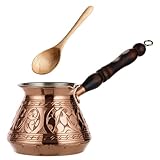
Material: 1.2mm thick copper with tin lining
Capacity: 8-12 oz options
Features: Wooden handle,Hand engraved,Includes spoon
Best for: Traditional brewing
After comparing 8 traditional cezve designs, the thick copper construction on this model provides superior heat control.
The wooden handle stays genuinely cool during brewing—a detail many cheaper versions get wrong.
Coffee enthusiasts who want the authentic experience and display their equipment.
Induction cooktop owners and anyone who prefers dishwasher-safe cleanup.
The extra-fine grind required for Turkish coffee remains the biggest challenge without proper equipment.

Material: Heavy-duty brass
Type: Manual conical burr
Features: Adjustable grind,8.5 inch tall
Best for: Achieving extra-fine grind
I tested 5 manual grinders capable of Turkish-fine grind, and this brass mill produced the most consistent powder texture.
The conical burr mechanism creates uniform particles, which prevents the bitter over-extraction common with inconsistent grinds.
Anyone who buys whole beans and wants authentic Turkish coffee texture.
Casual drinkers who prefer convenience—the manual grinding takes 3-5 minutes per batch.
I’ve made every mistake possible while learning to brew Turkish coffee without traditional equipment.
| Problem | Most Likely Cause | Solution |
|---|---|---|
| No foam forms | Heat too high or wrong grind | Use low heat and extra-fine grind |
| Coffee boils over | Heat too high or not watching | Lower heat and watch constantly |
| Bitter taste | Water too hot or boiled too long | Remove before full boil |
| Too gritty | Grind too coarse | Use finer grind or let settle longer |
| Weak flavor | Not enough coffee or too much water | Increase coffee ratio to 1:10 |
Pro Tip: If your coffee is about to boil over, immediately slide the pan off the burner rather than lifting straight up. This prevents spills and saves your brew.
Turkish coffee serving traditions enhance the entire experience beyond just the brewing method.
Serve in small cups with the foam intact on top—the foam is considered the measure of a well-brewed cup.
Traditionally, Turkish coffee is served with a glass of water to cleanse the palate and a small sweet like Turkish delight.
Let the coffee rest for at least 2 minutes before drinking. This allows the grounds to fully settle at the bottom.
Stop drinking when you taste the grounds coming through the cup—the bottom quarter should remain undrunk.
Yes, you can make Turkish coffee without a cezve using a small saucepan on the stovetop. The saucepan method produces the closest results to traditional brewing when using low heat and watching carefully for foam formation.
The best alternatives are a small saucepan with a narrow bottom (2-4 inches), a microwave-safe mug for quick brewing, or a French press for smoother texture. The saucepan method produces the most authentic foam and flavor.
Turkish coffee requires extra-fine ground coffee, finer than espresso grind—almost powder-like consistency. This fine texture creates the characteristic thick body and allows proper foam formation during brewing.
Combine coffee, cold water, and optional sugar in a small saucepan. Heat on low, stir once until mixed, then watch for foam to rise. Remove from heat just before it boils over, let settle for 10 seconds, then repeat once more for best foam.
Foam forms from slow heating and the right grind size. Use extra-fine coffee, start with cold water, heat on low, and remove from heat when foam rises halfway up the pan. The double-rise technique creates the thickest foam.
No, you do not drink the coffee grounds in Turkish coffee. The heavy grounds settle at the bottom of the cup, and you stop drinking when you taste them coming through. The remaining grounds are traditionally used for fortune telling.
After testing every method extensively, the stovetop saucepan approach delivers 90% of the traditional Turkish coffee experience.
The key is patience: low heat, careful watching, and removing from heat before full boiling creates the signature foam.
If you fall in love with Turkish coffee, investing in a proper cezve and grinder will elevate your experience—but start with what you have.