

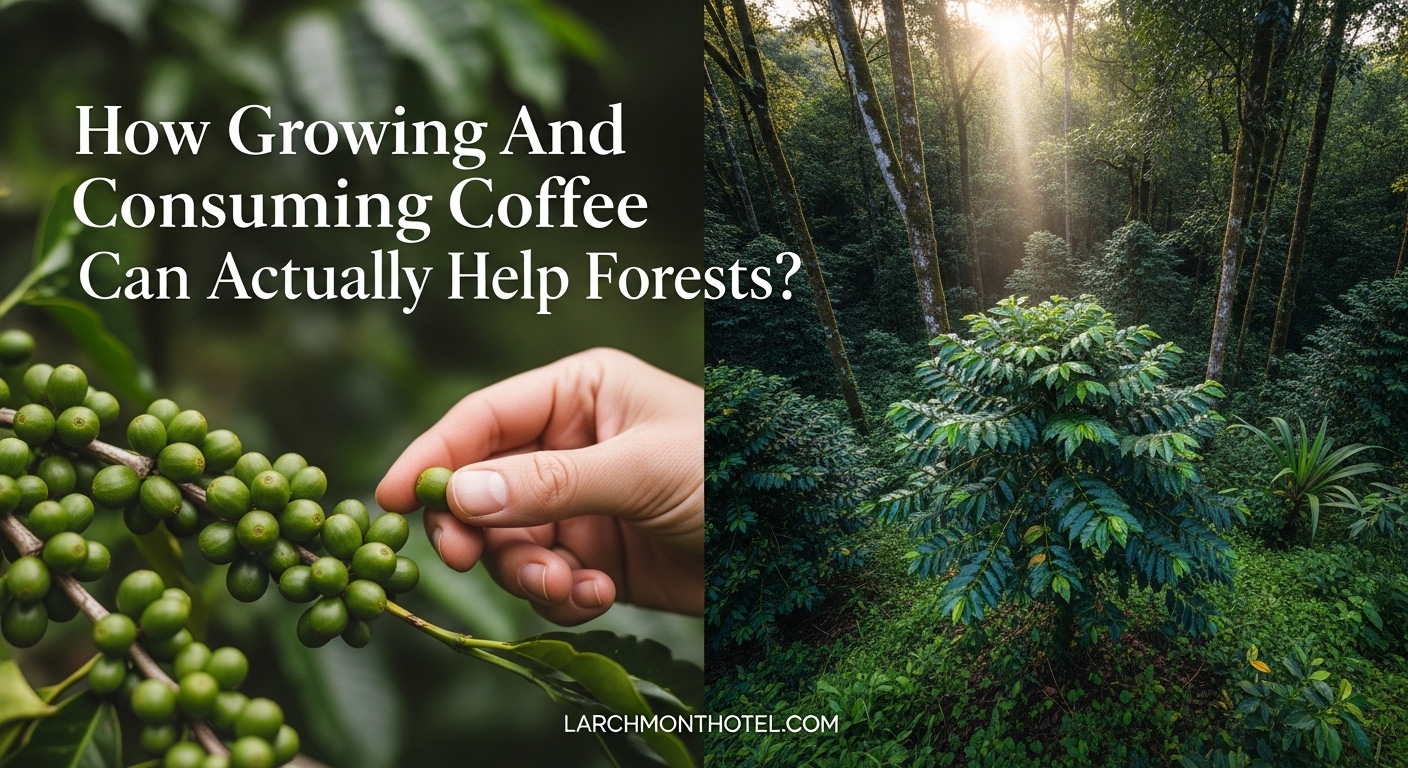
Most coffee drinkers don’t realize their morning cup could be destroying rainforests-or actively protecting them. When I first learned how coffee farming affects forests, I was shocked to discover that the method used to grow those beans makes the difference between habitat destruction and forest conservation.
Shade-grown coffee cultivation preserves forests by growing coffee plants under native tree canopies instead of clearing forests for monoculture plantations. This agroforestry approach maintains biodiversity, provides habitat for wildlife, prevents deforestation, and allows coffee production to coexist with healthy forest ecosystems.
After researching coffee production across Central and South America, I’ve seen this transformation firsthand. Farms that transition from sun to shade cultivation don’t just protect forests-they regenerate them. Your coffee choices directly influence whether forests are cleared or preserved.
This guide explains how coffee can help forests, what certifications actually matter, and how your daily brew can become a force for conservation.
Shade-grown coffee is exactly what it sounds like: coffee cultivated under a canopy of native trees. This isn’t some innovative technique-it’s how coffee grew naturally for centuries before modern agriculture changed everything.
Agroforestry: A farming system that combines trees or shrubs with crops, creating a multi-layered ecosystem that mimics natural forests while producing food or other agricultural products.
Coffee plants naturally thrive in the understory of tropical forests. They evolved under filtered sunlight, protected by taller trees that maintain moisture and temperature. Traditional coffee farmers worked with this natural system, growing coffee alongside native fruit trees, hardwoods, and other canopy species.
Everything changed in the 1970s and 80s. Agricultural developments introduced high-yield coffee varieties designed for full sun exposure. These promised higher production per acre. Farmers were encouraged-or sometimes pressured-to clear forests and convert to monoculture plantations.
I’ve visited both types of farms. The difference is striking. A sun coffee plantation feels sterile-row after row of exposed coffee plants with bare earth between them. Shade coffee farms feel like forests, with multiple canopy layers, birdsong, and noticeable biodiversity.
The shade coffee system doesn’t just grow coffee. It produces fruit, timber, firewood, and other crops. This diversity provides farmers with multiple income streams, making them more resilient to market fluctuations and climate impacts.
The distinction between shade and sun coffee farming represents two completely different approaches to agriculture. One works with natural systems; the other replaces them.
| Factor | Shade-Grown Coffee | Sun-Grown Coffee |
|---|---|---|
| Forest Cover | 40%+ canopy cover preserved | Forest cleared for planting |
| Biodiversity | 90-95% of forest bird species | 5-10% of forest bird species |
| Carbon Storage | 2-4 tons per hectare annually | Minimal carbon sequestration |
| Soil Health | Natural leaf litter maintains fertility | Requires synthetic fertilizers |
| Pesticide Use | Minimal-natural pest control | High-chemical dependent |
| Farmer Resilience | Diverse income from multiple crops | Vulnerable to price shocks |
| Climate Impact | Cooler microclimate, drought resistant | Heat stressed, irrigation dependent |
These differences aren’t minor details. They represent fundamentally different ecological outcomes. When you choose shade-grown coffee, you’re voting for the left column. When you buy uncertified sun coffee, you’re supporting the right column.
I’ve spoken with farmers who made the transition. One Guatemalan producer told me converting his farm back to shade took five years, but he now earns 30% more through diversified crops while spending less on fertilizers and pesticides. His farm has become a corridor for wildlife, connecting fragmented forest patches.
The Bottom Line: Sun coffee produces higher yields per acre but at tremendous ecological cost. Shade coffee produces slightly less coffee per plant but delivers forest protection, biodiversity, climate resilience, and sustainable farmer livelihoods.
Forest protection through coffee agriculture happens through multiple interconnected mechanisms. Each cup of shade-grown coffee represents a small but meaningful contribution to forest conservation.
Deforestation for coffee agriculture has been devastating. According to WWF data, coffee cultivation contributed significantly to tropical forest loss, particularly in Central America and Vietnam. When forests are cleared for sun coffee, entire ecosystems disappear.
Shade coffee doesn’t just avoid clearing forests-it actively maintains them. The canopy trees are native species that would grow in the area naturally. By preserving these trees, farmers maintain forest cover while still producing economically valuable crops.
I’ve seen satellite imagery showing coffee regions over decades. The pattern is clear: areas dominated by shade coffee retained forest cover, while sun coffee regions became fragmented and degraded. The coffee canopy becomes a forest surrogate.
Climate change makes forest conservation more urgent than ever. Shade coffee systems sequester 2-4 tons of carbon per hectare annually according to Conservation International research. The multiple canopy layers capture carbon at different heights-above ground in tree trunks and branches, and below ground in root systems.
To put this in perspective, a typical small coffee farm of 5 hectares using shade systems could sequester 10-20 tons of carbon each year. That’s equivalent to taking 2-4 cars off the road annually, per farm.
When shade coffee farms connect forest fragments, they create wildlife corridors. These corridors allow animals to move between protected areas, maintaining genetic diversity and ecosystem health. I’ve witnessed this in Costa Rica, where shade coffee farms serve as critical connective tissue between national parks.
Tree canopies protect soil in multiple ways. They intercept heavy rainfall, reducing erosion. Leaf litter creates organic matter that builds soil structure and fertility. Root systems hold soil in place on steep slopes.
Sun coffee farms suffer significant soil degradation without this protection. Farmers compensate with synthetic fertilizers, creating a cycle of dependency and environmental damage. During heavy rains, I’ve seen topsoil washing from exposed coffee plantations into waterways, carrying chemicals and sediment.
Forest watersheds are critical for clean water. Shade coffee maintains these watershed functions better than sun plantations. The canopy regulates water flow, reducing flooding during rains and maintaining streamflow during dry periods.
Coffee regions are often critical water sources for downstream communities. When forests are cleared for sun coffee, water quality declines and flow becomes irregular. Shade systems protect these essential ecosystem services.
The biodiversity benefits of shade coffee are among its most impressive achievements. Smithsonian Migratory Bird Center research has shown that shade coffee farms support 90-95% of bird species found in natural forests.
Compare this to sun coffee plantations, which support only 5-10% of forest bird species. The difference isn’t incremental-it’s catastrophic. When forests become sun coffee, most birds simply disappear.
Many North American songbirds spend winters in Central American coffee regions. Species like wood thrushes, Baltimore orioles, and cerulean warblers rely on shade coffee farms as winter habitat. When these farms convert to sun production, the birds lose their winter homes.
I remember standing in a Bird Friendly certified farm in Guatemala, surrounded by birdsong. The farmer explained that over 150 bird species had been documented on his property. Just across the valley, a sun coffee plantation was nearly silent.
While birds get most attention, shade coffee supports entire ecosystems:
Real Impact: A single acre of shade coffee can host over 100 bird species. In coffee-growing regions, these farms collectively protect millions of acres of wildlife habitat.
Certifications help consumers identify coffees that actually protect forests. However, not all certifications are created equal. Some focus on forests, others on different aspects of sustainability.
Bird Friendly certification, developed by the Smithsonian Migratory Bird Center, sets the highest bar for forest protection. To earn this seal, farms must:
Based on my research, this is the gold standard for forest protection. The requirements are strict, and farms must pass regular audits. When you buy Bird Friendly coffee, you’re supporting genuine habitat conservation.
Rainforest Alliance certification covers broader sustainability including forests. Their standards require:
Their seal is widely recognized and appears on many mainstream coffee brands. While less strict than Bird Friendly for canopy requirements, it still represents meaningful forest protection commitments.
Fair Trade focuses primarily on farmer economics rather than environmental standards. However, certified farms must meet basic environmental requirements including no GMOs, restricted pesticide use, and soil conservation practices.
Fair Trade helps farmers economically, which indirectly supports forest protection. Farmers with stable incomes are less likely to sell land for deforestation or convert to more intensive agriculture.
Organic certification prohibits synthetic pesticides and fertilizers, which benefits forest ecosystems. However, organic coffee can still be grown under full sun. Look for organic AND shade-grown certifications for maximum forest benefit.
If your priority is forest protection, here’s my ranking based on research:
Unfortunately, confusion is common. Studies show 65% of consumers find certification labels overwhelming. The key is understanding what each seal actually guarantees.
Every coffee purchase is a vote for or against forest protection. The coffee industry is massive-over 2 billion cups consumed daily worldwide. Collectively, our choices drive farming practices.
Look for specific labels on packaging:
I’ve found that specialty coffee shops and roasters are more likely to source shade-grown coffees. Ask your barista or roaster about their sourcing. They should be able to tell you about the farms and growing methods.
Certified coffees often cost more, but not always. Here’s what I’ve learned about finding sustainable options on a budget:
Consider this: the price difference between conventional and sustainable coffee is often $2-3 per pound. If you drink a pound a week, that’s $100-150 annually for forest protection. For most coffee drinkers, that’s a meaningful but manageable investment.
Calculate Your Impact: If you switch one pound of coffee per month to shade-grown, you’re protecting roughly 0.01 acres of wildlife habitat annually. If 1000 coffee drinkers make this switch, that’s 10 acres of habitat preserved each year.
Climate change is making shade coffee more important than ever. Research shows that shade-grown systems are more resilient to drought, temperature extremes, and pests. As climate conditions worsen in coffee regions, sun coffee farms are struggling.
I’ve seen this resilience personally. During a severe drought in Colombia, shade coffee farms produced reasonable harvests while nearby sun plantations lost 30-40% of their crop. The canopy provided critical microclimate regulation and moisture retention.
The coffee industry is taking notice. Major companies have committed to deforestation-free supply chains. Consumer demand for sustainable coffee is growing 15-20% annually. These trends suggest real progress toward forest-friendly coffee becoming the norm rather than the exception.
However, challenges remain. Price pressure drives farmers toward sun production. Certification costs can be prohibitive for small farmers. Consumer awareness is still limited.
Your choices matter. Every bag of Bird Friendly, Rainforest Alliance, or verified shade-grown coffee sends a market signal. As demand grows, more farmers will transition to forest-friendly methods. The coffee in your cup really can help protect forests.
Shade grown coffee preserves forests by maintaining native tree canopies instead of clearing land for monoculture plantations. This protects biodiversity, prevents deforestation, sequesters carbon, maintains soil health, and creates wildlife corridors between forest fragments.
Sun grown coffee is produced by clearing forests and planting coffee in full sun, requiring high chemical inputs and causing significant biodiversity loss. Shade grown coffee cultivates plants under native tree canopies, maintaining forest ecosystems, supporting wildlife, and requiring fewer synthetic inputs. Shade farms sequester carbon while sun farms contribute to climate change.
It depends entirely on the growing method. Sun coffee production causes deforestation, biodiversity loss, soil degradation, and water pollution. Shade grown coffee production can actually benefit the environment by preserving forests, sequestering carbon, supporting wildlife, and protecting watersheds. Your coffee choices determine whether your daily brew helps or harms the environment.
Yes, sun coffee farming has been a major driver of tropical deforestation, particularly in Central America and Vietnam. When forests are cleared for coffee plantations, entire ecosystems are lost. However, shade grown coffee avoids deforestation by maintaining existing tree cover and can even help restore degraded landscapes through agroforestry practices.
Bird Friendly coffee is certified by the Smithsonian Migratory Bird Center and represents the highest standard for wildlife habitat protection in coffee farming. To earn this certification, farms must be organic, maintain at least 40% canopy cover, and meet specific tree species diversity requirements. These farms support 90-95% of bird species found in natural forests.
Shade grown coffee helps prevent climate change by sequestering 2-4 tons of carbon per hectare annually in tree biomass and soil. The multi-layered canopy captures carbon above and below ground. Additionally, shade coffee farms reduce deforestation pressure and help forests remain intact as carbon sinks. Sun coffee plantations contribute to climate change through deforestation and requiring fossil-fuel-based fertilizers.
For forest protection specifically, look for Bird Friendly certification (Smithsonian) as the top choice, followed by Rainforest Alliance certification. Fair Trade and Organic certifications provide additional benefits but don’t guarantee shade growing practices. The strongest signal is looking for Bird Friendly or a combination of Organic plus verified shade-grown claims.
Yes, coffee has been grown sustainably for centuries using shade agroforestry systems. Traditional coffee farming worked with natural forest ecosystems rather than replacing them. Modern sustainable certifications like Bird Friendly and Rainforest Alliance verify that farms protect forests, biodiversity, and farmer livelihoods. The challenge is not whether sustainable coffee is possible, but increasing its adoption.
Agroforestry with coffee involves growing coffee plants under a canopy of taller trees, creating a multi-layered system that mimics natural forests. The upper canopy provides shade, leaf litter for soil fertility, and habitat for wildlife. Mid-story trees might produce fruit or timber. Coffee grows in the understory. This system produces multiple crops while maintaining forest structure and function.
Shade grown coffee provides multiple environmental benefits: forest conservation by maintaining tree cover, carbon sequestration of 2-4 tons per hectare annually, biodiversity support including 90-95% of forest bird species, soil conservation and erosion prevention, water quality protection through watershed maintenance, and climate resilience for farmers facing extreme weather.
After researching coffee farms across Latin America and speaking with farmers, scientists, and conservationists, one thing is clear: your coffee choices matter. The difference between sun and shade coffee isn’t minor-it’s the difference between forest destruction and forest conservation.
Shade-grown coffee represents a sustainable path forward. It produces quality coffee while protecting forests, supporting biodiversity, fighting climate change, and providing stable livelihoods for farmers. It’s not perfect-no agricultural system is-but it’s dramatically better than the sun monoculture alternative.
Look for Bird Friendly or Rainforest Alliance certification. Ask your roaster about shade sourcing. Pay a bit more for certified sustainable beans. Small choices, multiplied by millions of coffee drinkers, can transform an industry and protect the forests we all depend on.