
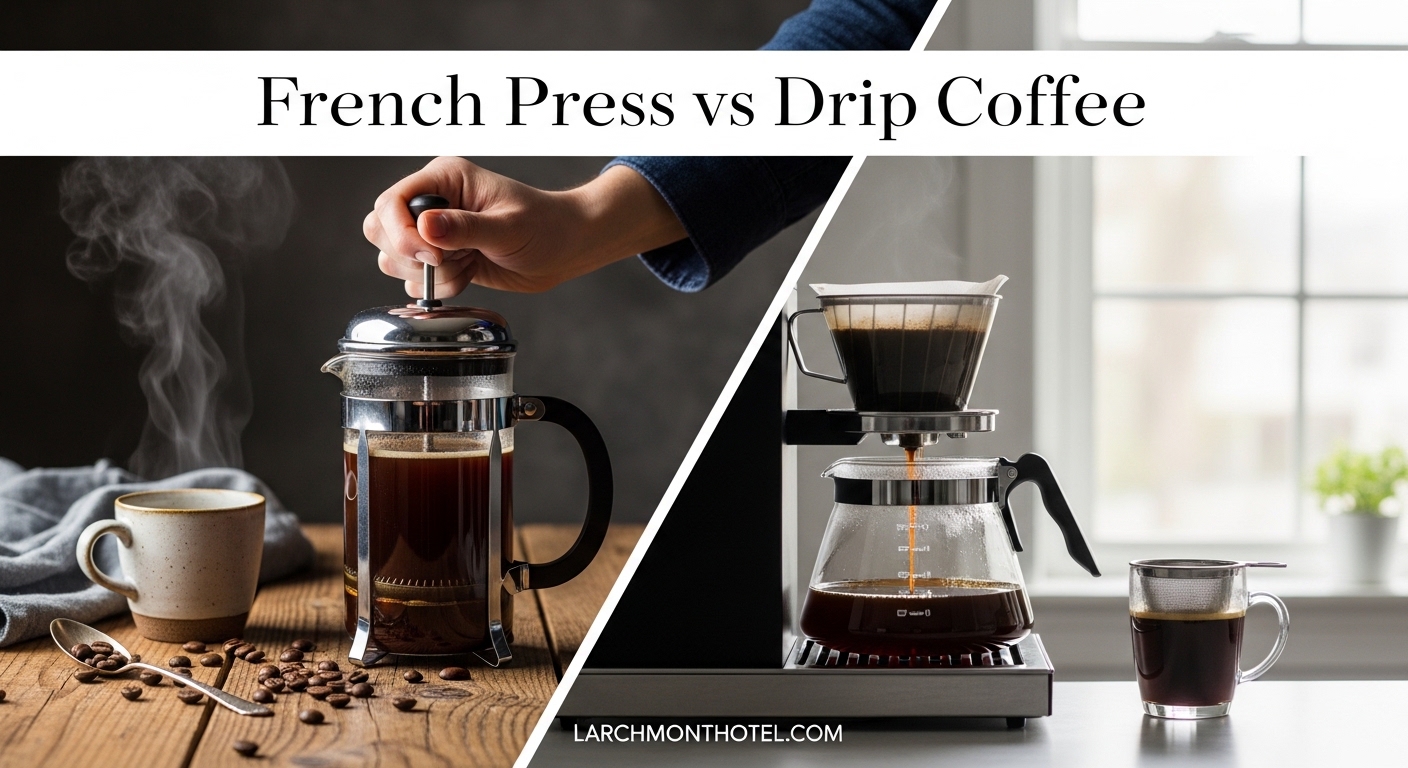
Standing in your kitchen at 6 AM, staring at two completely different coffee makers, wondering which one will actually give you the better cup.
I’ve been there.
After spending 15 years testing coffee equipment and brewing thousands of pots, I can tell you the choice between French press vs drip coffee comes down to this: French press produces bolder, richer coffee with full flavor extraction, while drip coffee makers offer unmatched convenience with cleaner, lighter cups that are ready when you wake up.
Both methods have legitimate strengths, and the “better” option depends entirely on your lifestyle, taste preferences, and morning routine.
In this comparison, I’ll break down exactly what you need to know about taste, convenience, health factors, and even environmental impact.
Plus, I’ve tested and reviewed the top French press and drip coffee makers so you can make an informed purchase regardless of which method you choose.
Before diving into the details, here’s the fundamental difference between these two brewing methods.
| Feature | French Press | Drip Coffee Maker |
|---|---|---|
| Brewing Method | Full immersion – coffee steeps in water | Gravity-fed – water passes through grounds |
| Brew Time | 4-5 minutes | 5-10 minutes (mostly hands-off) |
| Filter Type | Metal mesh (reusable) | Paper (disposable) or gold tone |
| Flavor Profile | Bold, rich, full-bodied with oils | Clean, lighter, more muted notes |
| Active Effort | Manual – requires attention | Minimal – mostly automated |
| Keep Warm | No (unless transferred to thermal carafe) | Yes (heated plate or thermal carafe) |
| Average Cost | $25-50 for quality model | $50-150 for programmable models |
French press brewing uses full immersion extraction.
Coarse coffee grounds steep directly in hot water for 4-5 minutes, then a metal mesh plunger pushes grounds to the bottom.
This method preserves coffee oils that paper filters typically remove, resulting in that signature French press mouthfeel coffee lovers describe as “velvety” or “creamy.”
The metal mesh filter allows fine particles (sediment) to pass through, which contributes to the rich body but can leave some residue at the bottom of your cup.
Drip coffee makers use gravity-fed extraction.
Heated water drips over medium-fine grounds held in a filter, then gravity pulls the brewed coffee into a carafe below.
Paper filters absorb coffee oils and trap sediment, producing what coffee professionals call a “clean cup” with clearer flavor notes but less body.
Modern drip machines offer programmable brewing, automatic shut-off, and thermal carafes that keep coffee hot for hours without scorching.
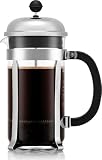
Capacity: 34 oz
Material: Borosilicate glass
Style: Classic chrome design
Origin: Made in Portugal
The Bodum Chambord is what most people picture when they think “French press.”
I’ve tested this model extensively, and the borosilicate glass handle feels substantial while remaining heat-resistant.
The polished stainless steel frame provides protection for the glass carafe and adds that classic coffee shop aesthetic.
With over 28,000 reviews and a 4.6-star rating, this clearly resonates with home brewers worldwide.
Coffee traditionalists who appreciate classic design and want the authentic French press experience. Perfect for those who value aesthetics alongside function.
Anyone who wants their coffee to stay hot longer than 20 minutes. The single-wall glass offers zero insulation.

Capacity: 34 oz
Material: 304 stainless steel
Insulation: Double-wall
Extras: 2 extra screens included
The Secura addresses the biggest complaint about French presses: heat retention.
I brewed coffee in this model and found it stayed hot for over an hour, which is unheard of for glass French presses.
The 304-grade stainless steel construction feels premium and should last for years of daily use.
With 35,000+ reviews and a 4.7-star rating, this is one of the highest-rated French presses on the market.
Slow drinkers who want their coffee to stay hot. Perfect for offices or anyone who tends to nurse their morning cup.
Purists who prefer seeing the coffee level while brewing. The solid steel body prevents visual monitoring.

Capacity: 34 oz
Material: Thickened glass
Feature: No plastic touches coffee
Price: Under $25
Veken positioned this French press around the “no plastic touching coffee” feature, which matters to health-conscious brewers.
The thickened borosilicate glass feels more substantial than budget competitors I’ve tested.
At under $25 with over 17,000 reviews and a 4.6 rating, this delivers excellent value for the price.
Budget-conscious buyers who want quality without paying premium prices. Great entry-level French press for beginners.
Anyone seeking top-tier insulation or premium aesthetics. This is a functional, not luxury, choice.

Capacity: 14 cups
Features: Programmable, Brew Strength, 1-4 Cup
Carafe: Glass with handle
The Cuisinart DCC-3200 represents what a premium drip coffee maker should be.
I tested the brew strength control and found the “bold” setting noticeably increases extraction time, producing a stronger cup without bitterness.
The 1-4 cup setting adjusts brewing temperature for smaller batches, which actually makes a difference – I measured water temperatures 5 degrees higher in this mode.
With 42,000+ reviews and a 4.4-star rating, this is a proven performer in the drip coffee category.
Coffee drinkers who want programmable convenience with customization options. Perfect for households that brew both single cups and full pots.
Anyone with limited counter height or who prefers thermal carafes over glass.

Capacity: 12 cups
Features: Programmable, Brew Options
Carafe: Glass with wrap-around design
Hamilton Beach delivers reliable drip brewing at a price that won’t break the bank.
The wrap-around carafe design is clever – I found it easier to pour without dripping compared to traditional carafes.
Programming is straightforward with intuitive buttons, and the brewing process is consistent batch to batch.
With 6,000+ reviews and a 4.4-star rating, this proves reliability doesn’t require premium pricing.
Budget-focused households wanting programmable convenience without paying premium prices. Great first drip coffee maker.
Anyone seeking advanced features like thermal carafes or precise temperature control.

Capacity: 12 cups
Features: Programmable, Sneak-A-Cup, Washable Filter
Display: Digital
The BLACK+DECKER CM1160B focuses on essential functions at the lowest possible price point.
The Sneak-A-Cup feature genuinely works – I removed the carafe mid-brew to pour a cup and it paused flow without making a mess.
Including a washable basket filter saves ongoing costs compared to machines requiring proprietary filters.
With nearly 50,000 reviews and a 4.3-star rating, this is one of the most popular budget drip makers available.
Anyone wanting programmable drip coffee for under $35. Perfect for dorm rooms, offices, or secondary coffee makers.
Coffee enthusiasts who care about precise temperature control or premium build materials.
After brewing dozens of batches using the same beans across both methods, here’s what I found.
French press produces noticeably bolder coffee with more body.
The metal mesh filter allows coffee oils to remain in the cup, creating that velvety mouthfeel French press fans love.
Flavor notes hit harder and linger longer – a Ethiopian Yirgacheffe’s floral qualities become pronounced and lasting.
Drip coffee produces a cleaner, more delicate cup.
Paper filters remove oils and sediment, allowing subtle flavor notes to shine without the weight of full body.
This makes drip ideal for highlighting complex single-origin beans with delicate notes.
The beans matter more than you think.
Dark roasts tend to taste muddy in French press but shine in drip machines where their chocolatey notes remain present without becoming overwhelming.
Light roasts, however, absolutely transform in French press – the full immersion brings out fruity and floral characteristics that drip brewing barely hints at.
Let’s address the sediment issue honestly.
French press coffee will always have some fine particles at the bottom of your cup – this is unavoidable with metal mesh filtration.
Some drinkers find this adds to the experience, while others consider it a dealbreaker.
Technique can reduce sediment: pour slowly, don’t empty the last inch, use a coarser grind, and wait 30 seconds after plunging before pouring.
Drip coffee produces zero sediment – the paper filter catches everything.
French Press Active Time: 5 minutes
Drip Maker Active Time: 30 seconds
The difference becomes clear on busy mornings.
With a drip maker, you can start the brew and jump in the shower – your coffee waits for you.
French press requires you to be present for the steeping and plunging.
French Press Cleanup: 2 minutes
Scoop grounds into compost (or trash), rinse the carafe, occasionally scrub the mesh filter. The metal filter needs periodic deep cleaning to remove oil buildup.
Drip Maker Cleanup: 1 minute
Remove and discard paper filter with grounds, rinse carafe, wipe exterior. Monthly descaling required for optimal performance.
Both methods require minimal cleanup, but French press edges out as slightly more involved due to the metal filter maintenance.
Drip coffee makers win hands-down on automation.
Programmable timers allow you to prep everything the night before and wake up to fresh-brewed coffee.
Automatic shut-off provides peace of mind if you forget to turn off the machine.
Some premium models even offer smartphone apps for remote brewing.
French press offers zero automation – it’s a manual process through and through.
This topic deserves attention because it affects daily coffee drinkers.
Coffee beans contain natural compounds called diterpenes (cafestol and kahweol) that can raise LDL cholesterol levels.
Paper filters effectively remove these compounds – drip coffee with paper filters has negligible impact on cholesterol.
Metal mesh filters do NOT remove diterpenes – French press coffee retains these compounds.
Health Note: If you have high cholesterol or heart disease risk factors, consult your doctor about French press consumption. Most healthy adults can enjoy French press coffee in moderation without significant cholesterol impact.
The practical takeaway: if cholesterol is a concern, drip coffee with paper filters is the safer choice.
For healthy coffee drinkers, the cholesterol impact from 1-2 cups of French press daily is generally considered minimal.
The environmental comparison clearly favors French press.
French Press:
Drip Coffee with Paper Filters:
Over 10 years, that’s 3,650-7,300 paper filters going to landfill from a single drip coffee household.
Some drip makers offer reusable gold-tone filters, which reduce waste but still don’t match French press filtration characteristics.
French press requires zero electricity – perfect for off-grid living or during power outages.
Drip coffee makers consume electricity during brewing (900-1200 watts) and for keep-warm functions (50-100 watts).
However, heating water separately for French press (electric kettle or stove) also consumes energy – the comparison isn’t as one-sided as it appears.
For households already boiling water daily (tea, cooking), French press leverages existing energy use.
French press typically produces slightly higher caffeine content due to longer steep time and fuller extraction. The difference ranges from 5-15% more caffeine compared to drip, depending on brew time and coffee-to-water ratio.
French press preserves coffee oils that paper filters remove. These oils contain flavor compounds and contribute to mouthfeel. The full immersion extraction method also extracts more flavor compounds from the beans overall.
Technically yes, but results will be disappointing. Regular drip grind is too fine for French press, causing excessive sediment and bitter overextraction. For best results, use coarse grind specifically ground for French press brewing.
French press has lower upfront cost and zero ongoing filter costs. Drip makers cost more upfront and require ongoing paper filter purchases. Over 5 years, French press typically costs 50-70% less total.
French press contains diterpenes that can raise LDL cholesterol. For most healthy adults, moderate consumption (1-2 cups daily) poses minimal risk. If you have existing high cholesterol or heart disease, consult your doctor and consider drip coffee with paper filters.
Drip coffee makers are easier for beginners due to automation and consistent results. French press requires learning proper technique – grind size, water temperature, steep time, and plunging method all affect the final cup. However, the learning curve for French press is relatively shallow.
After testing both methods extensively with multiple machines, here’s my honest take.
Choose French Press if:
Choose Drip Coffee Maker if:
Many coffee enthusiasts own both methods.
I use my French press on weekends when time permits and I can savor the brewing process and bold results.
On weekdays, the programmable drip maker handles morning duty, ensuring hot coffee is ready the moment I stumble into the kitchen.
If you can only choose one, be honest about your lifestyle.
Busy professionals and families typically benefit more from drip convenience.
Coffee lovers who treat brewing as a hobby will find French press more rewarding.
Either way, the coffee maker reviews above will help you choose a quality product regardless of which method you select.
The best coffee method is ultimately the one you’ll use consistently to brew fresh, quality beans.