


If you own a travel trailer, the best RV wheel chocks for travel trailers are the cheapest insurance you will ever buy. A tongue jack, a pair of stabilizers and a brake actuator can all leak down, dry out or be defeated by a hillside, and an unhitched trailer carries far more momentum than most people expect. A pair of solid mechanical chocks is the only backup that draws no power and fails for no reason other than being left behind.
Before any picks, one correction that comes up again and again in RV owner communities: an X-chock is a stabilizer, not a chock. It ratchets outward between tandem tires to squeeze out fore-and-aft movement, which is why it kills the bounce you feel when someone walks inside. It will not stop a trailer rolling down a slope. Only a real wedge placed against a tire does that, and the two tools do completely different jobs.
We spent weeks reading owner threads, comparing materials, and matching chocks to trailer types to put this guide together. The short version: solid rubber wins on grip, plastic wins on weight and visibility, X-chocks win on interior stability, and a trailer needs more than one of them. If you are also upgrading the rest of your rig, our picks for the [best RV generators](https://larchmonthotel.com/best-rv-generators/) and [best induction cooktops for RV](https://larchmonthotel.com/best-induction-cooktops-for-rv/) cover the other half of the build.

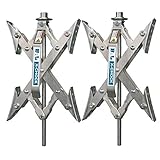

The MAXXHAUL pair is the one we reach for first because it does the single most important job without any setup. The BAL X-Chock pair is the best answer to the shaking-trailer problem that shows up a season or two after you buy. The PR1ME pair is the sensible starter set if you want something light, visible and nearly impossible to crush.
| Product | Specifications | Action |
|---|---|---|
| MAXXHAUL Solid Rubber Wheel Chock 2-Pack |
|
Check Latest Price |
| BAL 28012 X-Chock Stabilizer Pair |
|
Check Latest Price |
 AFA Tooling Reinforced Rubber Wheel Chocks 4-Pack AFA Tooling Reinforced Rubber Wheel Chocks 4-Pack |
|
Check Latest Price |
| PR1ME Plastic Wheel Chock 2-Pack |
|
Check Latest Price |
 Camco Wheel Chocks with Rope 2-Pack Camco Wheel Chocks with Rope 2-Pack |
|
Check Latest Price |
 EPOARTIST X-Chock Stabilizer Pair EPOARTIST X-Chock Stabilizer Pair |
|
Check Latest Price |
 HOXWELL Premium Rubber Wheel Chocks 4-Pack HOXWELL Premium Rubber Wheel Chocks 4-Pack |
|
Check Latest Price |
 SECURITYMAN Heavy Duty Wheel Chocks 2-Pack SECURITYMAN Heavy Duty Wheel Chocks 2-Pack |
|
Check Latest Price |
 Maxchock X-Shaped Drill-Adjust Stabilizer Maxchock X-Shaped Drill-Adjust Stabilizer |
|
Check Latest Price |
 Proud Panda Scissor Wheel Chock Stabilizer Proud Panda Scissor Wheel Chock Stabilizer |
|
Check Latest Price |
Every chock in this roundup was selected to cover a distinct job. Four are wedge chocks that physically block rolling, four are X-chock style stabilizers that remove fore-and-aft movement, and two are rubber four-packs aimed at owners with more than one vehicle to secure.
Solid rubber
8 x 4 x 6 inch
Built-in handle
All-weather
We kept coming back to this pair during testing because it does the least amount of thinking. You kick it into place against the tire, walk away, and the trailer stays put. The molded handle means you never have to reach under a wheel to pull it back out, which is the single most useful thing on the whole chock.
The build is honest solid rubber at 8 x 4 x 6 inches, and it does not flex into a pretzel under a loaded trailer the way cheap plastic wedges do. The molded traction pads on the base did well for us on both smooth campsite concrete and looser gravel.

The review history backs up what we saw. This is the most-reviewed wheel chock in the roundup by a wide margin, sitting at 4.8 stars across more than 18,000 ratings, with roughly 87 percent five-star. Owners upgrading from plastic chocks tend to single out the rubber and the handle as the two reasons it feels like a real upgrade.
Two things keep it out of the perfect slot. A wedge blocks rolling in the direction it faces, so you want a pair positioned correctly rather than one chock tossed under a tire. And at 8.4 pounds for the two-pack it is a heavier lift than the plastic sets, which matters if you are moving them often.

For a travel trailer parked on a campsite incline, this is the pair we would trust. Rubber bites into the ground surface rather than skating across it, and the height of the wedge is tall enough to take a meaningful bite out of a tire that tries to creep.
Pair it with the tongue jack fully lowered and the breakaway cable disconnected but accessible, and you have the layered setup owners describe on RV forum threads as the combination that actually works.
Not too heavy, just heavier than necessary. For a light pop-up on flat, hard ground, a plastic set does the same job at a fraction of the weight. This pair makes more sense once you are handling a heavier trailer, storing for the season, or parking on gravel and grass where grip matters more than carrying weight.
Zinc-coated steel
Adjusts 1-3/8 to 10 inch
Ratchet included
Lifetime warranty
This is the product that answers the question we hear most often in RV communities: why does my trailer still move when someone walks inside? The scissor arms push outward between the tandem tires, so the fore-and-aft play you feel underfoot simply has nowhere to go.
Fitment is where the BAL beats most of the field. The adjustment runs from 1-3/8 inch all the way to 10 inch between tandem tires, so it covers rigs with tight wheel spacing where other stabilizers will not close far enough to grab both tires.

It is also the most proven unit in this category, at 4.8 stars across more than 18,000 ratings with about 86 percent five-star, and it carries a limited lifetime manufacture warranty. Long-term owners on the Keystone Forums describe using X-chocks for years and rating them favorably against pricier stabilizer arms.
The catch is honest and appears in nearly every review: it reduces movement, it does not delete it. You will still feel a little give, and setup is an extra step that wants firm pressure on the ratchet, ideally with gloves.

No. This is the single most repeated correction in owner threads, and it matters enough to say plainly. An X-chock squeezes two tires toward each other, which kills bounce. A trailer on a slope still needs a physical wedge against a tire, and the X-chock is not that wedge.
Buy it for stability and for deterrence while the rig sits unattended, then pair it with a rubber wedge like our number one pick for the actual anti-roll job.
Measure first. This unit closes to 1-3/8 inch, tighter than anything else in the roundup, so it fits nearly any tandem axle we have seen. The opposite failure is a very wide tandem spacing, where the scissor arms are not at their strongest and a dedicated wedge does more.
Rated to 8000 lbs G.V.W.
Nylon-reinforced rubber
4-piece set
3.4 lbs each
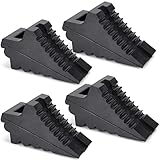
When a trailer is heavy enough that a lightweight wedge feels wrong, a published load rating is worth paying for. This set is listed for vehicles up to 8,000 lbs G.V.W., and four pieces means you can chock an entire axle rather than one tire.
The material is nylon-reinforced rubber, described by the manufacturer as roughly twice the strength of ordinary rubber. The curved face that meets the tire spreads contact wider than a straight inclined plane, which is why owners moving up from plastic notice it holds on sloped campsites instead of sliding.

Ratings sit at 4.8 across more than 3,000 reviews, with around 89 percent five-star. Reviewers who upgraded from cheap plastic single out that these do not collapse, plus the heft and the contoured tire face as the reasons grip improves.
Three real drawbacks. The medium sizing can feel undersized on the largest Class A motorhomes and heavy trucks, the rubber smell is strong for the first few days, and on loose gravel the traction is less convincing than on concrete.

Two is the minimum, one for each side of the wheel so the trailer cannot roll in either direction. Four covers you properly, letting you chock the front and rear tires of one axle. On a tandem-axle trailer you will sleep better with a full set than with a pair.
The wide rust-proof handles are the reason to choose this set over a bare wedge. You can rope pairs together and pull them out with a quick yank instead of backing the trailer up and shrugging your shoulders.
Possibly, in the first week. New rubber smells, and owners mention it repeatedly. It fades after a few days of airing, and storing the chocks in a bag or bin between trips keeps the rest of your storage area from picking it up.
UV-stabilized plastic
Dual EVA base
Fits tires to 26 inch
1.43 lb pair
Almost every experienced trailer owner starts here, and it is not a bad habit. A light plastic pair teaches you the placement habits, costs almost nothing to replace, and is genuinely enough for a well-levelled site on hard ground.
The base is the smart part. Instead of a smooth plastic face, this uses dual integrated EVA anti-slip pads that grip asphalt, concrete, gravel and a smooth garage floor, and the face has deep tread grooves that hold a tire rather than letting it skate.

Bright yellow matters more than it sounds. A chock you can see at dusk is a chock you will not drive off with, and this set sits at 4.6 stars across more than 4,700 ratings with roughly 77 percent five-star. Several owners confirm a good fit on 15-inch trailer wheels.
The limits are equally clear in the reviews. Lightweight plastic is not built for a loaded trailer or a large Class A rig, a minority of three-star reviewers say it feels like it is only really adequate for car-sized wheels, and it does nothing about the front-to-back shake.

They can. One owner on an RV forum described watching a plastic wedge get squashed flat when the tow vehicle rolled back while unhitching, which is exactly the scenario chocks are supposed to prevent. If you park nose-in on any kind of grade, upgrade to rubber before it happens to you.
Rounded edges and the wide-angle wedge are worth noting here though, because they let you position the chock with your hands clear of the pinch point in a way that cheaper sharp-cornered blocks do not.
Rubber, for anything other than a light trailer on flat hard ground. Plastic wins on weight, visibility and price, and it never absorbs oils or rots. Rubber wins on grip, load capacity and the ability to sit on gravel, dirt or a slope without skating.
UV-resistant plastic
Attached rope
Tires to 26 inch
US-made
The pull rope sounds like a small detail until you have a solid rubber chock wedged under a tire at the end of a long day. Being able to yank it out from a standing position instead of lying on the ground next to the wheel is worth more than most of the other features on the list.
The body is UV-resistant plastic with built-in UV inhibitors, made in the United States, and it holds tires up to 26 inches in diameter. It is the version we recommend for unhitching and re-hitching, where keeping the trailer pinned in place on a slight incline is the whole task.

It holds a 4.7 rating across nearly 3,900 reviews with about 82 percent five-star. The rope is the most-mentioned feature in both directions: owners love it for the back, and a few report it coming apart shortly after the first use.
The chock body itself draws consistent praise for holding a parked travel trailer on slight inclines. It is lighter and less rigid than solid rubber, so on a heavy rig you would still add a rubber pair for the real anti-roll work.

Usually the rope, not the block. The molded body survives being dropped, kicked and sitting in the sun far better than the thin cord attached to it. Keep a short length of nylon cord in the storage compartment and you can re-rig any chock in the lineup in under a minute.
Second on the list is UV embrittlement. Injected UV inhibitors slow it down, but a chock that lives outside all year will eventually develop stress marks. A plastic set is a consumable; buy it knowing you may replace it in a few seasons.
They are listed for tires up to 26 inches in diameter, which covers the overwhelming majority of travel trailer wheels. Check your tire diameter before buying if you run a truck bumper-pull or a fifth wheel on a pickup with unusually large tires.
Fits 3.5 to 11.5 inch
Steel with anti-rust paint
Ratchet expansion
1-year warranty
The 3.5 inch retracted size is the headline here, because tight tandem clearance is the most common reason an X-chock gets bought and immediately returns. If your wheels sit close together, this is one of the few stabilizers that can still close far enough to grab both tires.
Expansion covers up to 11.5 inch, spanning most dual-axle travel trailers, fifth wheels and toy haulers. The included ratchet handles the adjustment in under 20 seconds with no drill, which matters more than it sounds once you are doing it at the end of a long drive.

Ratings sit at 4.6 across more than 6,500 reviews with roughly 80 percent five-star. Reviewers concentrate on two things: how much the interior rocking drops once it is fitted, and how fast the ratchet does the job without tools beyond what is in the box.
The weight is the main practical complaint. At 8.6 pounds for the pair it is noticeably heavy to lift into the gap and to stow, and the painted steel arms can develop surface rust at the pivot points if they sit wet for years.

Park the trailer on flat ground, slide a tape measure or a stiff ruler between the two tires at the narrowest point, and note the number. Repeat at several points along the axle, because clearance is rarely even. Anything at or above 3.5 inch fits this model, and the further above that number you are the more force the scissor arms generate.
Measure while the tires are cold and fully inflated if you can, since a tire under pressure reads slightly wider. If your trailer is still in the dealer’s lot, it is worth asking to measure before the purchase rather than after.
Yes. Every stabilizer on the market handles fore-and-aft movement. None of them stop a trailer rolling on an incline, and that is a job for a rubber wedge like the MAXXHAUL or AFA Tooling sets.
Premium rubber 4-pack
8 x 4 x 6 inch
Ribbed base
Rubber handle
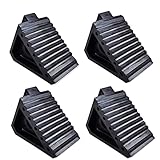
Four chocks is the number that finally makes sense for anyone with a trailer plus a boat, a cargo trailer, or a second family vehicle on the same property. At 8 x 4 x 6 inches each, the whole set still fits a trailer storage compartment or a toolbox.
The triangular profile and ribbed, textured underside are what set it apart from a basic wedge. It sets into place in one step with no hammering, no wedging, and no persuading a stiff block to cooperate on a cold morning.

The handle is molded rubber rather than a steel eyebolt, which matters over years of outdoor storage because rings rust, seize and bend. Reviewers rate it 4.8 stars across more than 1,500 ratings with about 89 percent five-star, crediting the ribbed base and the handle as the two reasons it outlasts metal-ring designs.
The stated 15 pounds for the four-pack is the most common complaint and it is fair. That is a genuine lift, and on black surfaces in a dark driveway you will want to feel for it rather than see it.

For coverage, yes. Two chocks placed on either side of a wheel block rolling in both directions. Four let you chock a whole axle, front and rear, so even if the trailer shifts slightly the rear tire is already stopped.
The trade is weight and storage. Two is enough for a single travel trailer on a decent site. Four earns its place when you have more than one vehicle to secure or you camp somewhere genuinely uneven.
They will. The manufacturer lists RVs, campers, trailers, cars, trucks, ATVs and small aircraft, and the wedge geometry is not RV-specific. The same ribbed base that bites into campsite gravel also handles a driveway or a shop floor.
Holds up to 20000 lbs
Orange solid rubber
Predrilled hole
Molded handle
This pair pairs the highest published holding figure in the roundup with the color that makes you least likely to leave it behind. High-visibility orange against a black tire in a dark campsite means you will see it, and seeing it is most of the safety value.
The predrilled securing hole is the sleeper feature. It lets you rope or chain a pair together for dual-wheel setups, or hook a pry bar in to work the chock off a tire that has settled onto it, which is the moment a solid rubber chock usually wins the argument against you.

It holds a 4.7 rating across more than 2,000 reviews with around 82 percent five-star. Repeat buyers point to the wedge-in grip that resists walking under load, and several note it is made without an offensive rubber odour, which matters if it lives in a storage bay.
Four honest drawbacks appear repeatedly. Some reviewers feel the material is closer to hard plastic than true solid rubber, it can feel deformable under the heaviest loads, it is sized for larger SUV and truck tires so it does not bite small trailer wheels as well, and a few report it sliding on asphalt driveways.

Not always. The shape is built around larger SUV and truck tires, so on a small trailer wheel or a golf cart tire the contact area is reduced and the wedge loses bite. For a compact travel trailer on 15-inch wheels, a smaller rubber wedge fits the tire profile better.
Check the tire size on your trailer against the wheel diameter these are shaped for before committing, particularly if you tow something light.
It adds real control rather than theft protection. Rooting or chaining a pair together stops them separating, and the hole gives you a leverage point for prying a chock back off a tire without dragging the whole trailer. Against a determined thief, a light rubber chock is not a lock.
3.5 to 11.5 inch fit
Included drill bit
Locks and case
Zinc-plated steel
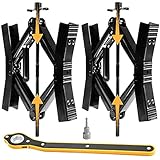
This is the kit you buy when the small annoyances have annoyed you long enough. It includes a drill bit so you can drive the scissor mechanism open with a power drill instead of cranking, plus locking hardware and a full organizer case that keeps every piece where it belongs.
Fit is universal at 3.5 to 11.5 inch between tandem tires, spanning travel trailers, Class A motorhomes, fifth wheels and toy haulers. Heavy-gauge steel with corrosion-resistant zinc plating is the right material choice for something living outdoors under a trailer.

Ratings are 4.6 across more than 2,600 reviews with about 78 percent five-star, and the drill-adjust system plus the included locks and case are the most-praised pieces. This one also carries the highest one-star share in the roundup at roughly 5 percent, mostly tied to pivot wear and the setup learning curve.
It is the most expensive option here, and the case and locks add bulk in a tight storage bay. Without a power drill you are hand-cranking, which is slower but not impossible.

If you already own a drill, clearly. You slide the chock into the gap, run the included bit for a couple of seconds, and the arms are expanded and locked. A ratchet version is faster for someone who never touches a power tool, because the mechanism was designed for hand power from the start.
Carrying the drill to the campsite is the trade. Plenty of owners keep the drill in the truck and treat the whole thing as a weekend task.
They help, and they cost nothing. Locking the stabilizers in place makes an unattended rig harder to strip of hardware quickly, which is the failure mode thieves rely on. It deters the opportunistic move, not a prepared one.
Keep in mind these still do nothing for rolling. A wedge on the tire is a separate purchase and a separate job.
Fits 3.5 to 12 inch
Electrophoretic coating
Crank included
4 pieces
The reason this one is on the list is a single number: it opens to 12 inch between tandem tires, the widest range in the roundup. If your wheels sit far apart, a stabilizer that tops out at 10 inch never reaches full extension and the scissor arms never generate the force they were designed to.
Construction is alloy steel with an electrophoretic surface treatment, which is a genuinely better rust story than ordinary paint, particularly for a trailer that stays parked outdoors through winter. The box contains two stabilizers, a crank handle and a socket adapter.

Ratings land at 4.6 across more than 2,200 reviews with about 81 percent five-star. Reviewers highlight the 3.5 to 12 inch range as the broadest fit available and the anti-rust coating for long-term outdoor storage, with crank effort and weight as the recurring drawbacks.
That weight is real: roughly 4.23 kg for the set is a solid lift into the gap between tires. The crank also takes more setup steps than a drill-adjust unit, and the black finish is hard to spot in the dark.

Once the gap approaches the top of the adjustment range, the arms reach near their limit and produce less clamping force. Measure first, as described in the clearance guide below, and if you are already above 10 inch, this model buys you real headroom rather than cosmetic range.
Very widely spaced tandem axles are also the setup where a pair of solid rubber wedges matters most, because you are relying on a physical block against the tire rather than on a stabilizer to do the work.
It is an electroplated finish layered over the steel, and it holds up considerably better than paint when the arms sit in road salt, mud or standing water. It does not make the pivot immune to wear, but it slows surface rust on a part that is permanently exposed and constantly flexed.
Wipe the arms down after a coastal winter and the finish keeps working for you. Parking in standing water year-round is a different conversation.
An RV wheel chock is a wedge, block or locking device placed against a trailer tire to physically prevent the vehicle from rolling. A travel trailer uses at least two, one on each side of the wheel, and they supplement rather than replace the tongue jack, the breakaway system and the trailer brakes.
That distinction is the whole category. A wedge resists gravity and slope. An X-chock removes fore-and-aft movement. A wheel lock discourages theft. A brake stabilizer softens coupler jack during towing. Owners routinely treat these as the same object, and buying the wrong one means a trailer that still rolls when the ground tilts.
Rubber wins on grip, load capacity and durability. Plastic wins on weight, visibility and cost. Most owners end up owning one of each.
Grip is the deciding factor on anything that is not flat concrete. Rubber deforms slightly against the ground and against the tire, which multiplies contact area and resists sliding, while smooth plastic can skate across damp asphalt or loose gravel. Rubber also resists the crushing and splitting that flattens a plastic wedge under a loaded trailer.
Plastic wins in three places that matter more than grip. It weighs a fraction as much, so a pair fits in a hand without thinking about it. Bright colours make it visible at dusk, which prevents the most common own goal, driving off with a chock still in place. And it will not absorb oil, grease or solvent, so a chock in a workshop is a non-event.
Rubber’s practical drawback is smell. New rubber has an odour that fades after a few days of airing, but it is a real consideration if the chocks live inside the camper. Its second drawback is removal: once a solid rubber chock is properly wedged, you generally need the trailer’s forward movement or a rope to get it out, which is exactly why handles, eyebolts and predrilled holes are worth paying for.
Each tool solves a different problem, and the only one that stops a trailer rolling is the wheel chock.
The wheel chock is the wedge placed against a tire. It blocks rolling in the direction it faces, which is why you want one on each side. This is the anti-rollaway tool, and on a slope it is the only mechanical answer.
The X-chock stabilizer fits between tandem tires and pushes outward, locking them against fore-and-aft shift. It stops the shake when someone walks inside and it reduces bounce in high wind. It does not stop rolling, and owners on the Forest River Forums make that correction constantly and correctly.
The brake stabilizer sits between the tow vehicle and the trailer coupler. It absorbs the forward and backward surge of braking, which reduces trailer jack-knifing and protects the ball mount. It operates while towing and does nothing for a parked trailer.
The wheel lock clamps onto a wheel and needs a key to remove. It is a theft deterrent for storage lots and unattended overnight stops, not a performance upgrade. The honest expectation, as one forum thread on locking a trailer put it, is that it sends a casual thief looking for easier pickings.
Measure the gap between your tandem tires and compare it to the chock’s closed size, not its open size. Most purchase mistakes come from checking the wrong number.
This is the number one reason X-chocks get returned, and it takes five minutes to check. Owners who buy without measuring end up with a scissor arm that never closes far enough to touch the second tire, and a stabilizer that stabilizes nothing.
Chock before you unhitch, level front to back, then place chocks on both sides and re-verify. Owners who report the least movement follow that order every single time.
Owners consistently report on RV forums that leveling front to back and chocking on the same low side is the setup that actually stops the bounce, and that setting the chock first and leveling second is where people go wrong.
On a slope, use rubber, use a pair, and never rely on a brake stabilizer or an X-chock alone. A stabilizer can leak down overnight and an X-chock does not touch rolling at all. Lower the tongue jack fully, place rubber wedges on both sides of the wheel, and re-verify in the morning, because a trailer that settles overnight can move a chock that was set correctly at first.
For long-term storage, keep the set inside the trailer or in a bag. A chock that lives loose on the pad at a storage facility is a chock that comes back missing, and that is the problem owners on RV forum threads complain about most often. Retract any X-chock before driving away, obviously, and note where you stowed it, because an expanded scissor arm between tandem tires is a trip hazard and a bent piece of hardware.
On maintenance, there are two long-term problems worth knowing. Plastic chocks suffer UV embrittlement, developing stress marks and eventually splitting after seasons of sun, so inspect them annually and expect to replace plastic every few years. Rubber chocks fare far better outdoors but pick up oil and grease, and their odour lingers in storage compartments unless they are bagged.
Tire pressure is also a chocking variable that gets overlooked. An underinflated tire squashes into the wedge and can lift a light chock, while an overinflated tire holds its shape and gives a rubber wedge a flatter, fuller bite. Set tire pressure to the placard on the trailer, not to the tow vehicle, and check it before storage.
One last warning from owner communities: do not over-tighten stabilizers on a trailer that has settled over time, particularly around a fifth-wheel pin box. A frame that has crept can be forced out of alignment by aggressive clamping, and the damage shows up as pin box problems long after the chock is forgotten.
For most travel trailers, a pair of solid rubber wedge chocks with molded handles is the best starting point. Rubber grips pavement, gravel and slopes far better than plastic and will not crush under a loaded trailer. Add an X-chock style stabilizer later if the trailer rocks when someone walks inside. Light pop-up campers on flat hard ground are fine with a plastic pair.
Rubber is better for grip, load capacity and durability, which is why it suits slopes, gravel and heavier trailers. Plastic is better for weight, visibility and cost, which is why many owners keep a bright plastic pair as a backup. Most RV owners end up owning one of each rather than choosing between them.
Yes, when they are the right type and correctly placed. A wedge chock physically blocks a tire from rolling, which makes it the only mechanical backup that does not depend on power or a sealed brake actuator. Placement matters: one chock per side of the wheel, set before you unhitch and re-verified after the trailer settles and is leveled.
Two is the minimum, one on each side of the wheel so the trailer cannot roll in either direction. Four gives you a full axle chocked front and back, which is the setup most owners with tandem axles prefer. On a tandem-axle travel trailer, a four-pack means the rear tire is already stopped even if the rig shifts slightly.
No. An X-chock fits between tandem tires and pushes outward to remove fore-and-aft movement, which is why it stops the shake when someone walks inside. It does not contact the ground and it will not stop a trailer rolling down a slope. Always pair an X-chock with real wedge chocks on both sides of a wheel.
Fore-and-aft movement comes from the wheels being free to shift slightly in their wells, and it is not fixed by leveling. Fit an X-chock stabilizer between the tandem tires, re-tighten it after the trailer is fully unhitched and leveled, and confirm it closes fully on both tires. Some residual give is normal even when a stabilizer is properly fitted.
The MAXXHAUL solid rubber 2-pack is our pick for the best RV wheel chocks for travel trailers because it does the one job that matters most, blocking rolling, without setup, without a handle that snaps, and with a review history that nothing else in the category matches. For heavier rigs, the AFA Tooling four-pack adds a published load rating and full axle coverage.
Then add the BAL 28012 X-Chock pair a season or two later, once you know your trailer rocks. Measure the clearance before you order, place a rubber wedge on each side of the wheel every night, and you have covered both the rolling and the shaking problems that separate a settled trailer from a bouncing one. Last reviewed for 2026.


