

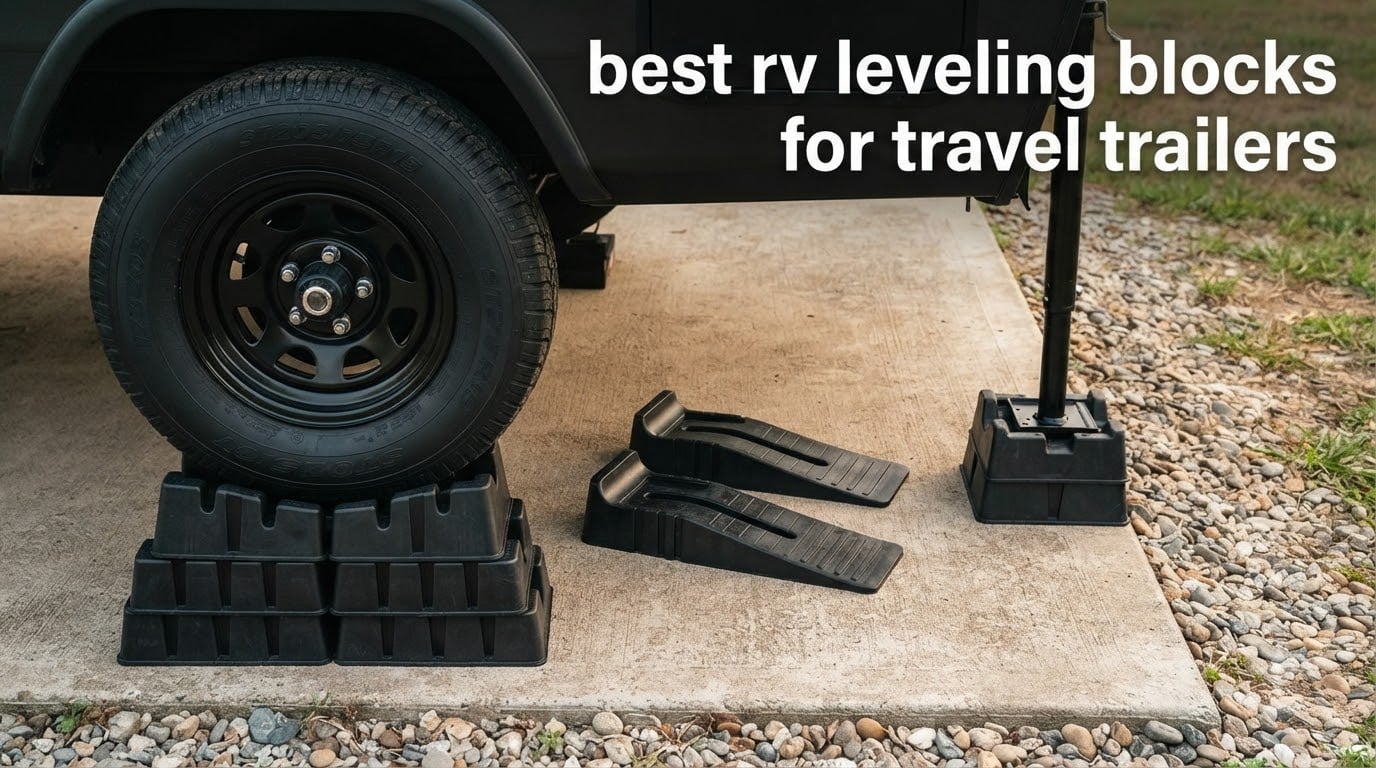
Most travel trailer owners need one of two things: a set of interlocking blocks they build into a staircase under the low-side tires, or a pair of curved drive-on ramps that do the same job in a single backward pull. Almost nobody needs the third category, the large motorhome jack pads sold for fifth wheels and Class A rigs, and several of them will not fit between tandem tires at all. That is the first thing to sort out before any brand name enters the conversation.
These are the best RV leveling blocks for travel trailers we could justify, and we scoped the list to trailers specifically. A tandem-axle travel trailer on 15-inch or 16-inch tires has different clearances, different spring geometry and different load per tire than a Class C motorhome or a fifth wheel on 17.5-inch tires. Buying from a general RV roundup usually means carrying dead weight for your rig. Our list of ten covers interlocking stackers, curved ramp kits and one jack-support pair, and we tell you in each review who should skip it.
We spent weeks comparing specs, reading buyer feedback at length and working through the block-count arithmetic that decides whether a 10-pack is enough. The short version: a curved ramp set wins on speed and on arriving alone after dark, interlocking blocks win on cost, packing flat and tandem flexibility, and jack-support blocks are an add-on rather than a replacement. Everything else is detail, and we get into it below.
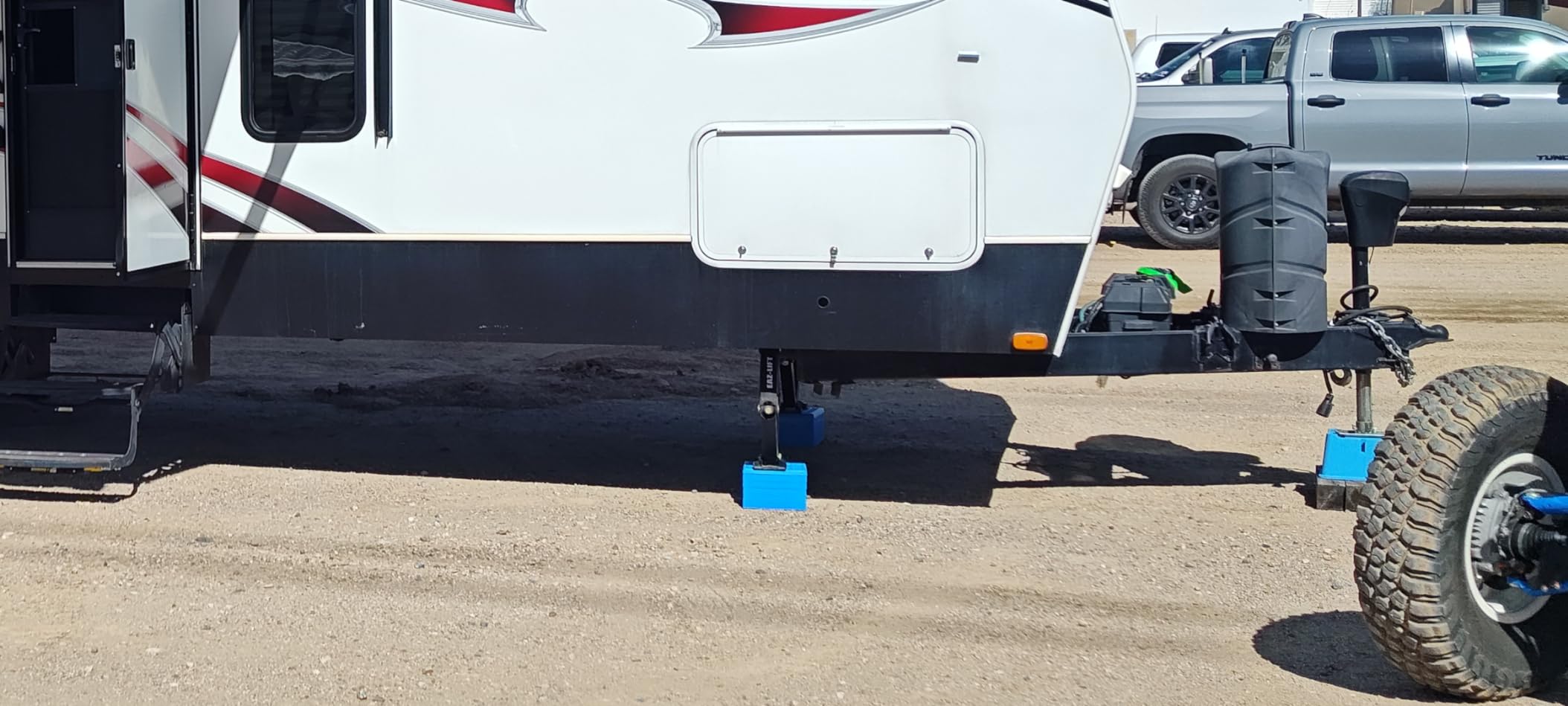
The honest answer is more than most kits ship with, because people count the stack under the tire and forget the ramp the tire has to climb to reach it. A one-inch block presents roughly a four-inch step to a tire, so a single block is a step, not a destination. You need enough layers to build a staircase, and you need one or two extra blocks at the base of that staircase as the run-up.
Here is the arithmetic per tire. Multiply by the number of tires on the low side, then double it if you carry two kits so you are not repacking between campsites.
A 10-block pack covers a 2-inch lift on one side, which is the most common real-world number on a decent site. A 12-piece set with top caps gives you a little margin. If you camp on badly sloped ground regularly, buy two sets. That is the arithmetic behind every kit on this page.


| Product | Specifications | Action |
|---|---|---|
| Tri-Lynx Lynx Levelers 11 Pack |
|
Check Latest Price |
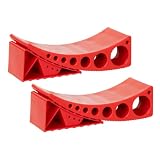
| Andersen Hitches Camper Leveler 2-Pack |
|
Check Latest Price |
| Camco FasTen Leveling Blocks 10-Pack |
|
Check Latest Price |
 Beech Lane Camper Leveler 2-Pack Kit Beech Lane Camper Leveler 2-Pack Kit |
|
Check Latest Price |
 Andersen Hitches EZ Jack Blocks 2-Pack Andersen Hitches EZ Jack Blocks 2-Pack |
|
Check Latest Price |
 RVMATE 12 Pack Leveling Blocks RVMATE 12 Pack Leveling Blocks |
|
Check Latest Price |
 Homeon Wheels 10-Pack Leveling Blocks Homeon Wheels 10-Pack Leveling Blocks |
|
Check Latest Price |
 OULEME 12 Pack Leveling Blocks OULEME 12 Pack Leveling Blocks |
|
Check Latest Price |
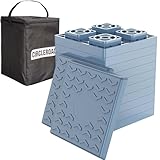 CircleRoad 12 Pack Leveling Blocks CircleRoad 12 Pack Leveling Blocks |
|
Check Latest Price |
 PAULINN 12 Pack Leveling Blocks PAULINN 12 Pack Leveling Blocks |
|
Check Latest Price |
Rated to 40000 lbs
8.5 x 8.5 x 1.5 inch blocks
1 inch lift per block
Cap top and nylon bag
The Lynx Levelers are the block kit most travel trailer owners already own or will end up owning, and for good reason. Each block measures 8.5 x 8.5 x 1.5 inches but locks to a 1 inch increment once the dovetail edges are engaged, so the math is clean and predictable. The 11-piece kit gives you 10 blocks, one cap top plate and a nylon storage bag.
What stands out is the breadth of job. The same stack levels tires, supports a tongue jack, props a stabilizer and steadies an appliance, which is why forum regulars on RVForum and Good Sam keep calling these the orange Legos. The interlocking face means a built stack behaves like one solid object rather than a loose pile.
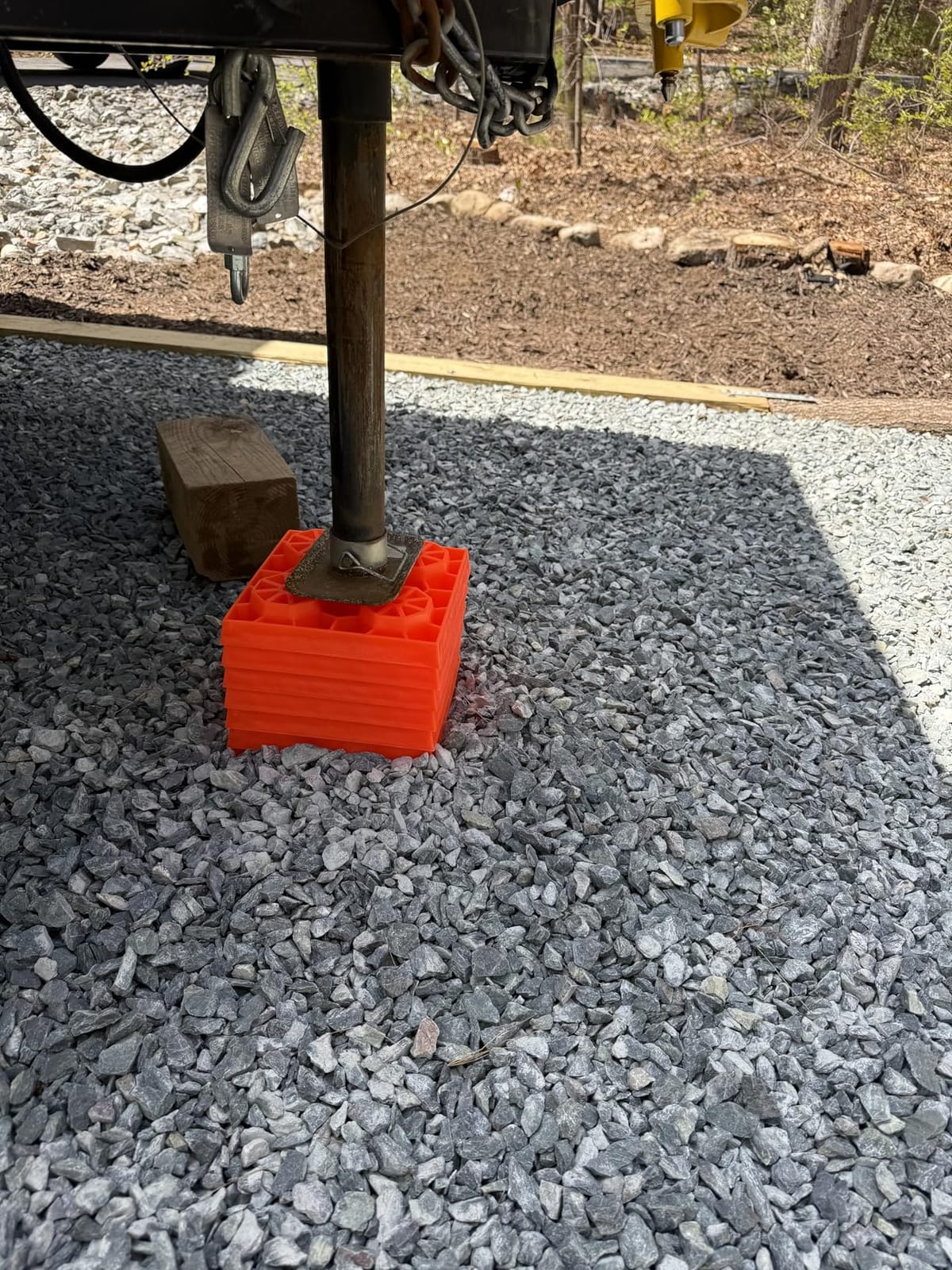
The published rating is 40,000 lbs, and that number matters far less than most product pages suggest. See the per-tire load section below: a typical travel trailer puts roughly 1,500 lbs on one tire. Blocks fail by sliding or by the stack losing its interlock, not by crushing at the published figure.
Two honest limitations. The 1 inch increment is small, so a 3-inch lift eats nine blocks per tire, and you will feel that weight in the truck bed. And the cap plate at 0.5 inch is thinner than the blocks, so it takes a little care to sit flat on top.
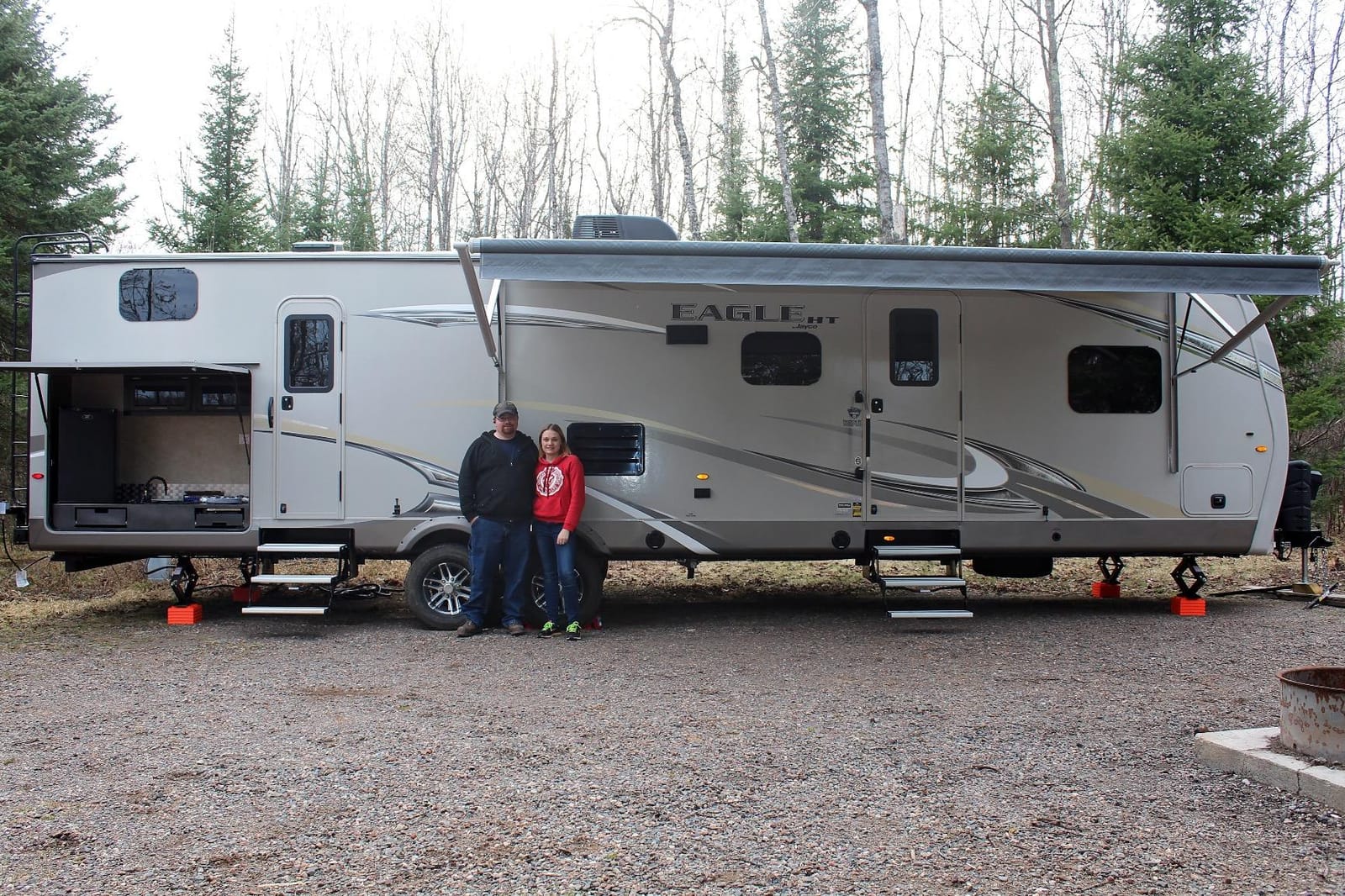
If your usual sites are sloped, forest back-ins or gravel pads that never quite match, the Lynx kit is the right call. The 1 inch increments let you trim a stack to the actual gap instead of rounding up to the next 4 inches like a ramp system forces you to. That precision is the whole reason stacking blocks persist.
Building a staircase takes a few minutes and a bit of shuffling, which is exactly the friction that sends people looking at curved ramps. If you arrive alone at dusk and want to be sitting down in five minutes, read the Andersen section next.
0.5 to 4 inch adjustable ramp
15 x 5.75 x 3 inch leveler
30000 lb trailer capacity
Lifetime warranty
These are the curved drive-on levelers owners describe as having nothing to adjust. You back the low-side tire up the ducktail curve, the tire climbs to the height you stopped at, and you drop a chock behind it. There is no shuffling blocks, no pyramid to build and no guessing.
Two levelers ship in the pack, one per tire, so you can do a full side of a tandem axle in a single pass rather than doing one tire and then repeating. The ramp adjusts from 1/2 inch to 4 inches and is rated for trailers up to 30,000 lbs with tires as large as 32 inches, which covers most fifth wheels too.
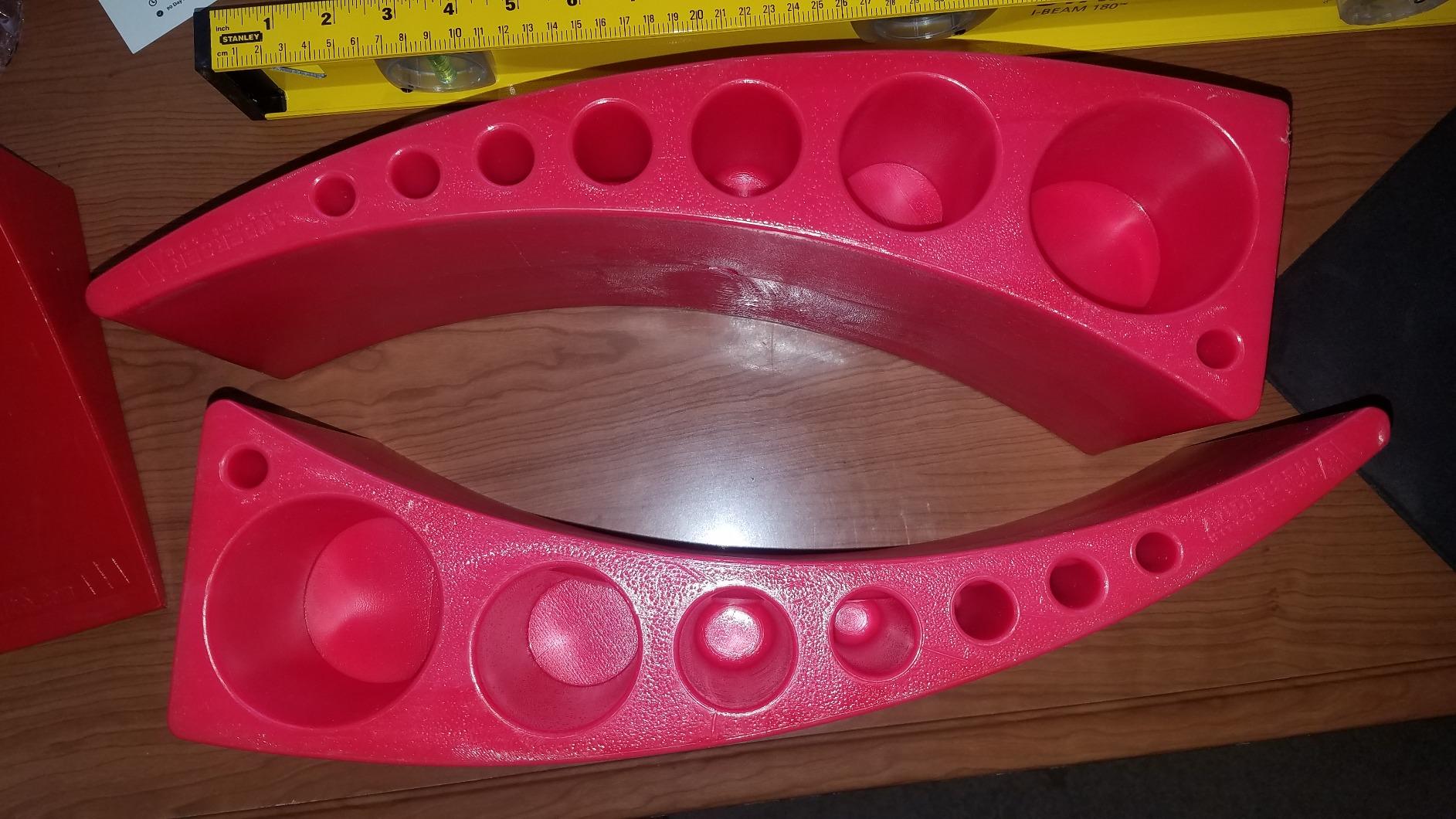
The two real-world cautions are both about terrain rather than the ramp itself. On gravel or sand the smooth ramp surface wants to scoot as the tire climbs, and owners on RVForum commonly add rubber grip mats underneath to fix it. On very uneven ground the 4 inch ceiling means you will still want a stacker alongside it.
Tandem owners should measure before buying. Where dual tires sit close together, the ramp can be physically too long, and some buyers trim the end down. A pair of snips and two minutes solves it, and the lifetime warranty survives the cut.
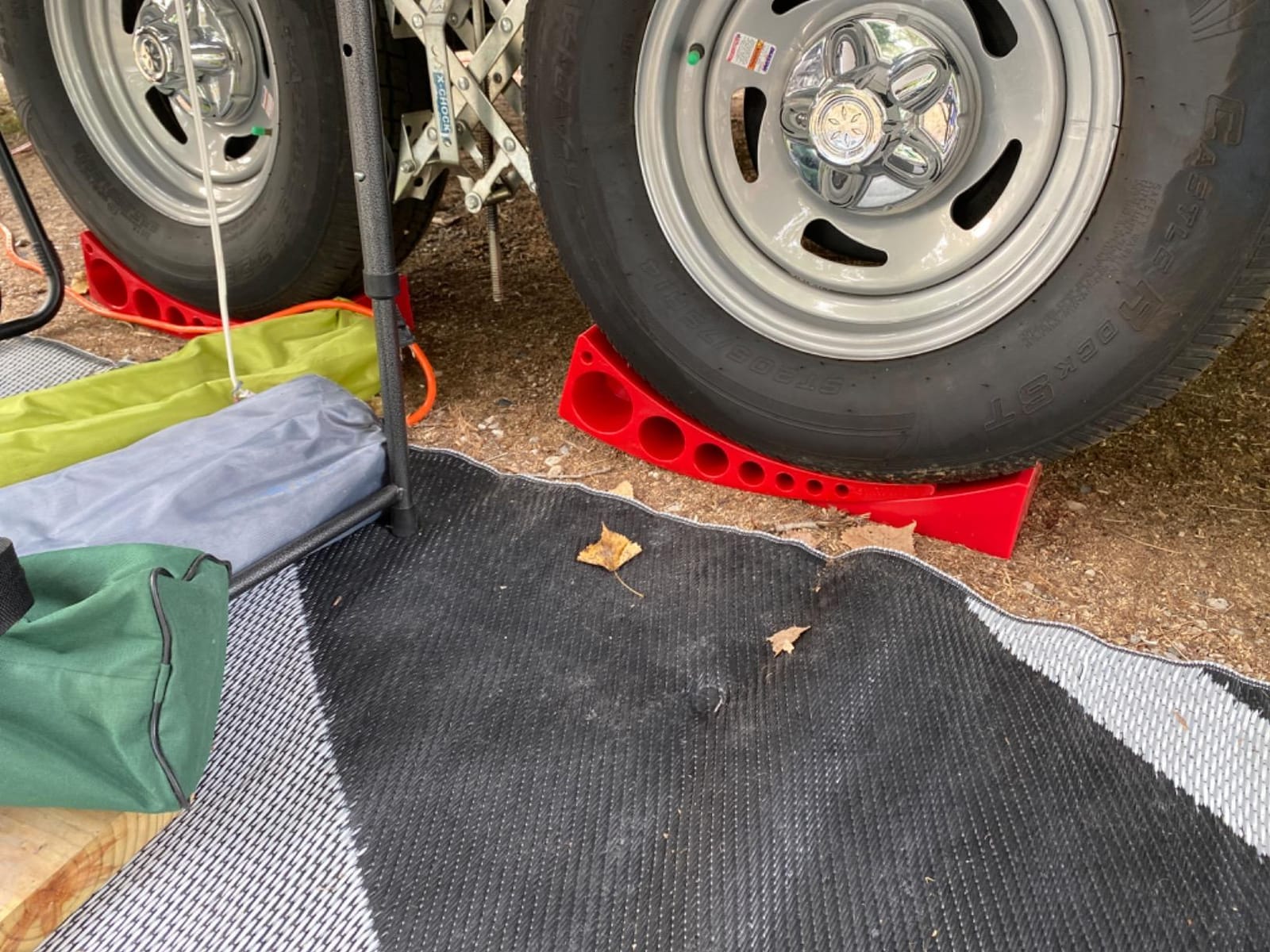
The speed of this system changes how camping feels. One person can be level and chocked in a fraction of the time a stack build takes, which matters when you are backing into a tight wooded site in fading light with the trailer already where you want it. That is why solo campers gravitate here.
A slick ramp on wet gravel or sand is a genuine issue, and grip mats are not included in this pack. Budget for them. The included chock is a separate piece, so keep it with the levelers rather than loose in a bay.
8.5 x 8.5 x 1.5 inch blocks
Max stack 4.5 inches
T-handle locks the stack
Quad-grid load design
Camco FasTen blocks solve a specific problem: keeping a built stack from separating in the truck bed. The integrated T-handle threads through the blocks and locks them together as one column, then folds flat for storage. On a rough forest road, that handle is the difference between arriving with a usable stack and arriving with ten loose tiles.
Each block is 8.5 x 8.5 x 1.5 inches and adds roughly one inch interlocked. The quad-grid underside spreads load across the base rather than concentrating it on a rim, which is the reason they hold up on gravel better than lighter sets. Camco publishes a firm ceiling: do not stack higher than 4.5 inches.
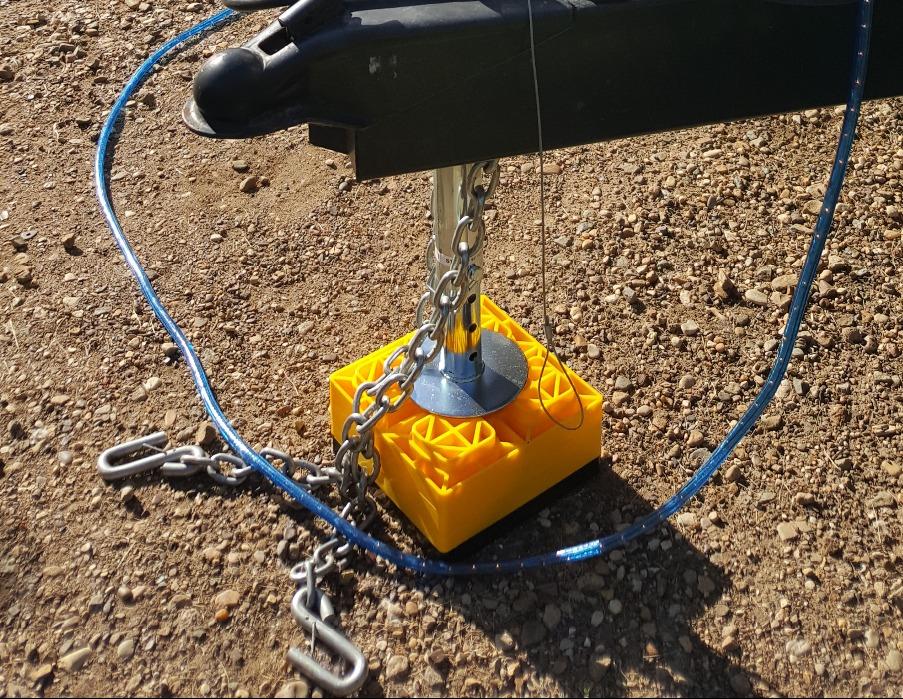
The trade-off is the patented lock. These blocks interlock with each other and with the wider Camco range of big blocks, jack pads and ramps, but they will not mesh with Lynx or RVMATE pieces. If you run mixed brands in your bay, that is a real annoyance rather than a theoretical one.
We also see occasional complaints about fulfillment speed rather than the product itself, so if you are building a kit for a trip, order with time to spare.
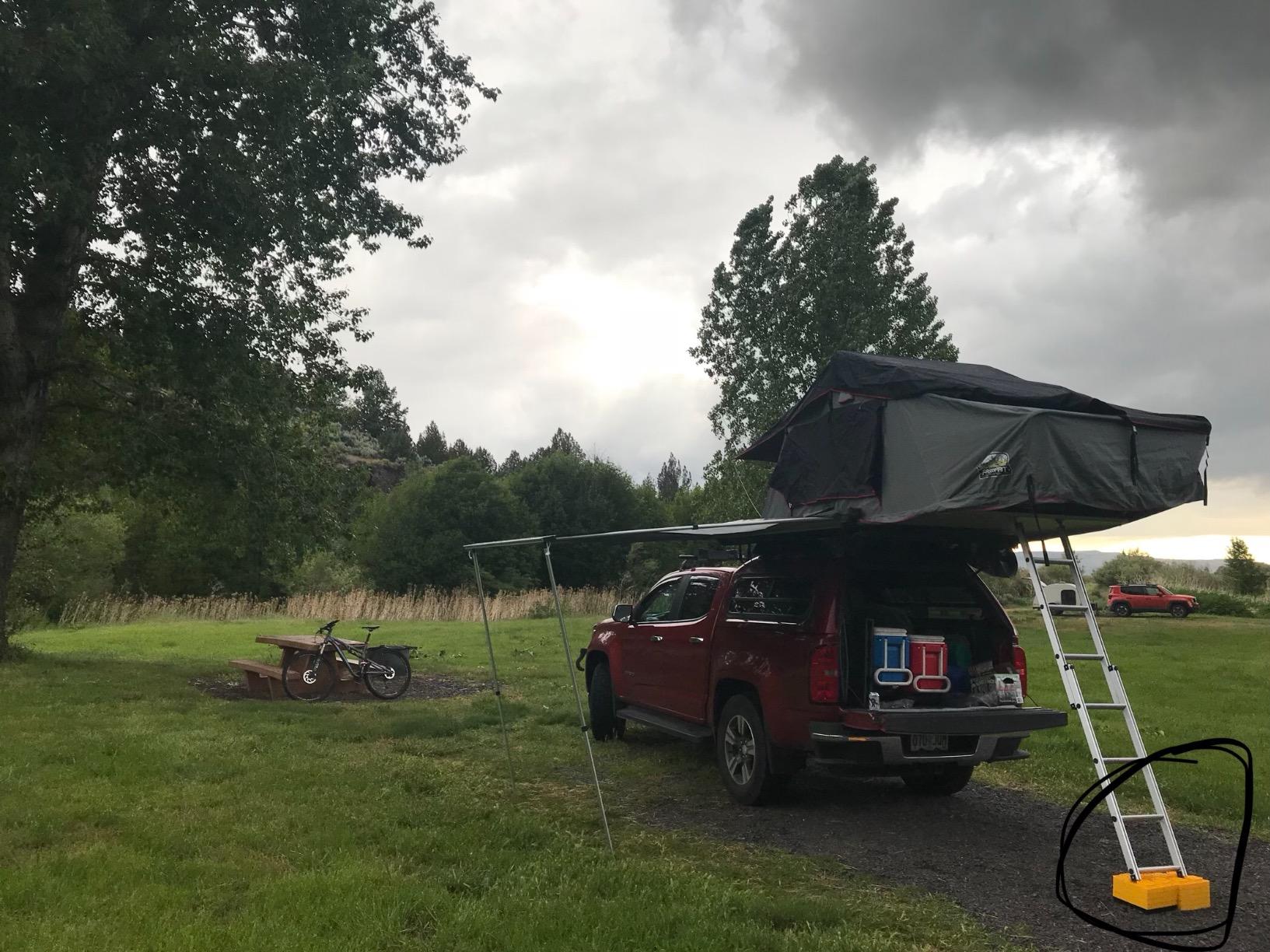
The locking handle makes this the pick for anyone hauling gear over washboard roads or stowing blocks in an exterior compartment. The stack arrives intact, you unload one column instead of a pile, and the blocks stay square rather than shifted out of alignment.
If you already own Lynx blocks, adding Camco does not increase your usable inventory the way another Lynx pack would. Either commit to the Camco system across the board, or stay inside one brand. For the record, 4.5 inches of maximum stack is more ceiling than most travel trailer sites ever demand.
Two levelers two chocks two grip mats
Bag included
0.5 to 4 inch range
Structural nylon polymer
The Beech Lane kit is the one to buy if you want the whole leveling system in a single bag. You get two curved levelers, two chocks, two rubber grip mats and a carrying case. Nothing else to hunt down, and the grip mats solve the scooting problem that Andersen owners complain about.
Construction is a high-performance structural nylon polymer, patented, and the lifetime warranty is the reason this brand shows up so often in owner recommendations. The range is 1/2 inch to 4 inches, and each leveler is about 6 inches wide by 15 inches long, which is a slightly more compact footprint than the Andersen ramp.
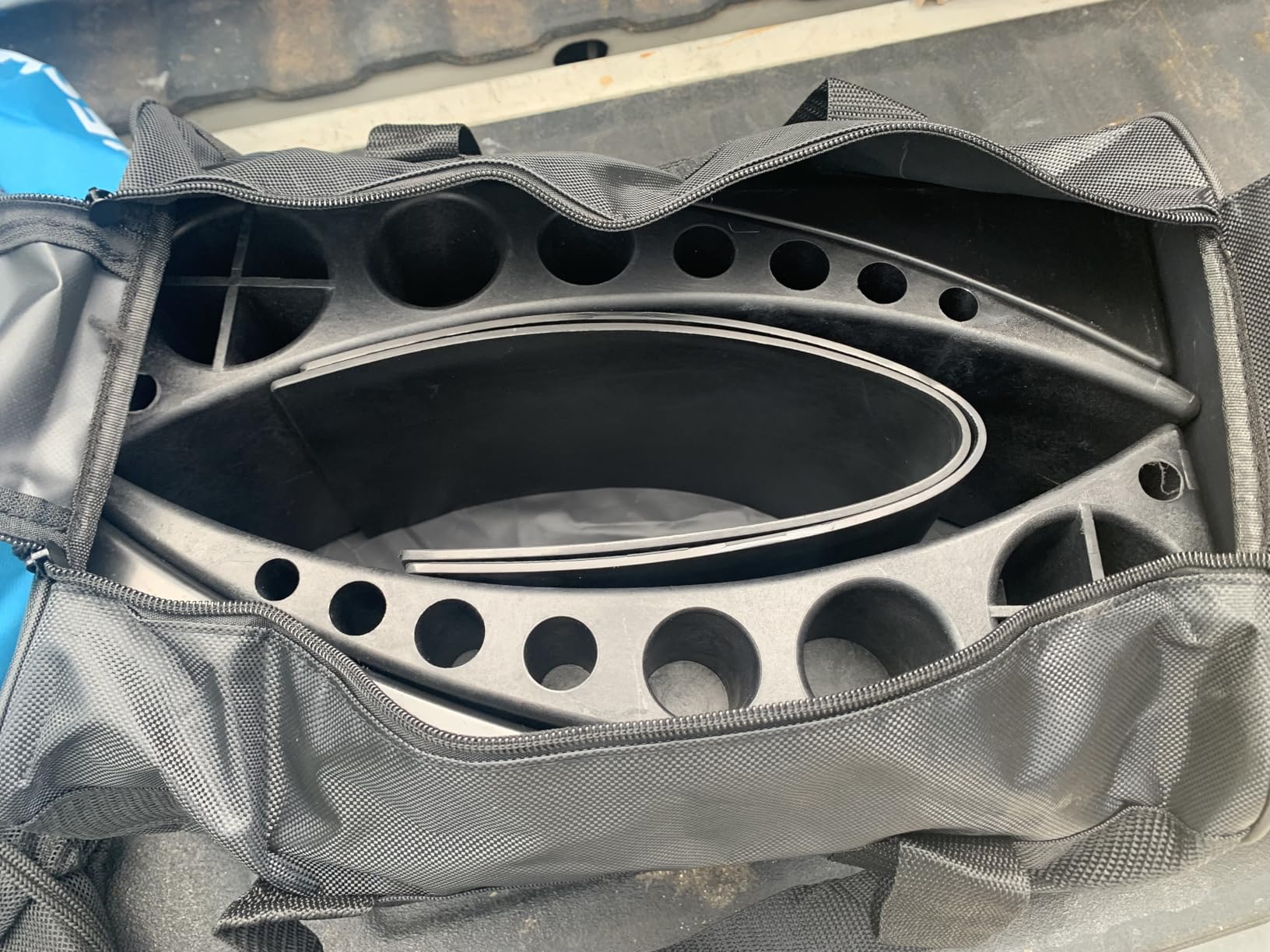
On a tandem axle with tight dual spacing, up to 4 inches may need trimming from one leveler to fit between the tires. The warranty still applies afterward, which is unusual and worth knowing before you cut anything.
The weight is the catch. At 17 pounds this is the heaviest package on our list, and if you move it between the truck and the trailer regularly you will notice it. Owners who level at the site once and leave the kit in the trailer do not care.
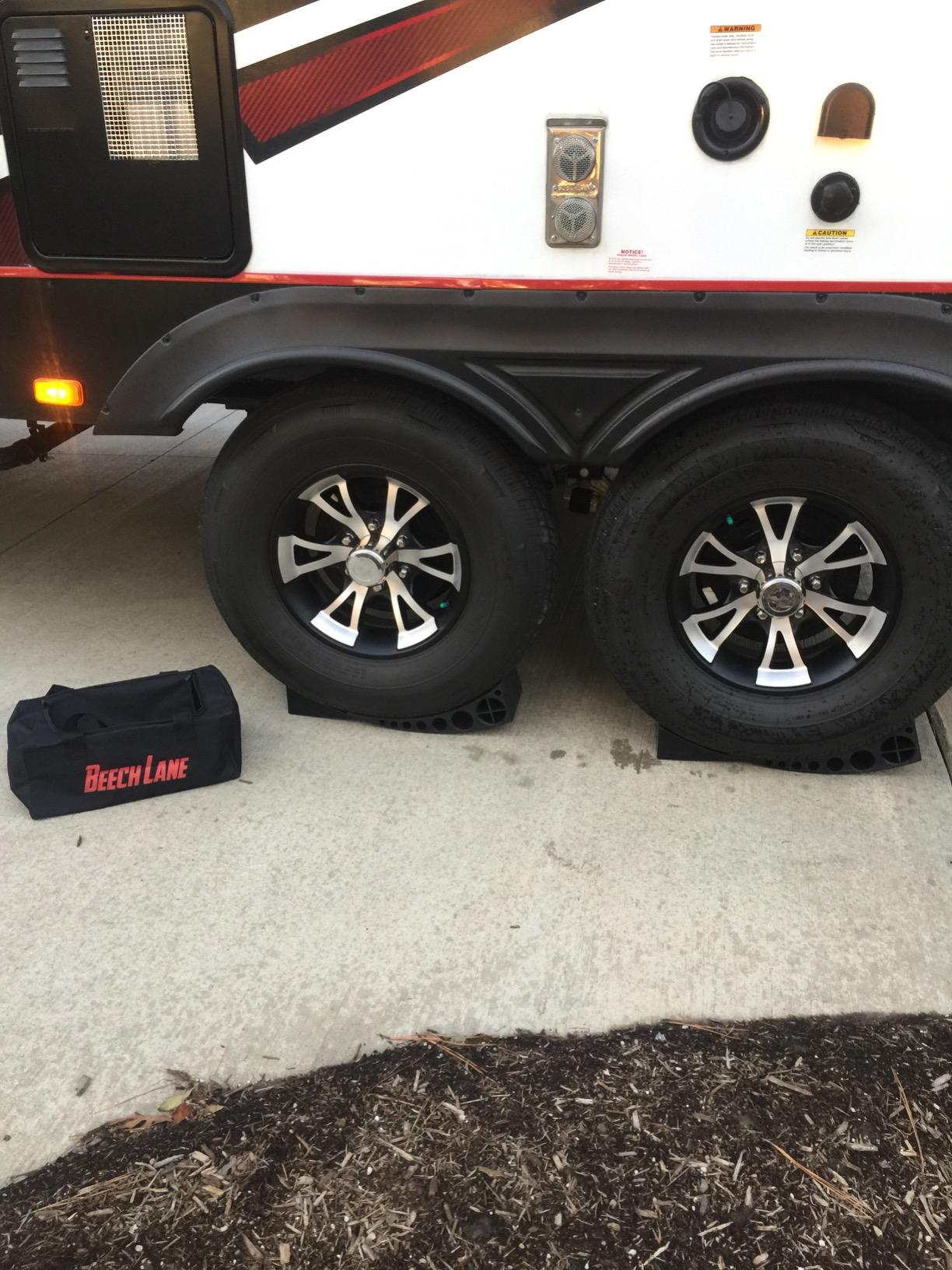
Standalone curved levelers frequently ship without chocks or mats, and those are the two pieces you always need. This kit removes the follow-up purchase entirely. If you have been reading forum threads debating whether grip mats are worth it, this is the set that includes them.
Two curved levelers, two chocks, two mats and a bag occupy noticeably more volume than a flat stack of ten blocks. In a small travel trailer storage bay this matters more than the weight does, so measure your compartment before committing.
2.5 inch recessed post hole
Stacks two high for 14 inches
2000 lb capacity
Lifetime warranty
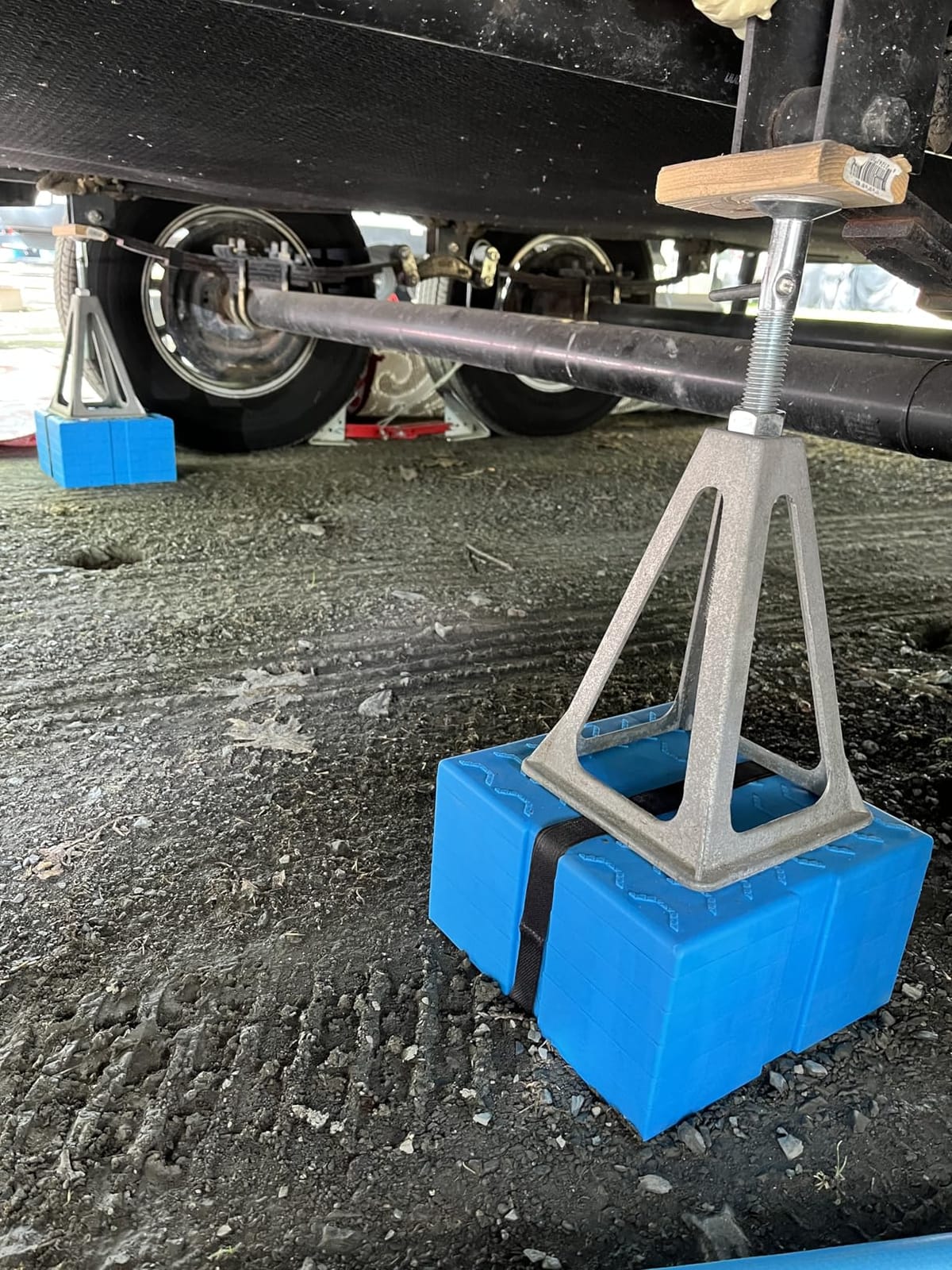
These blocks are not tire levelers and it is worth being clear about that from the start. They support stabilizer and landing gear posts on soft ground, and the 2.5 inch recessed post hole is the whole idea: a jack foot that drops into a recess cannot slide off a tilted pad the way it can on bare ground.
They also stack two high for up to 14 inches of clearance, which makes them useful on high-clearance trailers and on sites where the stabilizer would otherwise dig into soft soil. The plastic finish shrugs off dirt and oil, and the recessed finger holes on both sides make them easy to pull out of packed mud.
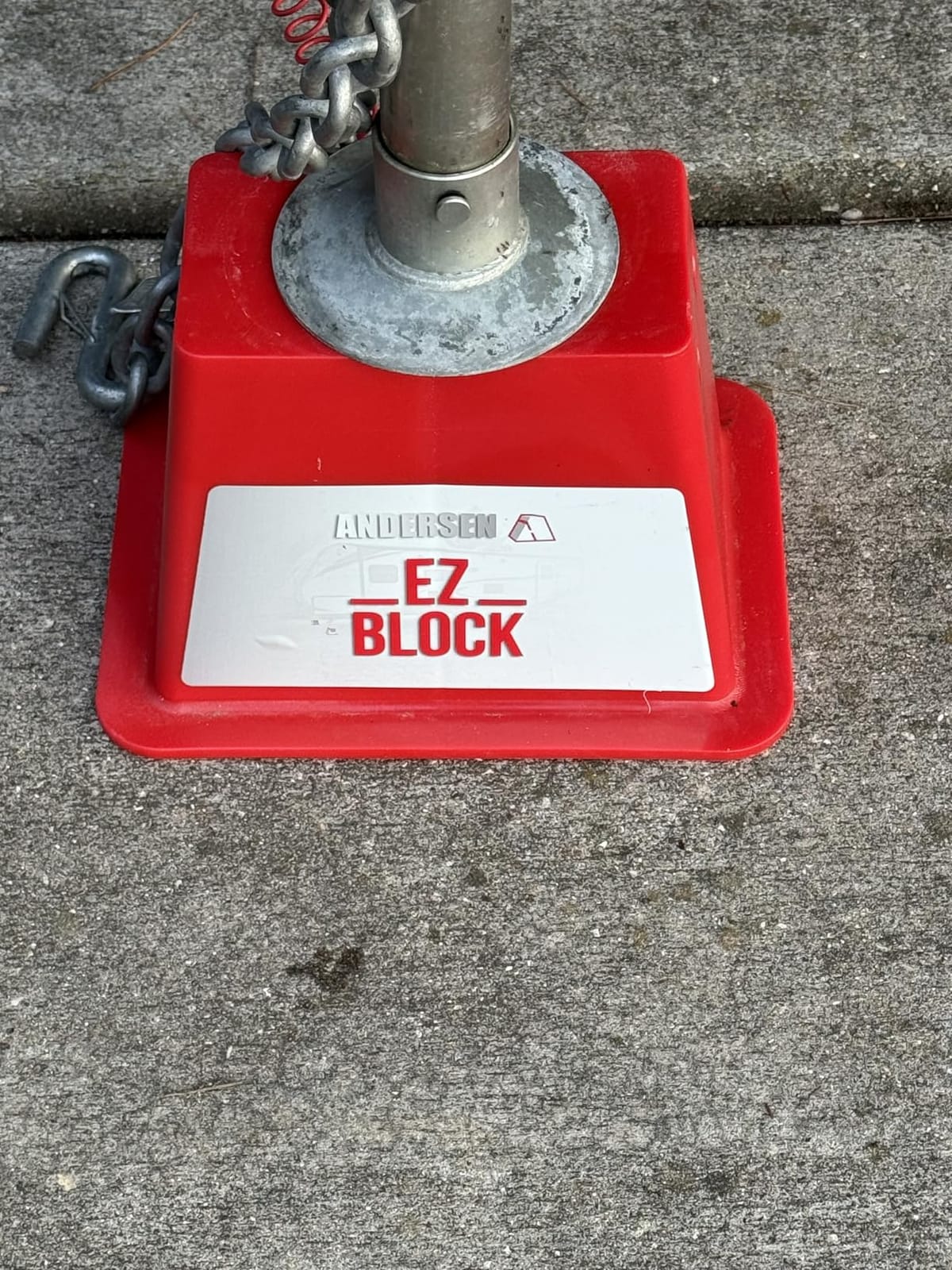
The 2,000 lb capacity is right for jack duty and nothing more. Do not read it as a trailer rating and do not try to put a tire on these. Reviewers are consistent about that distinction, and the 2.5 inch post hole will not accept a tire anyway.
Most travel trailers have stabilizing jacks, not leveling jacks. This is the correct accessory for that equipment, and it pairs naturally with an interlocking stacker for the tires rather than replacing one.
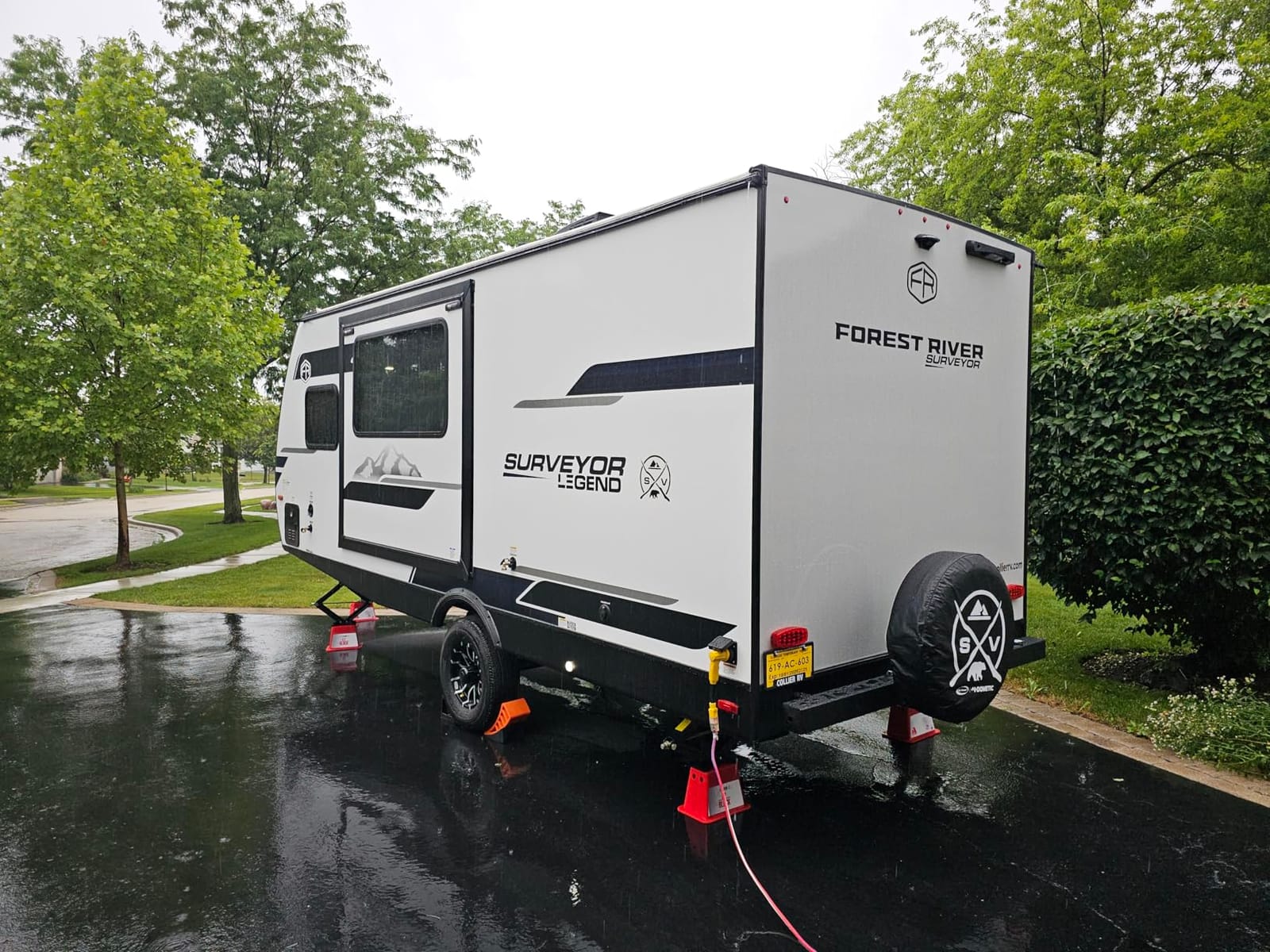
On a site where the stabilizers would otherwise sink and the trailer ends up leaning, a pair of these under the jack posts is a complete fix. The stacking capability means you can also gain real clearance under a high trailer without digging.
If side-to-side tilt is your problem, these do nothing for it. Buy them as the second half of a leveling kit alongside an interlocking stack, and treat the 2,000 lb figure as a jack-post limit rather than a trailer number.
10 blocks plus 2 top blocks
1 inch lift per block
Reinforced interlocking material
Storage bag
The RVMATE set is a 12-piece kit: 10 blocks at 8.5 x 8.5 x 1.5 inches, two top blocks at 8.5 x 8.5 x 0.75 inches, and a carrying bag. Each block contributes one inch of height, and the construction is a high-density reinforced material with an interlocking face.
The top blocks are the reason to look at this one. They sit between the tire and the stack body, so the tire tread is not bearing directly on the main block surface. Reviewers repeatedly single out the caps as the part they value most, and the whole thing also works under hydraulic, tongue, stabilizer and fifth wheel jacks.
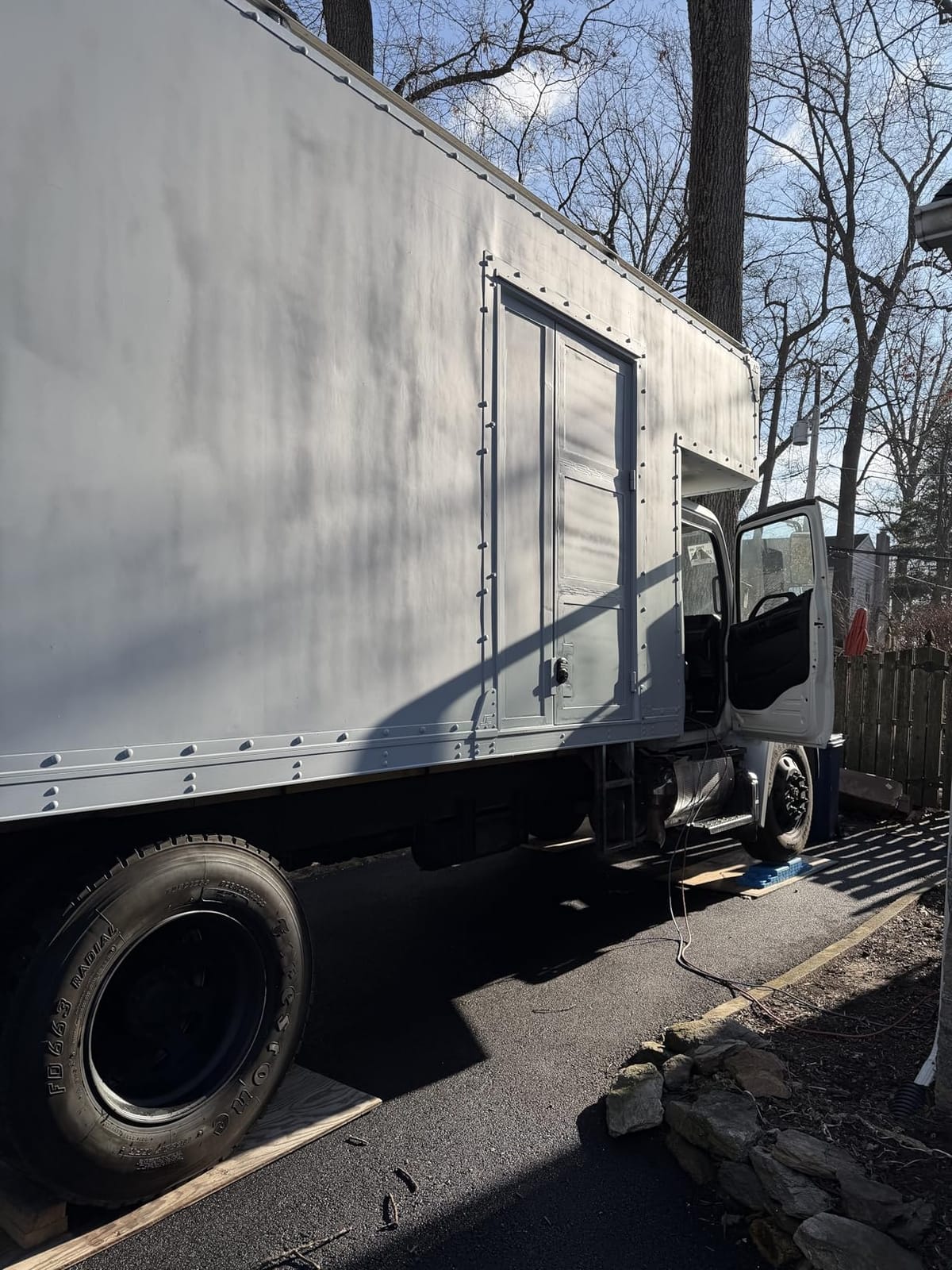
The average rating of 4.6 is a notch below the 4.8 sets, and the review history is shorter than Lynx or Andersen because the listing is newer. That is a fair trade for the tread protection, but if you want the highest confidence in a proven design, the Lynx pack has years of owner history behind it.
Note the cap height: 0.75 inch per cap, so measure your total lift including the cap if you are matching against a target number.
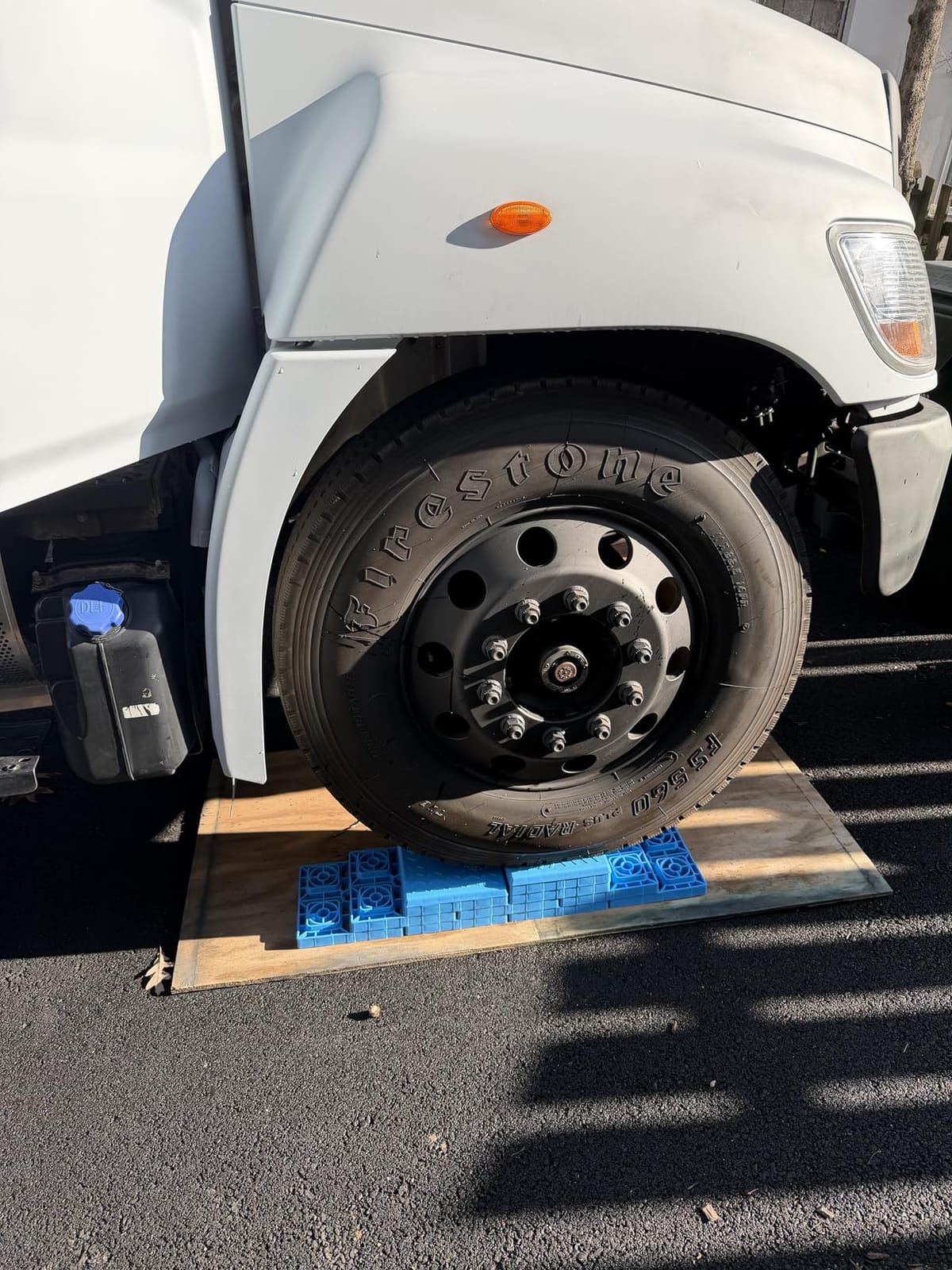
On rough campsites, a tire sitting on a bare block edge is the fastest way to chew a sidewall. The dedicated top caps spread the contact and give the tread a flatter surface to rest on, which is the practical reason to choose this set over a plain 10-pack.
Ratings are strong but the base is smaller. For a trailer you will level for a decade, owner longevity is worth something, and the Lynx pack has a much longer track record in the category.
8.5 x 8.5 x 1.3 inch blocks
1 inch lift per block
Anti-slip pads on two blocks
Zippered bag
The Homeon Wheels set does one thing differently from every other stacker here: two of the blocks carry anti-slip pads on the underside. That is a small detail that decides whether a built stack walks on a gravel pad while a tire climbs onto it. Reviewers who camp on gravel mention the pads first.
Each block is 8.5 x 8.5 x 1.3 inches and adds a full inch of height when locked. The kit ships with a zippered carrying bag and printed instructions, and it is compatible with single, dual and tandem wheels plus tongue, fifth wheel, hydraulic and stabilizer jacks.
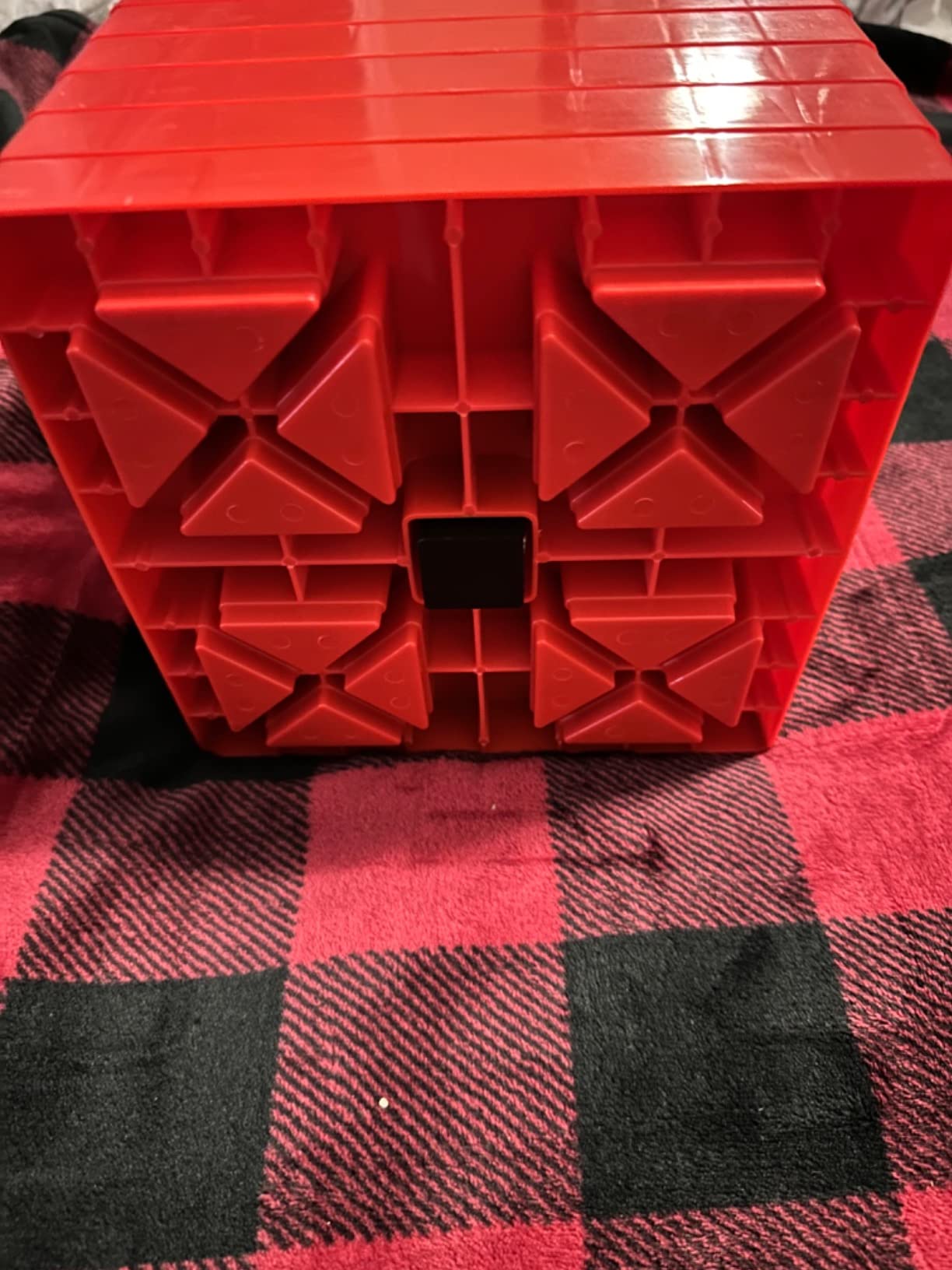
The weakness is rock. On loose gravel and sharp stone, lighter blocks can crush or distort, and once a face deforms that block will not lock cleanly with the next one. Owners who camp on that surface put a board down under the stack or move to a heavier set.
There are no drain holes, which means mud and water have to be flushed out before the dovetail faces engage. It is a minor annoyance that becomes obvious in wet weather.
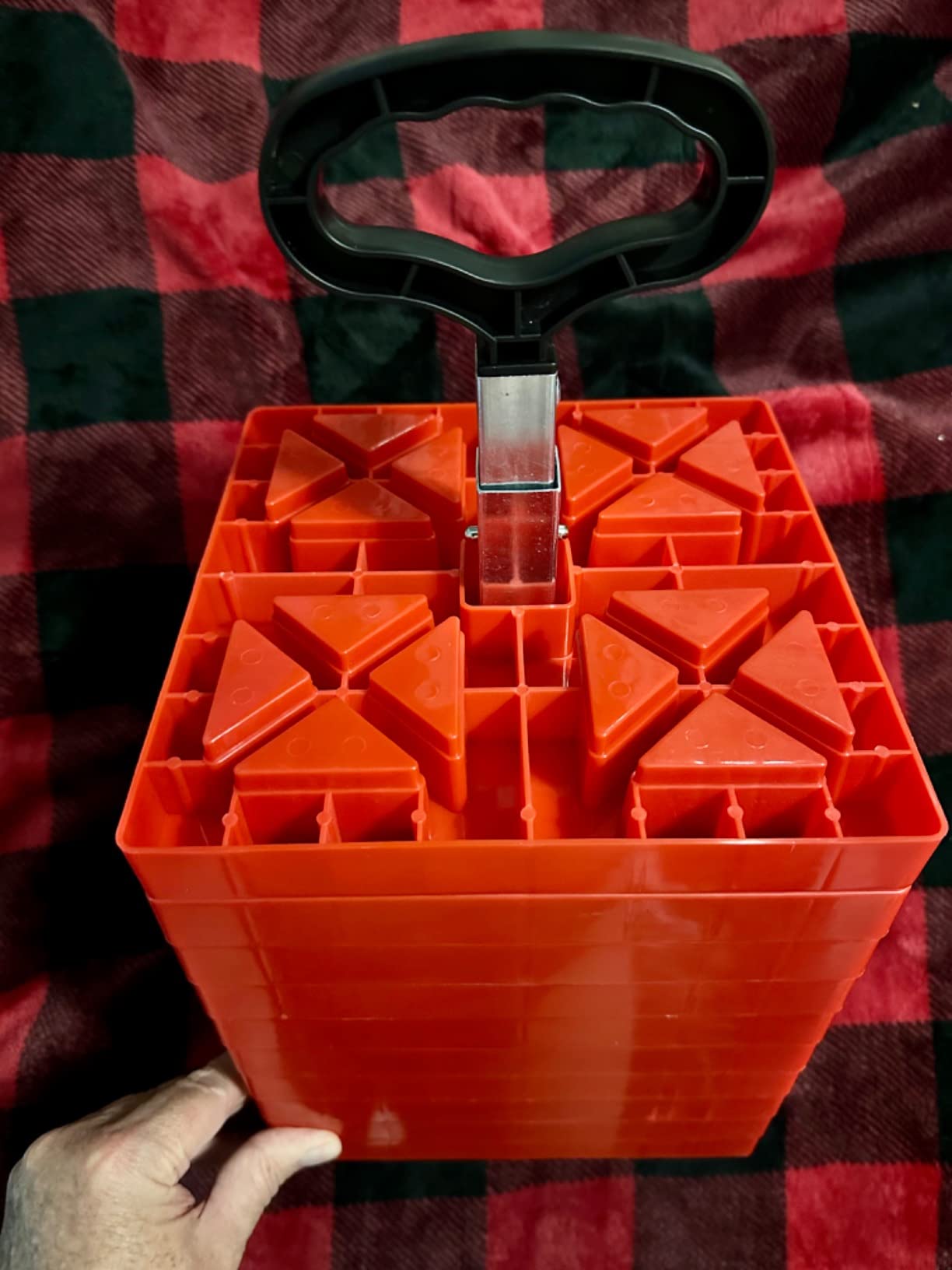
If you mostly camp on relatively flat, firm pads, this set performs well and stays light in the truck. The anti-slip pads and the low weight are the two features you notice in normal use, and the manufacturer is praised for replacing damaged sets.
The durability ceiling on loose stone is real, and there is no chock in the box unless you buy the bundle. Pair it with a separate wheel chock rather than assuming one is included.
10 blocks plus 2 top blocks
Anti-UV stabilized polypropylene
1 inch lift per block
Bag included
Desert camping is the scenario this set is built for. The blocks are polypropylene with anti-UV aging additives, increased density and increased thickness, and that combination is aimed squarely at blocks sitting in direct sun at a dry site for weeks at a time. It is also the most versatile catalog in the group, with 24-pack and wider 17.2 inch options if you need more footprint.
The pack holds 10 blocks at 8.5 x 8.5 x 1.5 inches and two top blocks at 8.5 x 8.5 x 0.7 inches, plus a carrying bag. Every block adds one inch. The same pieces double as jack and stabilizer pads when you are not leveling tires.
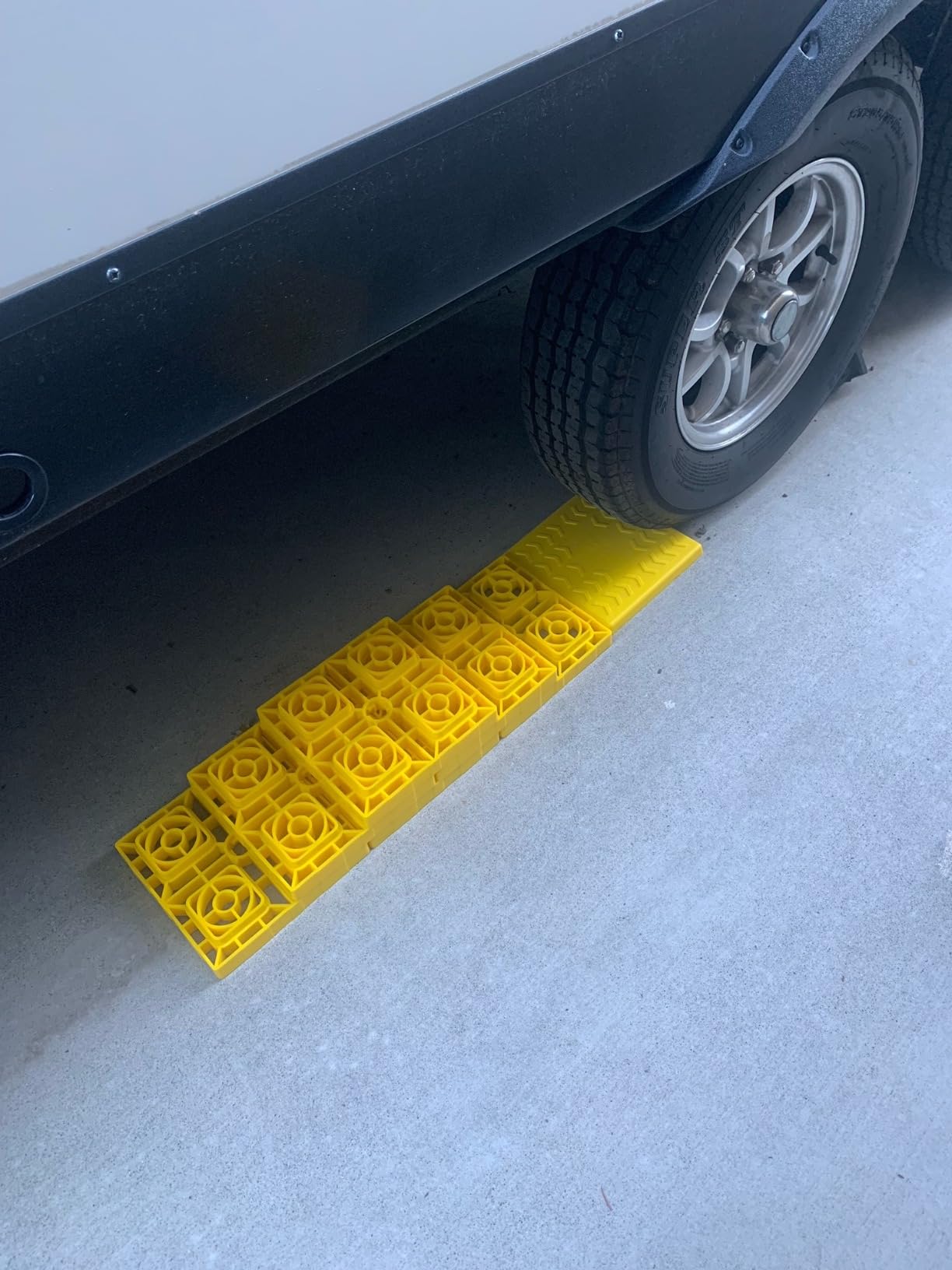
At a 4.7 average across nearly 900 reviews, the satisfaction level is high, but the review base is a fraction of Lynx, Camco or Andersen. Owners who switched from a softer set report the density and thickness difference is obvious under a loaded trailer.
The 0.7 inch caps are the thinnest we tested, so they add less height than the RVMATE caps. On a lift where every quarter inch matters, that is worth factoring in.
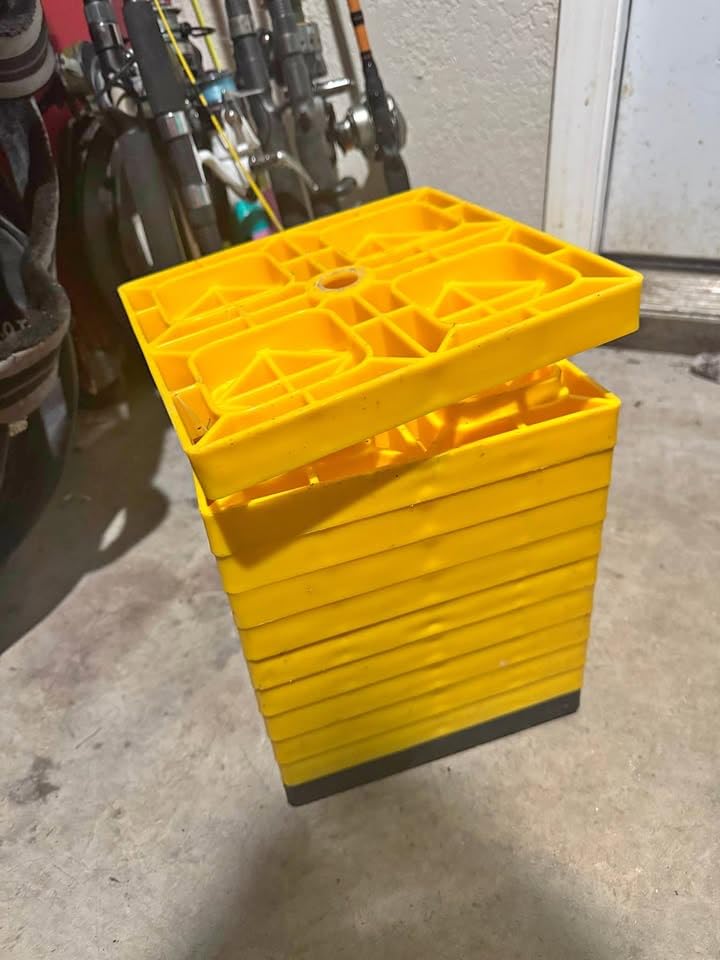
Prolonged sun is what degrades ordinary polypropylene blocks, and the anti-UV additive here is the specific answer. If your sites are dry, hot and long-stay, this is the set most likely to still look square after a full season.
Ratings are good rather than exceptional, and the review count is still building. If you want the category’s deepest owner history, the Lynx pack is the safer long-term bet.
10 blocks plus 2 top blocks
Solid base structure
1 inch lift per block
Storage bag
This set’s distinguishing feature is a solid bottom structure rather than a ribbed or hollowed one, and that is exactly the design choice you want on soft ground. A solid base spreads the tire load over more of the footprint instead of letting a rim dig into wet grass or damp sand.
You get 10 blocks at 8.5 x 8.5 x 1.5 inches, two top blocks at 8.5 x 8.5 x 0.7 inches and a storage bag. Each block adds one inch in a pyramid stack, and the blocks double as a base for other stabilizing equipment. Three color options are available.
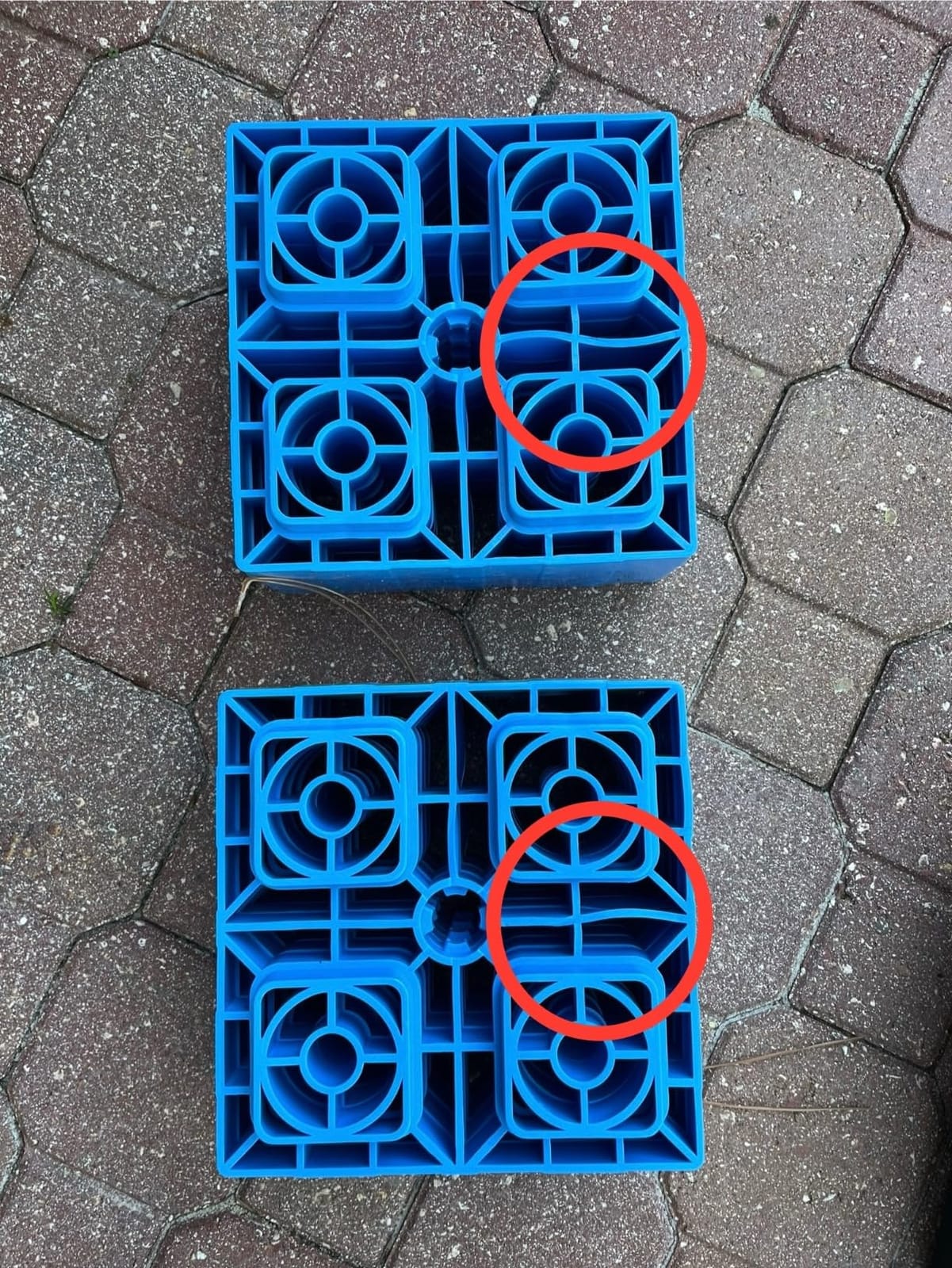
The material grade is where the feedback splits. A meaningful minority of owners report blocks flattening under pickups, heavier rigs or long sun exposure, and the same reviews note softening in heat. If your trailer is on the heavy end of the scale, the material grade matters more than the block count.
No published weight limit appears on the listing, so you have no manufacturer figure to check against your per-tire load. That absence is worth factoring into your decision.
If your recurring problem is the trailer settling into grass or damp sand after you drive on, the solid base here is the right shape to fight it. The nesting design also packs down smaller than most kits, which helps in a crowded bay.
Reports of deformation under load and softening in heat are specific enough to take seriously. On a light pop-up or a mid-weight trailer on mild sites it is fine; on a heavy rig in desert heat, pick a set with a higher-density material.
1.25 inch blocks with 0.8 inch layers
Max stack 4.45 inches
2 velcro storage straps
UV and water resistant
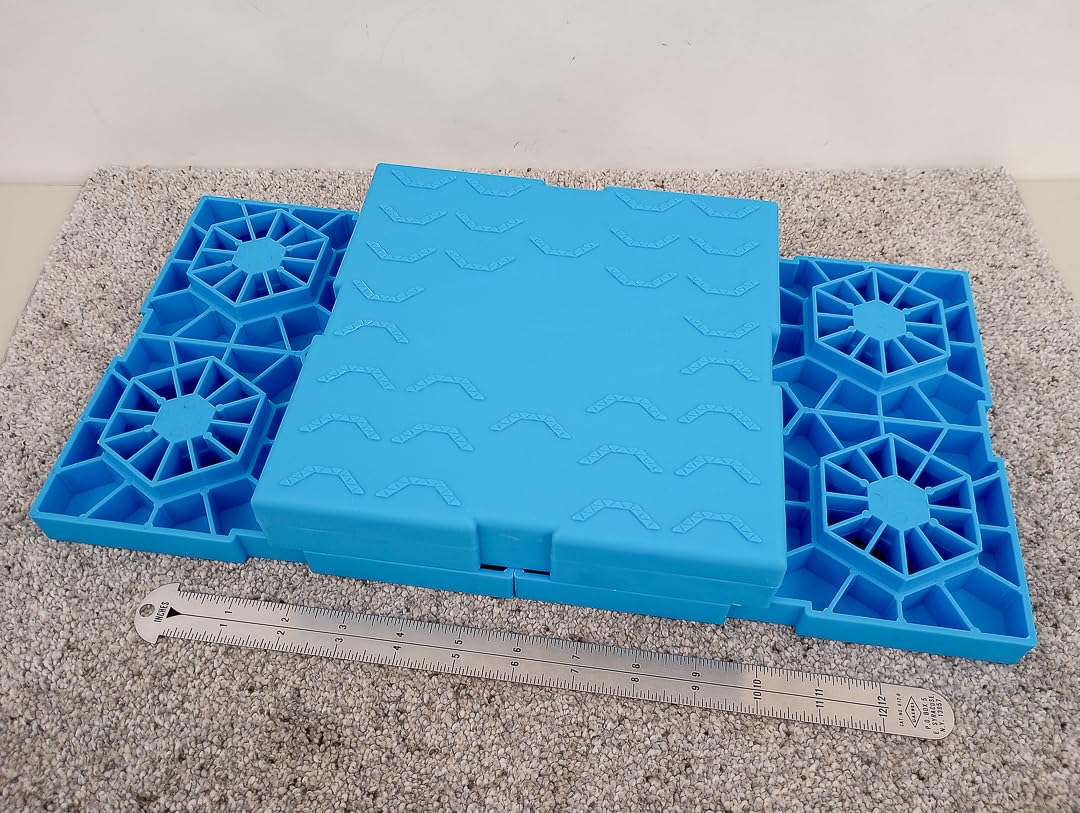
The PAULINN set is the only one here with a mixed increment. A single block is 1.25 inches, and each additional interlocked layer adds 0.8 inch, which gives you finer control on sites where 1 inch steps overshoot the gap. Top blocks are 8.5 x 8.5 x 0.7 inches.
Storage is handled unusually well. Two velcro straps compress the loose stack into a bundle instead of relying on a bag, and the blocks nest when rotated 90 degrees. The material is described as high-density reinforced and rated against UV, water and temperature extremes.
Maximum stack is 4.45 inches across five blocks, so this set is not for a big correction. It is for finishing a level that blocks alone would overshoot, which is a genuine and underappreciated job.
The alignment marks on the faces are the one friction point. Blocks that do not line up will not nest properly, and first-time users lose time to it before they learn the 90 degree rotation.
Once you know what you are looking at, the mixed increment is a real advantage. A 1.5 inch gap is awkward with 1 inch blocks and trivial here, and that situation comes up constantly on sloped pads.
With 175 ratings, long-term durability is the least proven on this page, and the 4.45 inch ceiling is modest. If this is your only leveling kit and you camp on rough terrain, a set with a higher ceiling is a better foundation.
Most leveling confusion disappears once the two axes are separated. Side-to-side is the tires, and that is what leveling blocks and curved ramps handle. Front-to-back is pitch, and that is the tongue jack and, on some trailers, the stabilizers. Doing side-to-side first also means you are not fighting the jack while a tire is still on the ground.
Interlocking stackable blocks are the cheapest, pack flat, work on tandem axles and any jack, and reach whatever height you have enough pieces for. Curved drive-on levelers are the fastest, need no building, but top out around 4 inches and only support one tire each. Jack pads and jack blocks sit under stabilizers and landing gear posts, and they do not level side to side at all. Most owners end up with one stacker plus a jack pad pair.
Published ratings are static crush figures measured in a lab, not the number that matters on your rig. The useful number is your real per-tire load: take GVWR, subtract the tongue weight, and divide by the number of tires carrying that weight. A travel trailer at 7,000 lbs GVWR with about 1,000 lbs of pin weight carries roughly 6,000 lbs across four tires, or about 1,500 lbs each. No block kit on this page is close to failing at that load. Blocks fail by sliding, by the interlock releasing, or by the material softening in heat, not by crushing.
This is the safety point that most product listings skip. A tandem axle is tied together by equalizer bars and leaf springs. If you raise only the front tire on a side, the equalizer bar runs out of travel and the suspension is loaded sideways. Both tires on the lifted side need to come up together, which is why a ramp per tire or a wide stack beats a narrow single-tire shim. A curved leveler that supports one tire while its neighbor sits on bare ground is the exact failure case.
Cut 2×8 or 2×10 boards, chamfer one end and you have a functional ramp for a seasonal site. Owners like that they can be drilled, notched for a jack post and thrown in a woodpile. They are heavier, they splinter, they soak up water, and they do not interlock, so you are building a stack by guesswork. Most people who try them keep a plastic set anyway.
Once the trailer is level, the stabilizers still carry load on soil that may not hold it. A rigid pad spreads that load across far more square inches than a jack foot, which is the whole reason to add one. The Andersen EZ Jack blocks on this page do the same job with a recessed post hole that stops the jack from sliding. If you are still choosing between buying a block set and buying a jack, blocks come first; the pads come second.
Once side to side is handled and the trailer is chocked, the rest of a small-trailer kit matters just as much. Picking the right [RV generators](/best-rv-generators/) for the electrical side and the right [induction cooktops for RV](/best-induction-cooktops-for-rv/) for the galley decides whether you enjoy the trip. Our [boondocking generator guide](/best-rv-generators-for-boondocking/) covers the longer power plan.
Before you start, pick a site where the trailer’s footprint matches a reasonably flat area. A trailer that fits is far easier to level than one parked diagonally across a slope.
For a typical travel trailer, count 2 blocks per tire for 1 inch of lift, 5 for 2 inches, 9 for 3 inches and 14 for 4 inches. A 10-pack covers about a 2 inch lift on one side, because you also need blocks for the ramp the tire climbs. If you camp on sloped ground regularly, carry two sets.
Curved levelers are faster because you drive the tire up and drop a chock, with nothing to build. Stacking blocks cost less, pack flat, and give you finer height control in one inch steps. Curved levelers top out around 4 inches, so most owners keep a stacker as backup.
The Tri-Lynx Lynx Levelers are the best overall choice for most travel trailers, with 40,000 lb interlocking blocks, 1 inch lift per block and a 4.8 average over more than 18,000 reviews. Pair them with a pair of Andersen jack blocks for soft ground. Curved ramp kits level faster if you want a one move setup.
Yes, and tandem axles are the reason most owners choose interlocking blocks. Build the stack wide enough to sit under both tires on the lifted side, and never raise just one tire on a tandem, because the equalizer bar between the axles cannot travel that far and the suspension is loaded sideways.
Only very few travel trailers have auto-leveling. Most have stabilizing jacks, which steady the trailer but do not correct side-to-side tilt, and those are the correct accessory for a jack pad rather than a tire block. If you own a rig with true hydraulic or electric leveling, blocks become a backup for soft ground.
The most common failures are a stack that slides or separates while the tire climbs, one tire lifted on a tandem running the equalizer bar out of travel, blocks sinking into soft ground, and jacks popping when raised too far on a slope. Curved ramps can also scoot on wet gravel without grip mats underneath.
Yes. Cut 2×8 or 2×10 boards, chamfer one end and they work as a ramp on a seasonal site, and they can be notched for a jack post. They are heavier than plastic, they splinter, they do not interlock, and they soak up water, so most owners keep a plastic set once they try wood.
For most travel trailer owners in 2026, the best RV leveling blocks for travel trailers are the interlocking stackers, because they handle tandem axles, work under any jack, pack flat and let you trim a lift to the actual gap. The Tri-Lynx Lynx Levelers are the pick: the deepest review history in the category, a 40,000 lb interlocking design, one inch per block, and a cap plate and bag in the box.
Buy the Andersen curved ramp pair instead if you level alone, arrive after dark, or want a trailer level in a single backward pull. Add a set of Andersen EZ Jack blocks if your sites are soft, and keep a wheel chock with whichever system you choose. Whichever route you take, count the ramp blocks as well as the stack, buy the chock at the same time, and treat leveling gear as a system rather than a single purchase.


