
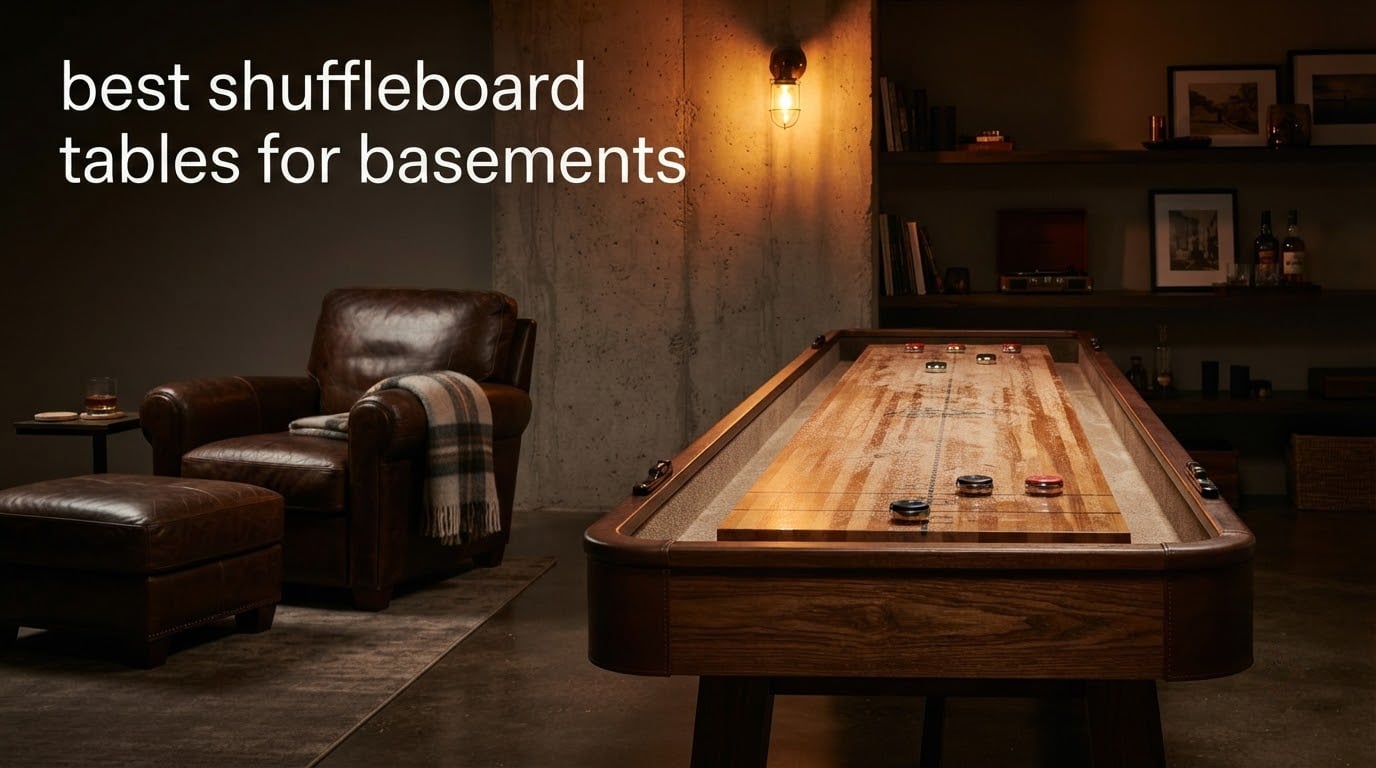
The best shuffleboard tables for basements are the ones with a solid or engineered hard-wood playfield at least 1.5 inch thick, some form of leveling hardware, and a footprint of 9 to 12 feet that clears your stairwell. Humidity, uneven concrete and a 7-foot ceiling rule out most of what is sold online.
I went through the full lineup of 9-foot and 12-foot tables that fit a typical rec room, then filtered for the things a basement punishes: warped playfields, tables that rock on sloped slabs, and cabinets that stop at the bottom of a staircase. Ten models survived that pass, and they are the ten reviewed below.
Basements fail shuffleboard tables in three predictable ways. First, seasonal humidity swing bows a thin playfield until pucks drift sideways. Second, a concrete slab that is out of level by a fraction tilts the whole cabinet, and a tilted table makes a close game look lopsided. Third, the delivery crew arrives at a basement door and stops, because nobody measured the stairwell.
The good news is that the fix for all three is known before you buy. Measure the route, check the playfield thickness and finish, and confirm the table has real leveling hardware underneath rather than four fixed feet. Our basement sump pump guide covers the other system that decides whether a finished basement stays usable year round.
How I picked: I compared playfield material and thickness, stated overall dimensions and weight, the presence of leg levelers and climate adjusters, warranty length, and the number of reported assembly and arrival problems across the published owner reviews. Every table below arrives with pucks and scoring, and every one is a no-power game that works in an unconditioned space. Updated for October 2026.
The Playcraft Woodbridge wins on construction: a 1.75 inch true vertical stave butcher block playfield, pro-style climate adjusters and 6 inch metal levellers, which is the combination that survives a damp basement. The Atomic 9 foot LED is the value pick for anyone working with a short wall and a tight budget. The Hathaway Excalibur is the budget pick that still includes concealed leg levelers and dual abacus scorers.


Every table below is a table-shuffleboard cabinet rated for two to four players. Read the playfield and leveling details first; those are the two that decide whether a table still plays true in your basement after a year.
| Product | Specifications | Action |
|---|---|---|
| Playcraft Woodbridge Shuffleboard Table |
|
Check Latest Price |
| Atomic 9 Foot LED Shuffleboard Table |
|
Check Latest Price |
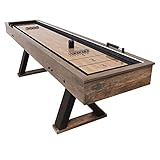 American Legend Kirkwood 9 Foot Shuffleboard Table American Legend Kirkwood 9 Foot Shuffleboard Table |
|
Check Latest Price |
 Barrington Urban 9 Foot Shuffleboard Table Barrington Urban 9 Foot Shuffleboard Table |
|
Check Latest Price |
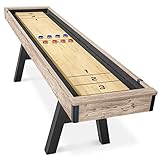 GoSports Premium 9 Ft Shuffleboard Table GoSports Premium 9 Ft Shuffleboard Table |
|
Check Latest Price |
| Hathaway Excalibur 9-Ft Shuffleboard Table |
|
Check Latest Price |
 Hathaway Merlot 12-Ft Shuffleboard Table Hathaway Merlot 12-Ft Shuffleboard Table |
|
Check Latest Price |
 Playcraft Georgetown Shuffleboard Table Playcraft Georgetown Shuffleboard Table |
|
Check Latest Price |
 Hathaway Challenger Shuffleboard Table Hathaway Challenger Shuffleboard Table |
|
Check Latest Price |
 Barrington 12 Ft Solid Wood Shuffleboard Table Barrington 12 Ft Solid Wood Shuffleboard Table |
|
Check Latest Price |
144 in L x 24 in W x 31 in H, 350 pounds
1.75 inch vertical stave butcher block
Pro-style climate adjusters
This is the 12 foot configuration of the Woodbridge, and it measures 144 by 24 by 31 inches at 350 pounds. The playfield is 1.75 inch true vertical stave butcher block sealed with multiple coats of satin polyurethane, which is the construction detail that matters most in a basement. Stave construction, not laminated strips, means the board has far fewer glue lines for moisture to attack.
The base is where the real basement engineering sits. Reinforced double-paneled arched pedestal legs carry 6 inch metal levellers, and pro-style climate adjusters let you shape the playfield after it settles. Owners regularly call out the levellers and adjusters as the reason the table stays playable on an uneven floor.
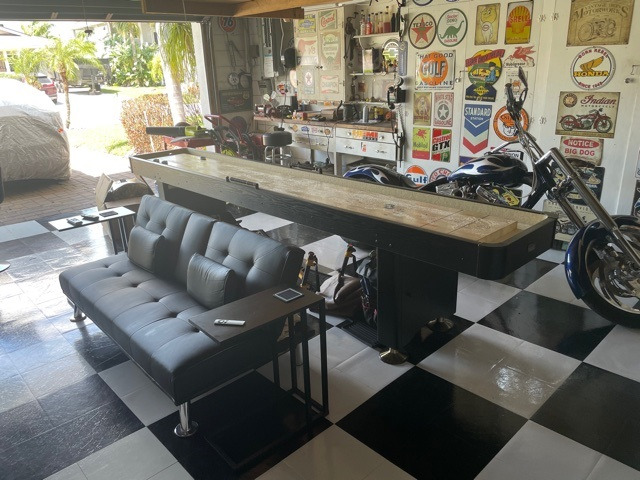
Everything arrives with the table: 8 deluxe pucks, a matching abacus, a brush and USA-made speed wax, and the in-leg storage cabinet keeps all of it off the concrete. Nothing has to be bought separately to play on day one, which matters when the nearest supply store is a long drive from a basement.
There is a one year manufacturer warranty, longer than the 180 day coverage on some cheaper models. The height is a genuine advantage in a low-ceiling space: at 31 inches tall you can walk over the table end, and a 7 foot ceiling still leaves usable air above it.
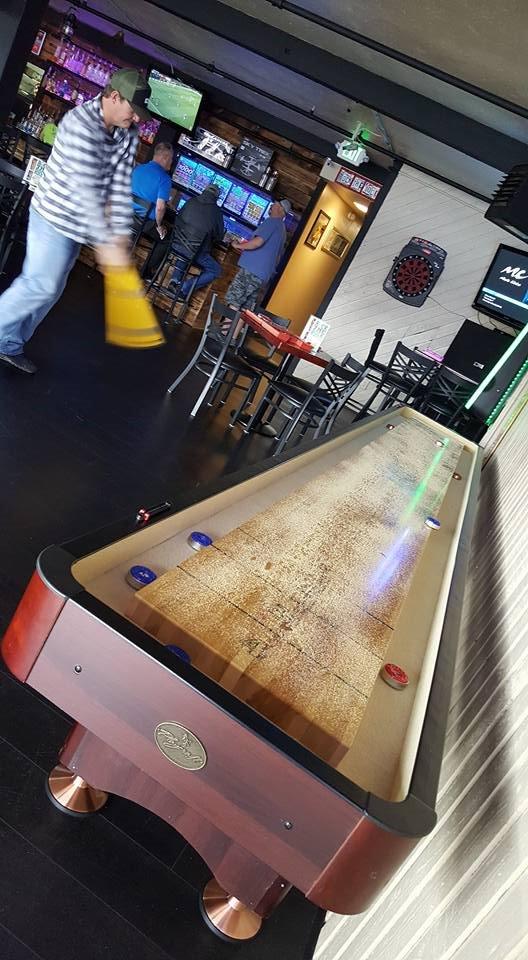
A 1.75 inch vertical stave board with a satin polyurethane seal is among the most resistant playfields in this group. Combined with pro-style climate adjusters, it gives you two separate controls: the adjusters shape the surface, and the thick sealed stave resists the seasonal bow that flattens thinner boards.
The board is also available in 9, 12, 14 and 16 foot lengths. If your basement wall is shorter than 12 feet, the same playfield and adjuster package is available in a footprint that fits, and the 14 and 16 foot versions are available as two pieces.
At 350 pounds, this is not a two-person carry down a stairwell. Plan on professional in-home delivery with the move-in included, and measure every turn on the route before you order.
If the 2-piece design matters to you because of a difficult access route, note that it is only offered at 14 and 16 feet. The 9 and 12 foot versions arrive as single units.
108.25 x 24.25 x 31 inches, 156 pounds
Poly-coated playing surface with 8 feet of play
At 156 pounds this is the table you can actually carry down a basement staircase with one other person. It measures 108.25 by 24.25 by 31 inches and gives you 8 feet of playable surface inside a 9 foot frame, which fits a rec room wall that will not take 12 feet.
The LED rails are the reason this table shows up in finished basements, where lighting is usually a single overhead fixture on a dimmer. Abacus-style scoring sits at one end, and the box includes 8 pucks in red and blue plus a canister of shuffleboard wax.
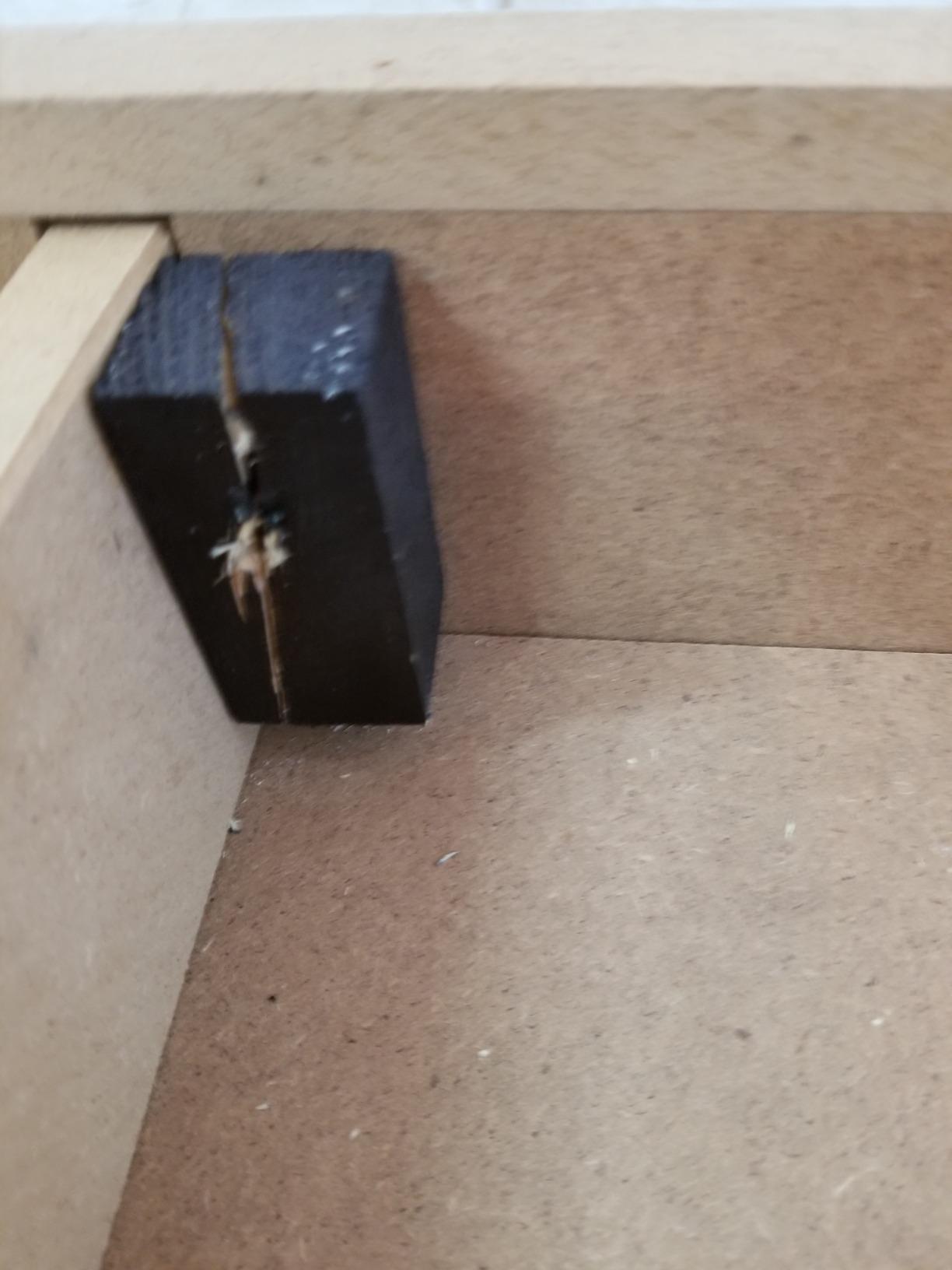
Owners mostly describe it as an easy and affordable way into full-size table shuffleboard, and many report the surface measured square and true once levelled. Pedestal legs with levelers take out the rock on a basement slab, and the frame holds rigid even when kids lean on the rails.
Two adjustments matter before first play. The included sand runs very fast on a 9 foot board, so most owners swap in slower granules, and the bundled pucks are larger than ideal at this length, with medium pucks fitting the surface better.
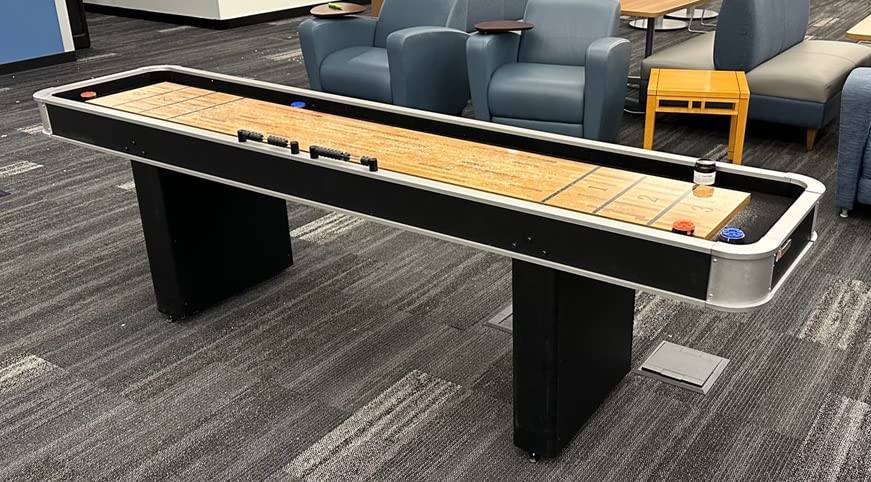
The frame and playfield are pressed particle board under an oak veneer rather than solid wood. It is the reason the table weighs so little and assembles quickly, and the reason the playfield is roughly half the thickness of the butcher block boards elsewhere in this list.
Damage on arrival is the other recurring theme in the reviews. Inspect the carton on arrival and photograph any chipped corners before assembly, because the frame is the first thing to crack.
Buy this one if your basement has a short wall, a narrow stairwell and a fixed spending limit. It is the least stressful table in the group to move into a space that is hard to reach.
Skip it if you plan heavy daily play or share the table with kids who throw pucks. The playfield coating is the first part to show wear on this build.
108 x 24.02 x 32.09 inches, 198 pounds
LED rails plus a full bowling set
The Kirkwood is a 9 foot table at 108 by 24.02 by 32.09 inches and 198 pounds, and it doubles as a bowling game. The box includes 8 chrome weighted pucks, 10 bowling pins, a pin setter and a bowling surround, so a basement rec room gets two games out of one footprint.
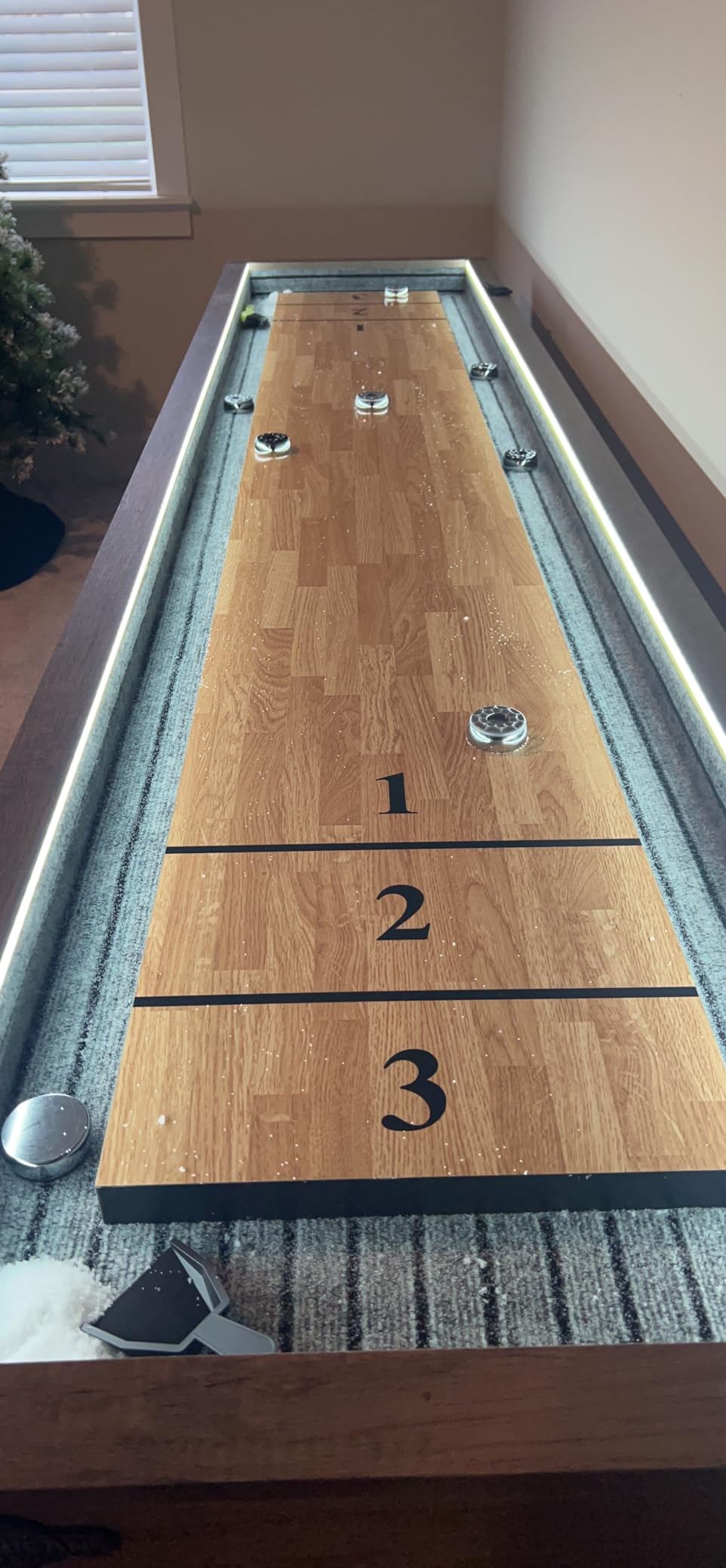
LED light-up rails run off an AC adapter and give the cabinet an arcade look against a wood grain finish. Grey carpeted gutters and K-shaped signature legs make it read as furniture rather than bar equipment, which matters if the basement is finished.
The weakness is durability. At a 3.9 average with 18 percent one star reviews, this is among the least well-regarded tables in the group, and the complaints cluster on the same two things: a metal frame that feels less substantial than solid wood cabinetry, and a top finish that peels or chips at the edges after limited use.
The 30 day warranty is the shortest here. A surface that runs slick until it is seasoned with powder adds a second adjustment step in a damp room, where humidity already changes how the pucks track.
Family basements with mixed-age kids get the most out of this table. Shuffleboard alone can stall out with a big group, and the bowling set keeps the same cabinet useful for a second game without a second table against the wall.
The pins, setter and surround are all included, so there is no extra purchase. Budget room for the bowling surround, which sits around the far end of the table.
Basements with heavy weekly use will show the edge peeling and finish wear that buyers already describe. A 30 day warranty gives you no recourse if the top separates a month after assembly.
If your priority is a surface that stays flat through a humid winter, look at a thicker playfield with a sealed finish rather than a poly-coated top on a metal frame.
108 x 24 x 32 inches, 185.2 pounds
1.5 inch UV-coated engineered wood playfield
The Urban measures 108 by 24 by 32 inches at 185.2 pounds, with a 1.5 inch UV-coated engineered wood playfield. What separates it from the other budget tables is the leveling package: 1.5 inch hidden leg levelers plus under-table climate adjuster wing bolts.
That combination is the direct answer to an out-of-level basement slab. The leg levelers lift the cabinet, and the wing bolts reshape the playfield once the frame is sitting where you want it. Owners single these out as the reason the table works on uneven floors.
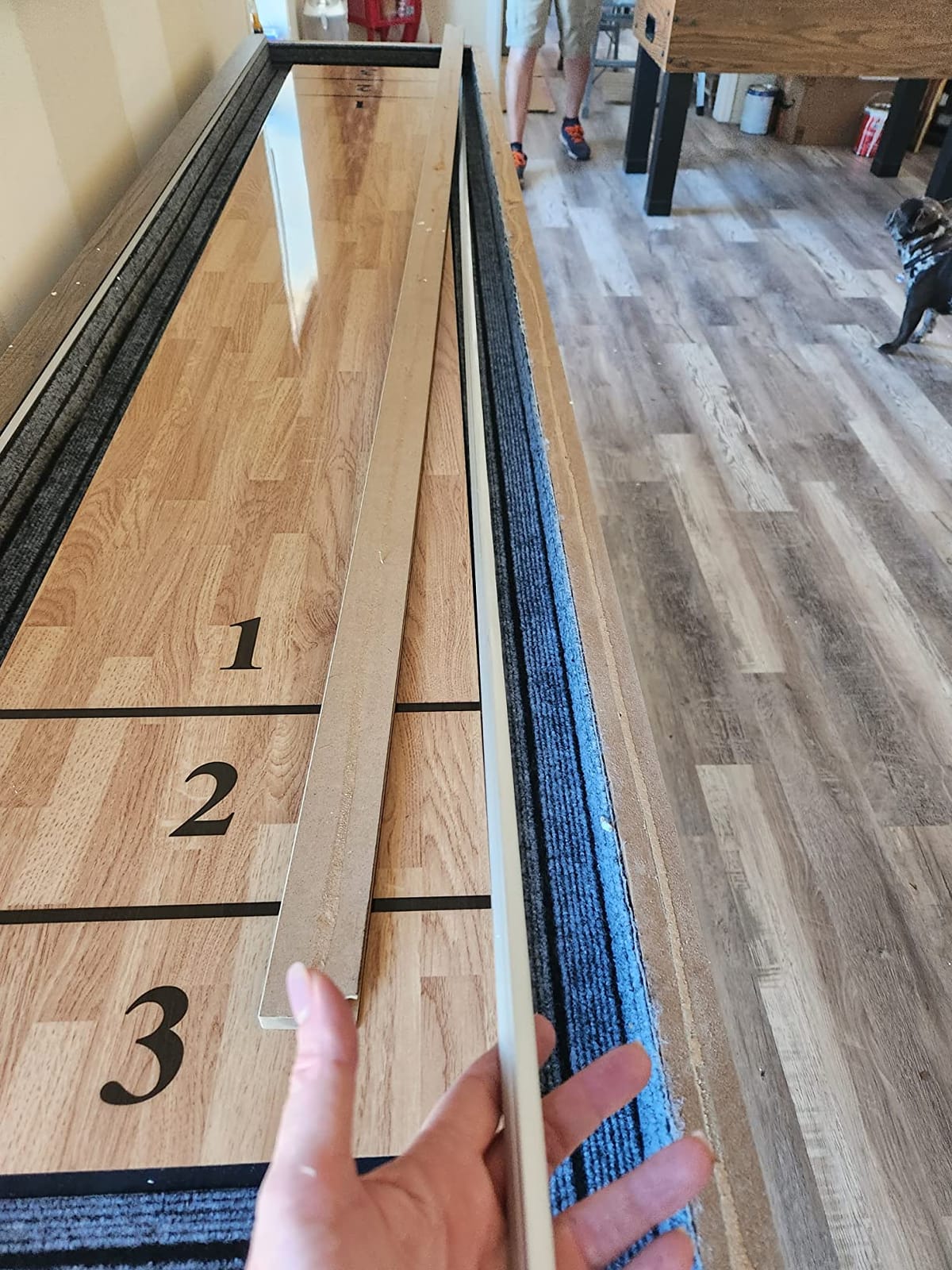
Carpet-lined gutters and side walls cut the noise, which is a genuine benefit in an enclosed room where sound carries into the rest of the house. Two bead-style slide scorers come mounted, and shuffleboard speed powder and both four-puck sets are in the box.
Assembly is short because the playfield mainframe arrives preassembled, so the work is attaching legs and the crossbar. The manufacturer recommends a 13 by 6 foot room for movement around the table, which is a useful number to check against your basement before you commit.
Most tables at this size give you leg levelers or adjusters, not both. Having both means you can correct the floor first and the playfield second, which is the sequence that actually works on a sloped slab.
The carpet-lined gutters do double duty. They quiet play and they protect the playfield edges, which is where poly-coated surfaces usually show their age.
The playfield is engineered wood and the legs and crossbar are MDF with a faux concrete finish. That is furniture-grade construction, and it will not match the feel of a solid stave butcher block board under a heavy hand.
The warranty runs 90 days. Some owners also upgrade the included speed powder for slower granules once the basement warms up in summer.
108.7 x 24 x 32.3 inches, 180.8 pounds
8 ft x 14 in play surface
The GoSports table is 108.7 by 24 by 32.3 inches at 180.8 pounds, with an 8 foot by 14 inch play surface. It arrives pre-assembled with video instructions, and the only assembly step is attaching the legs, which matters when your building window is a weekend.
Powder coated steel legs carry built-in levelers, and owners point to those levelers as the practical advantage on uneven floors. A rustic oak finish on the frame keeps it looking like furniture in a finished basement rather than warehouse equipment.
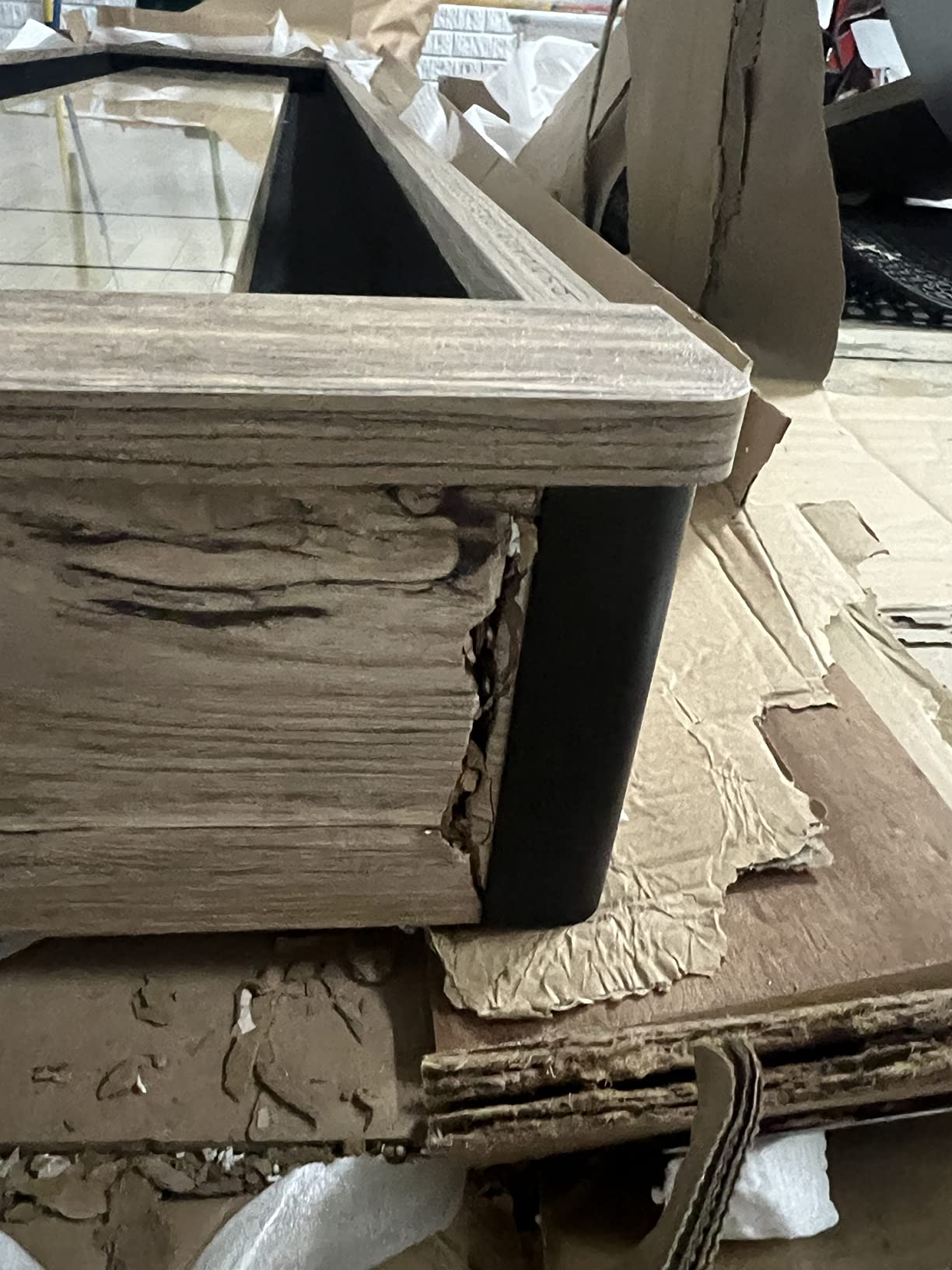
The box includes 8 regulation metal pucks at 1.75 inch diameter, 16 oz of sand-like shuffleboard wax, a brush and built-in score trackers. Nothing to add before the first game.
The catch is the honest spec: the frame is sold as 9 feet but the usable play surface is 8 feet. That changes scoring strategy compared with a table where the playfield runs nearly the full frame length, so set expectations before anyone chalks a number on the abacus.
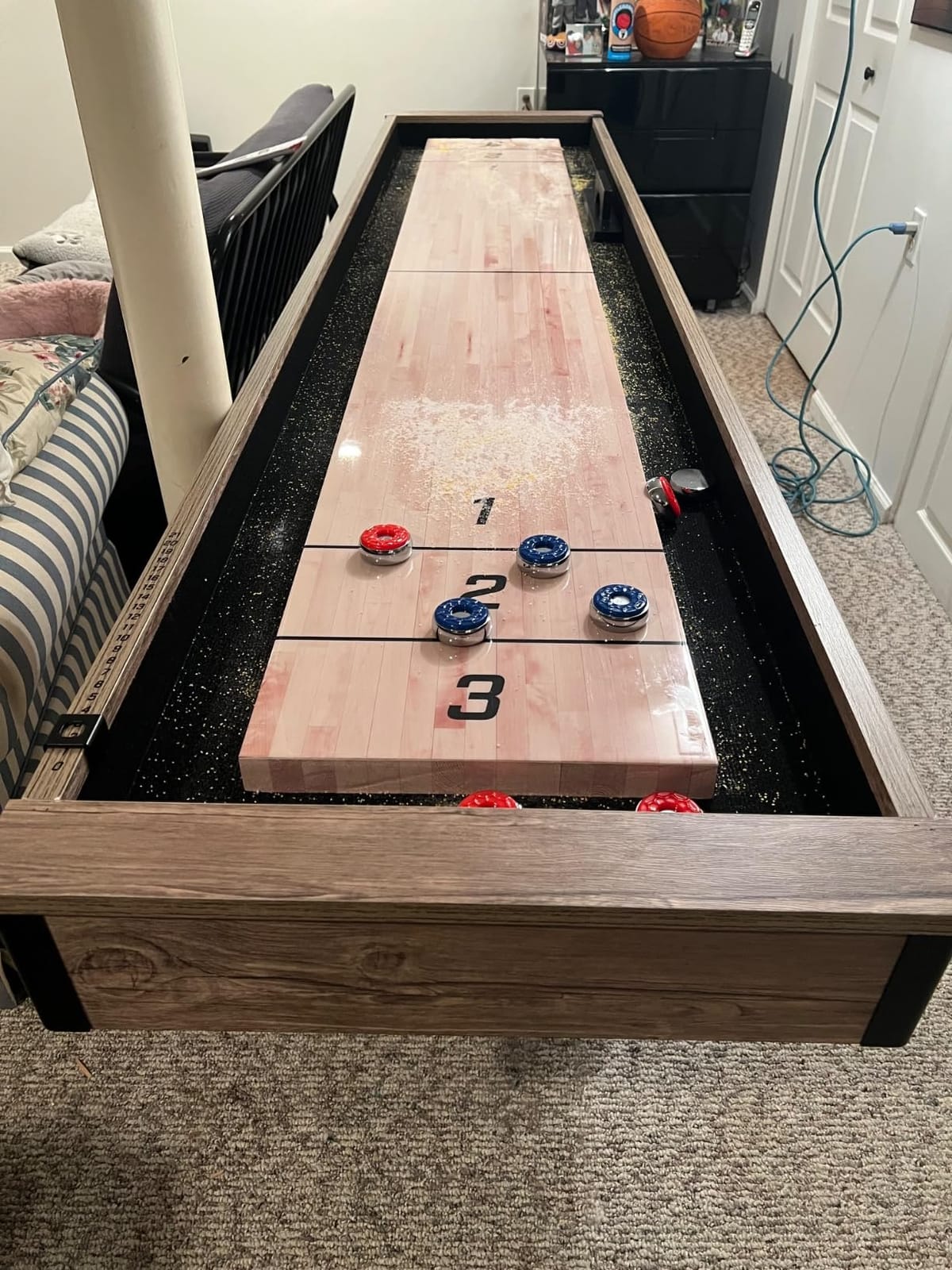
An 8 foot play surface on a 9 foot frame means the scoring zones occupy a smaller share of the table. Games finish faster, and the margin between a well-placed puck and a good one is narrower than on a full-length board.
For family play that is a feature, not a flaw. Shorter games suit mixed groups where two or three players get a turn without a long wait.
There is no storage cabinet, so pucks, wax and brush live in whatever bin you put them in. In a basement that already needs shelving, that is worth checking against our heavy duty storage rack picks.
The warranty is six months, and the playfield is composite rather than solid hardwood, so it will not develop the same patina as a butcher block board over years of use.
108 x 24.25 x 30 inches, 202.4 pounds
Four concealed leg levelers
The Excalibur is listed for basements and rec rooms at 108 by 24.25 by 30 inches and 202.4 pounds. Thirty inches tall makes it the lowest profile here, which is the number that matters if your basement joists hang low or you have ductwork across the ceiling.
Four concealed adjustable leg levelers are specified for uneven concrete, tile or hardwood floors, and families pick this table out for exactly that reason. X-pattern legs with a black support bar carry the load, and dual abacus scorers mount on both sides so players can score from either end.
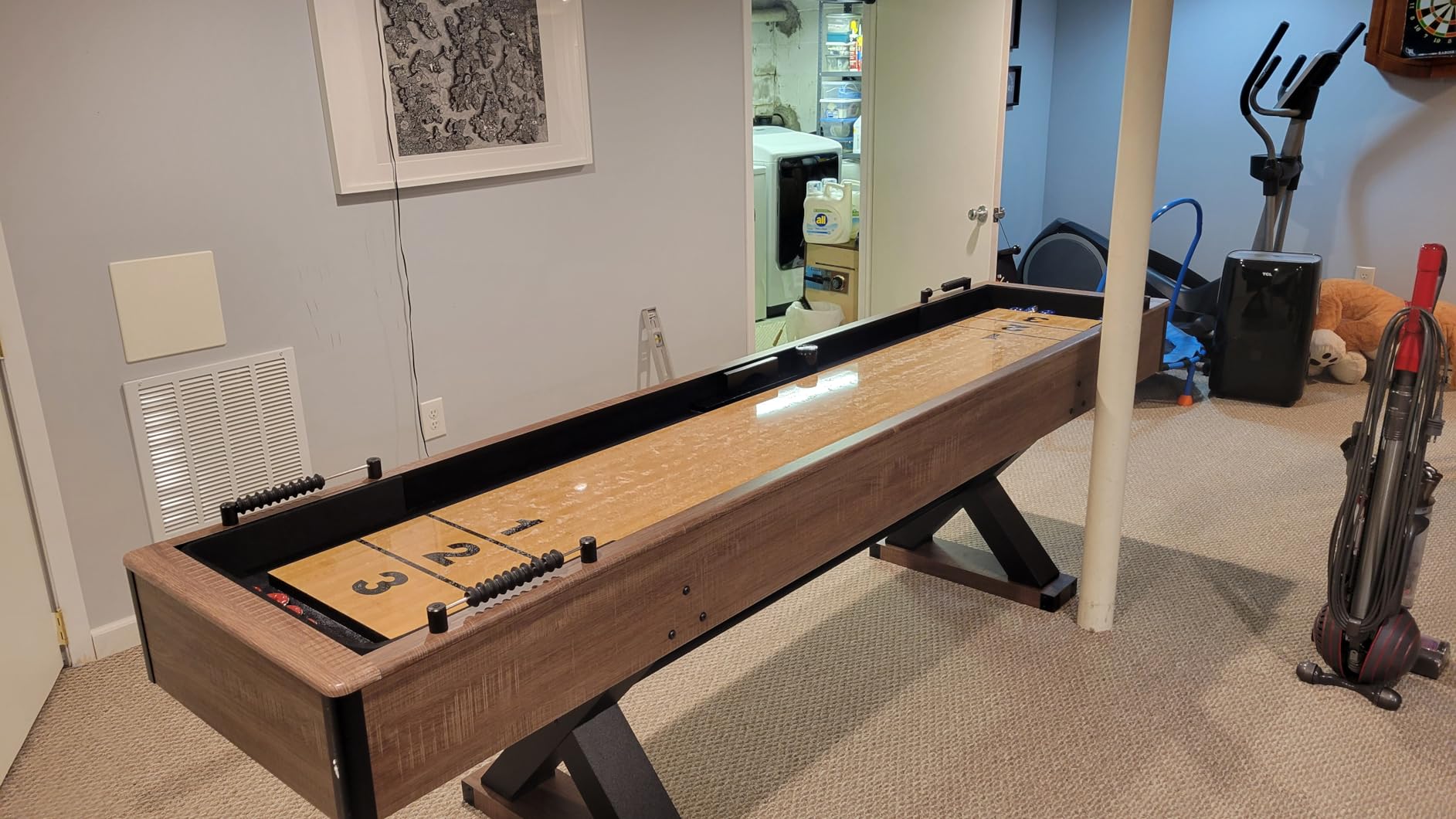
Carpeted gutters run along both sides to catch stray pucks quietly, which matters in a basement where the next room is a bedroom. The box includes 8 pucks, two ABS abacus scoring units, a brush and shuffleboard powder, backed by a 180 day limited warranty with US support.
The recurring complaint is usable length. Owners measure about 7.5 feet of playing surface on a 9 foot frame, so this plays shorter than the headline number and you should set your family scoring rules around that.
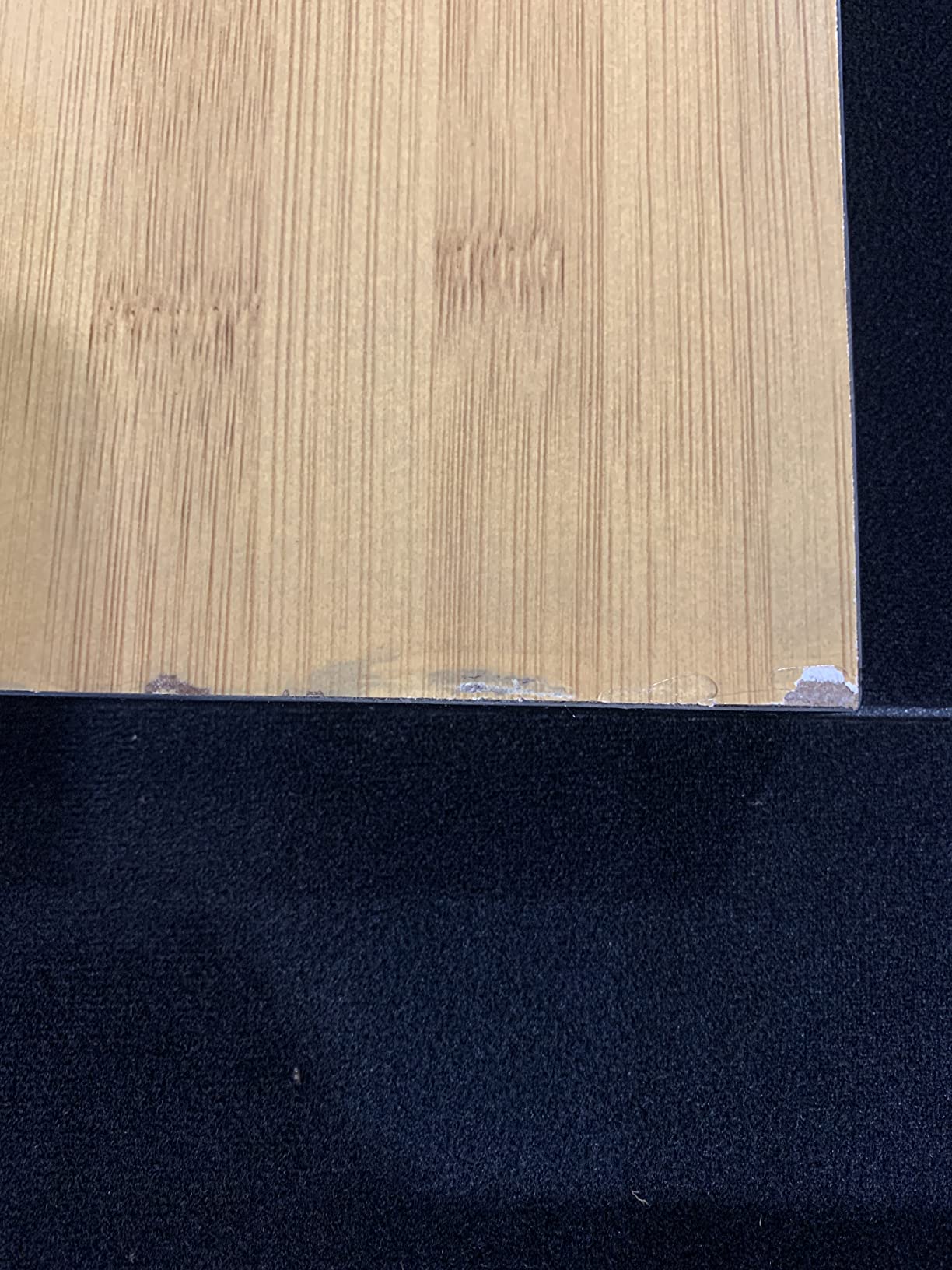
At 30 inches, the Excalibur sits at the low end of the height range in this group. In a basement with exposed beams or a low duct run, that lower profile is the difference between a table you can stand beside easily and one you work around.
Families also like the learning curve. Shuffleboard needs no stance and no cue, so mixed-age and mixed-skill groups can play within minutes of unboxing.
The poly-coated melamine playfield can chip or peel at the edges, especially with overthrown pucks. Many owners substitute medium speed granules and silicone spray because the included sand runs fast.
Reviewers also caution that edge wear shows quickly in semi-public or all-ages play. For heavy weekly use in a shared basement, a thicker playfield is the safer bet.
144.5 x 24 x 31 inches, 268 pounds
1.75 inch solid birch butcher block playfield
The Merlot is 144.5 by 24 by 31 inches at 268 pounds, and it gives you an 11 foot by 15 inch playfield inside the 12 foot frame. That near-full-length playfield is the reason serious players end up here: longer slides than a 9 foot board, fewer dead zones, more room to read the shot.
The playfield is 1.75 inch solid birch butcher block finished with 10 layers of lacquer, which is a hard, scratch-resistant gloss surface. Built-in climate adjusters and 1.5 inch leg levelers are both standard, so you can correct the floor and then shape the surface after it settles.
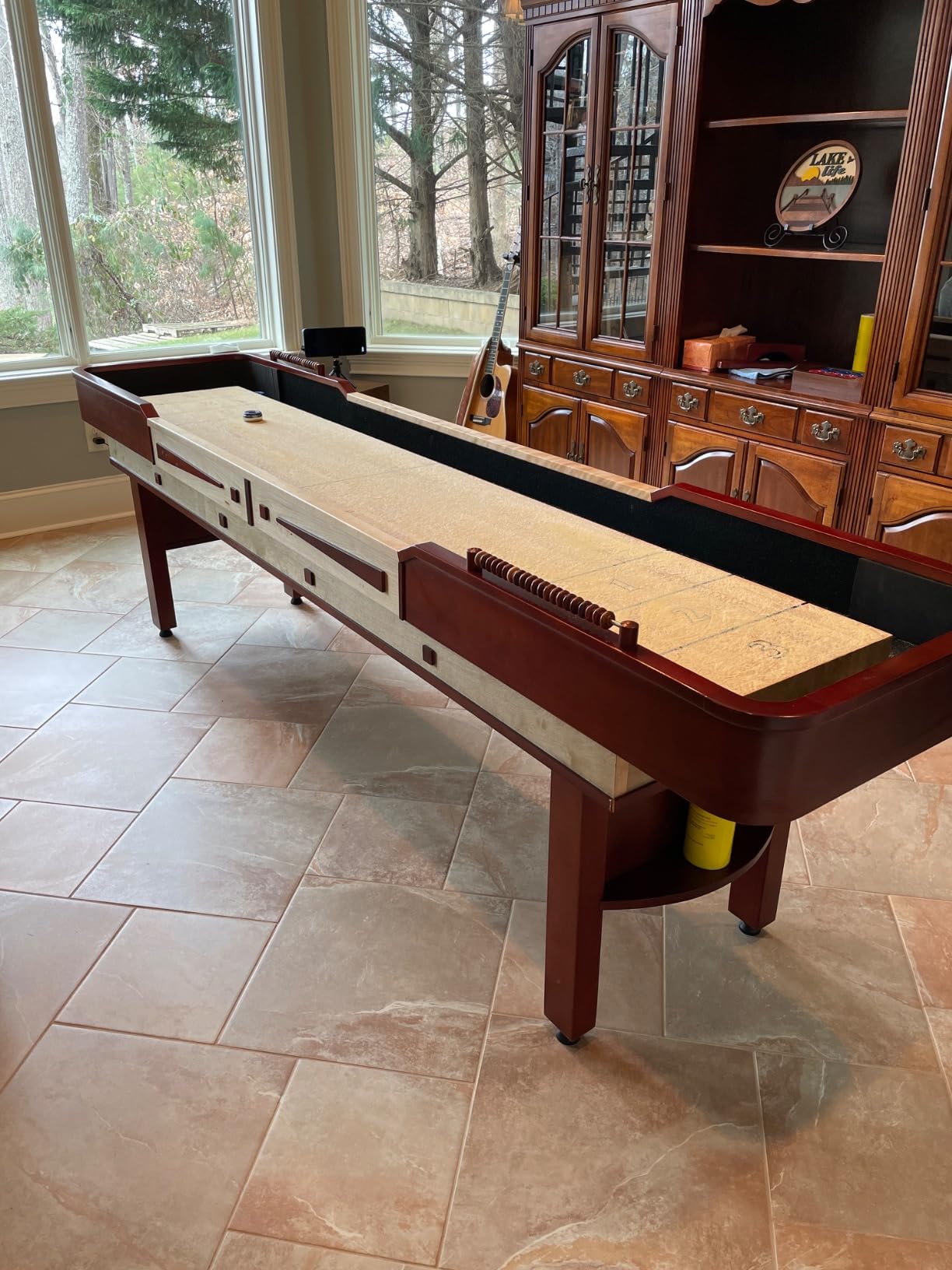
EVA foam-padded gutters cushion pucks and cut noise, which is the specific advantage in an enclosed basement. Dual abacus scorers with wood bead tracking sit at both ends, and a built-in under-table storage shelf holds pucks and the brush. The box includes 8 pucks, a can of wax and a table brush.
Solid 1 inch wood side and end aprons with double-paneled legs make this feel like furniture in a finished room, and the warranty is 180 days with US based support.
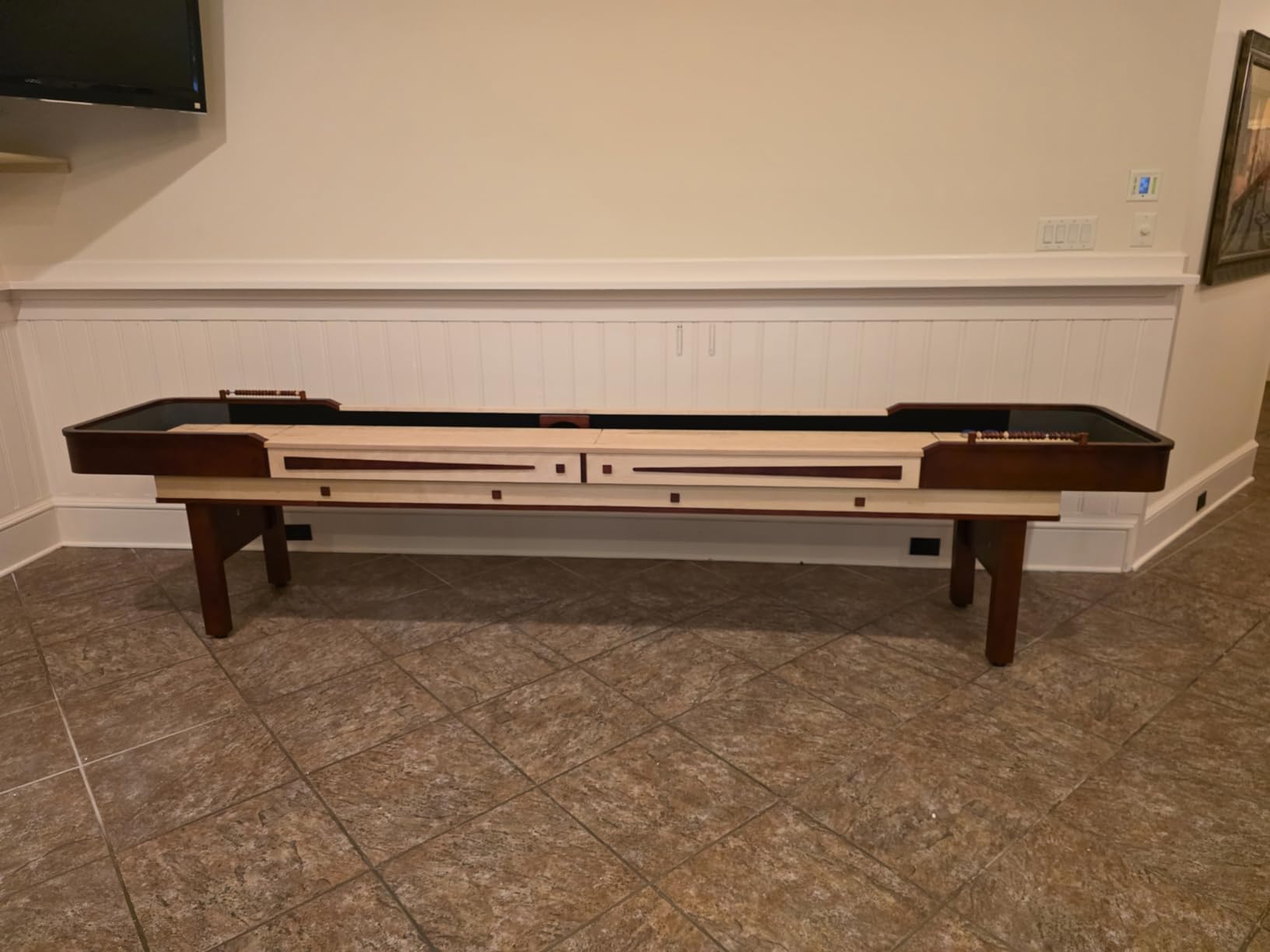
An 11 foot playfield gives pucks a long, straight run and a scoring area that rewards weight control. Families that have played a 9 foot table and outgrown it usually describe the jump to 12 feet as the point where the game becomes competitive.
The birch playfield with ten lacquer layers is also the more forgiving surface in this group. Lacquer is harder than a poly coat, so edge chips and finish wear happen later.
Buyers consistently call out size and weight as the only real caveat. Moving a 12 foot table down a basement stairwell needs multiple people and careful planning of every turn, and the tightest doorway is usually the deciding factor.
Wax speed also needs retuning for the longer playfield. Expect to buy slower granules rather than running the included wax out of the can.
192 x 25 x 31 inches, 345 pounds
1.75 inch vertical stave butcher block
This is the Georgetown in its largest listed configuration at 192 by 25 by 31 inches and 345 pounds. The rating here is the highest in the group, and the reason is consistent across owner reviews: the 1.75 inch true vertical stave butcher block playfield arrives straight and needs minimal adjustment.
The frame matches it. Reinforced double-paneled arched pedestal legs carry 6 inch metal levellers, and pro-style climate adjusters handle playfield shaping after the cabinet is placed. Owners frequently say the quality rivals tables costing several times more.
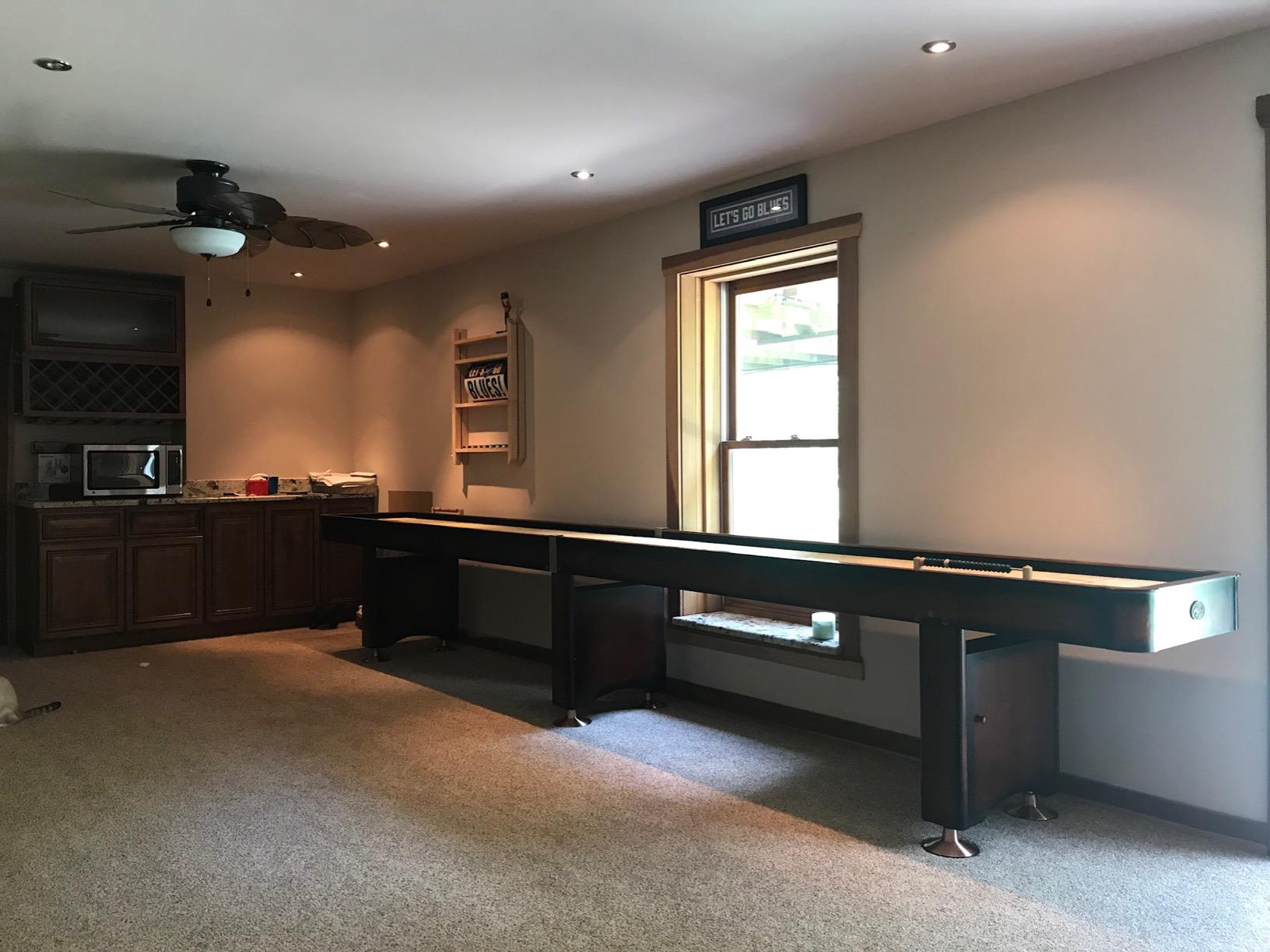
A hand-stained burnished finish gives it a furniture-grade look that suits a finished rec room, and the in-leg storage cabinet keeps 8 deluxe pucks, the matching abacus, a brush and USA-made speed wax out of sight. Customer service is praised for replacing damaged tops and legs quickly.
Two practical notes from owners. Reaching the climate adjusters on some models means removing the playfield screws, and that step is not in the instructions, so have a screwdriver ready. The included tool is generally considered useless, so a socket set makes assembly easier.
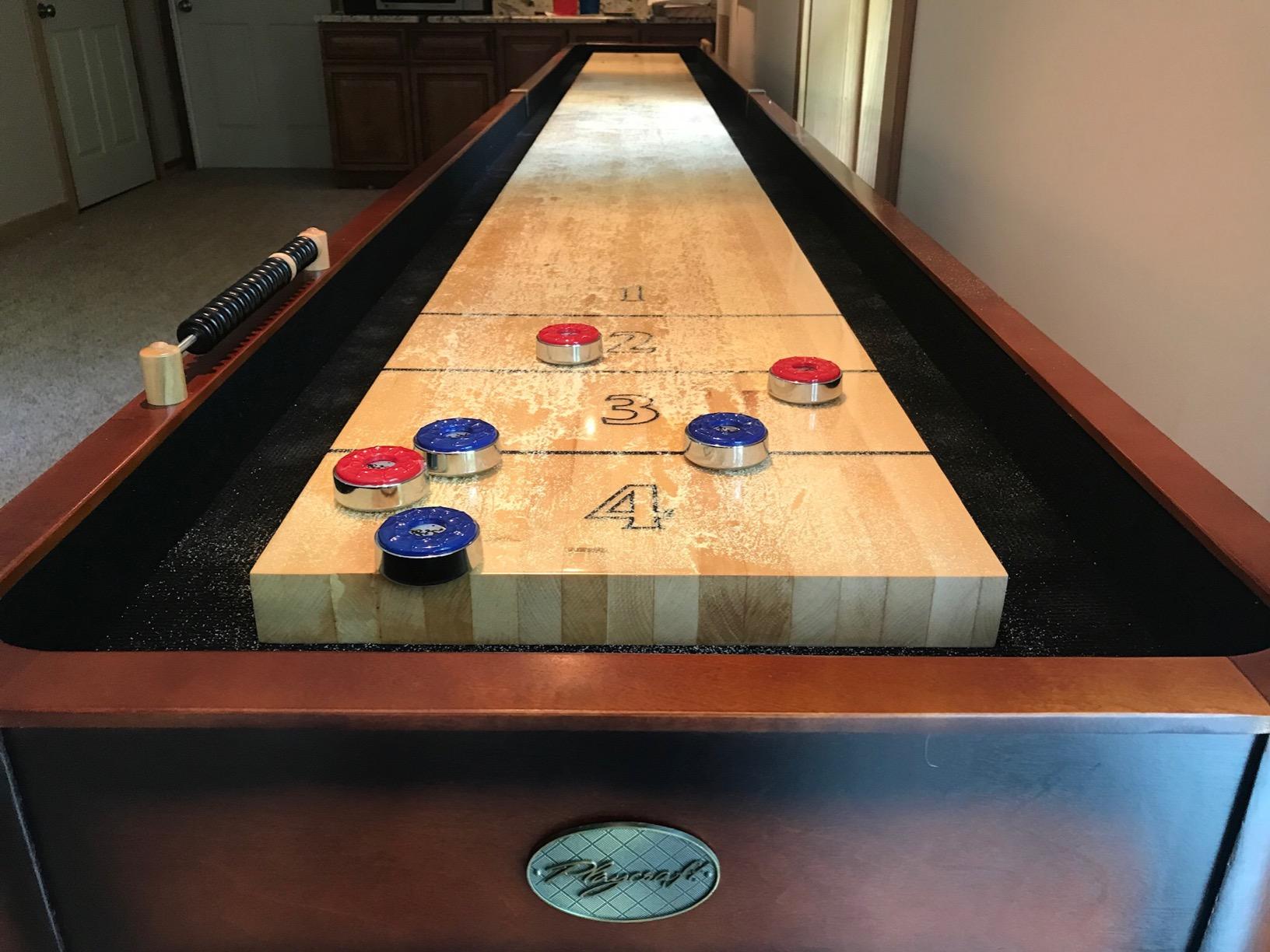
The Georgetown can be ordered as a 2-piece design in 14 and 16 foot sizes specifically for small or hard-to-access spaces. For a basement with a narrow stairwell or a low doorway, that option removes a lot of risk from the delivery.
It is not offered at 12 feet, so buyers whose route requires a split cabinet need to size up to 14 or 16 rather than down to 12.
At 345 pounds and full cabinet width, this is the hardest table here to move. Owners report three or more people for stairs, and any route with a 90 degree turn at the bottom needs measuring first.
Occasional reports of stripped screws or a cracked leg arriving out of the box are worth mentioning to a retailer before the packaging is discarded.
144 x 24.25 x 30.5 inches, 180 pounds
1.5 inch finger-jointed butcher block
The Challenger gives you a 12 foot footprint at 144 by 24.25 by 30.5 inches and only 180 pounds, which makes it the lightest of the 12 foot options in this group. For a basement with a long wall and a difficult stair, that weight difference is the deciding factor.
The playfield is 1.5 inch finger-jointed hardwood butcher block with a durable poly finish, and the table includes built-in climate adjusters plus 6 inch leg levelers. Dual abacus scorers and carpeted gutters are standard, and the walnut laminate cabinet has antique bronze hinges with integrated storage.
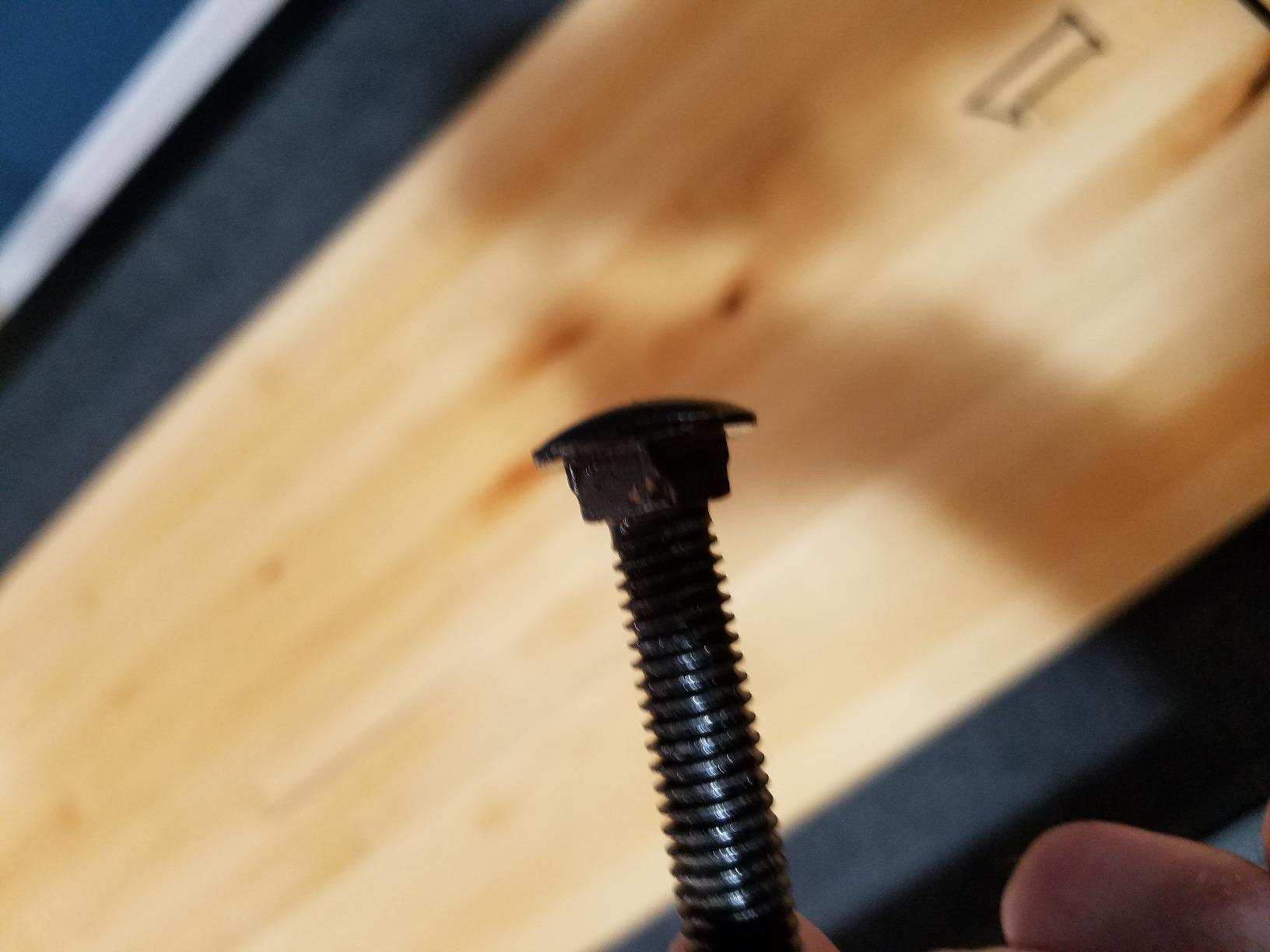
Opinion on this table is sharply split, and the split is explainable. Buyers who level the legs before attaching them and swap in slower wax report a table that looks professional and plays well, and the play surface often arrives already concave and level.
The one-star reviews focus on hardware. Carriage bolts supplied do not fit the round, undersized holes in the legs, there are no pre-drilled holes for the abacus rods, and the climate adjusters can arrive loose or unattached with unclear instructions on removing the underside screws.
Buy better furniture bolts than the supplied carriage bolts. The legs have round, undersized holes that the included hardware will not seat in properly, and forcing them leaves the cabinet loose over time.
Drill the abacus rod holes yourself slowly. There are no pre-drilled holes, and forcing a rod into hardwood is how owners split the wood at the scoring end.
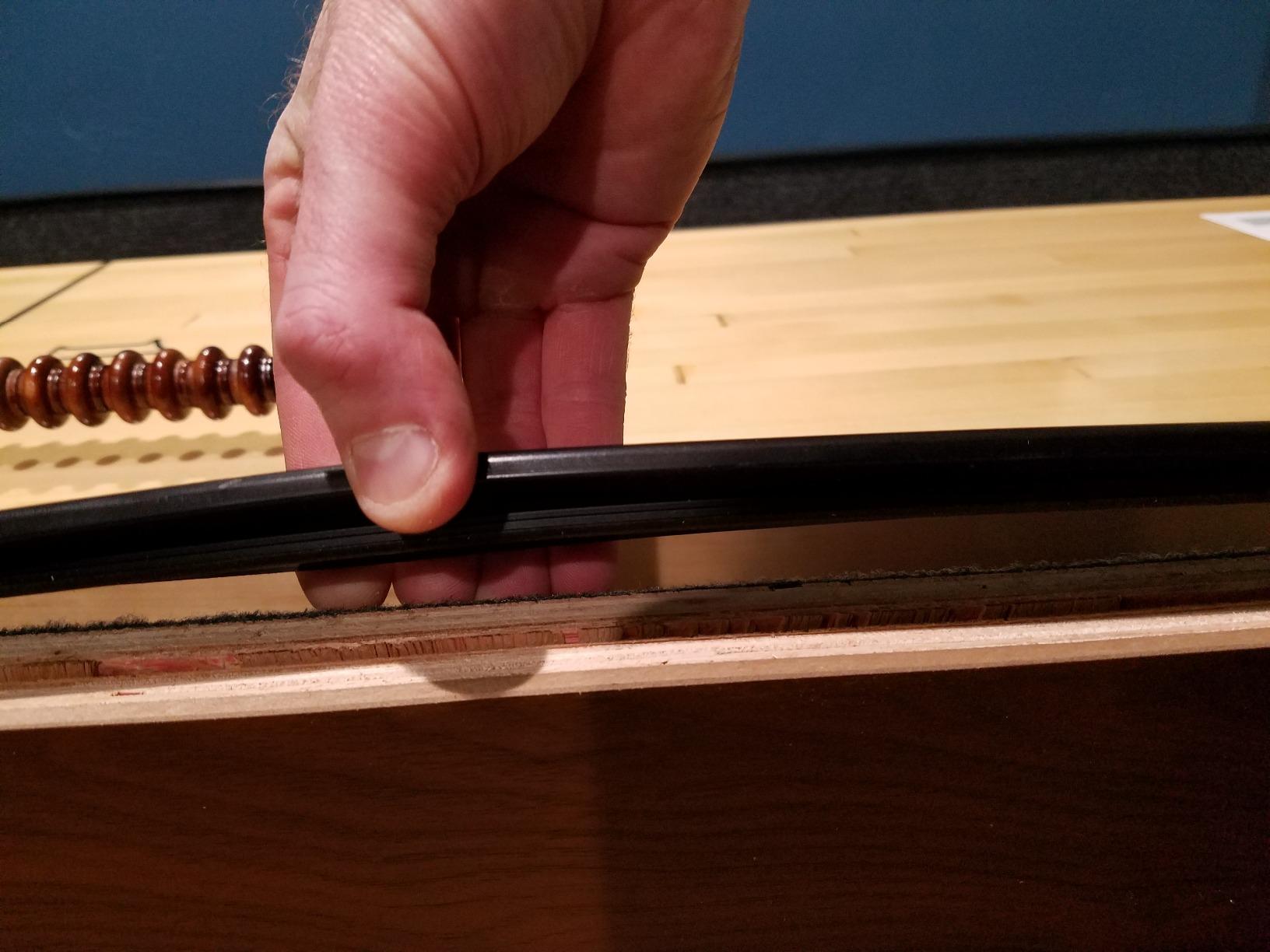
The cabinet is MDF in walnut laminate with reinforced plywood corners, and the rail rubber is not glued down. Veneer peels and glued joints are the most cited durability complaints in the reviews.
Several owners also question whether the board can be fully flattened with the supplied adjusters. If your floor is badly out of level, the Barrington Urban or Playcraft lines are safer choices.
144 x 24.5 x 32 inches, 305.8 pounds
1.75 inch solid wood poly-coated playfield
This Barrington is 144 by 24.5 by 32 inches at 305.8 pounds, with a 1.75 inch solid wood poly-coated playfield. The playfield is among the best-specified surfaces at this size in the group, and the top rail is solid wood rather than veneer for a furniture-grade edge.
What you cannot get elsewhere at this length is storage. The pedestal leg cabinets are real cabinets, with bracket-hinged doors and a shelf in each one, which in a basement beats stacking wax cans and brushes on the concrete.
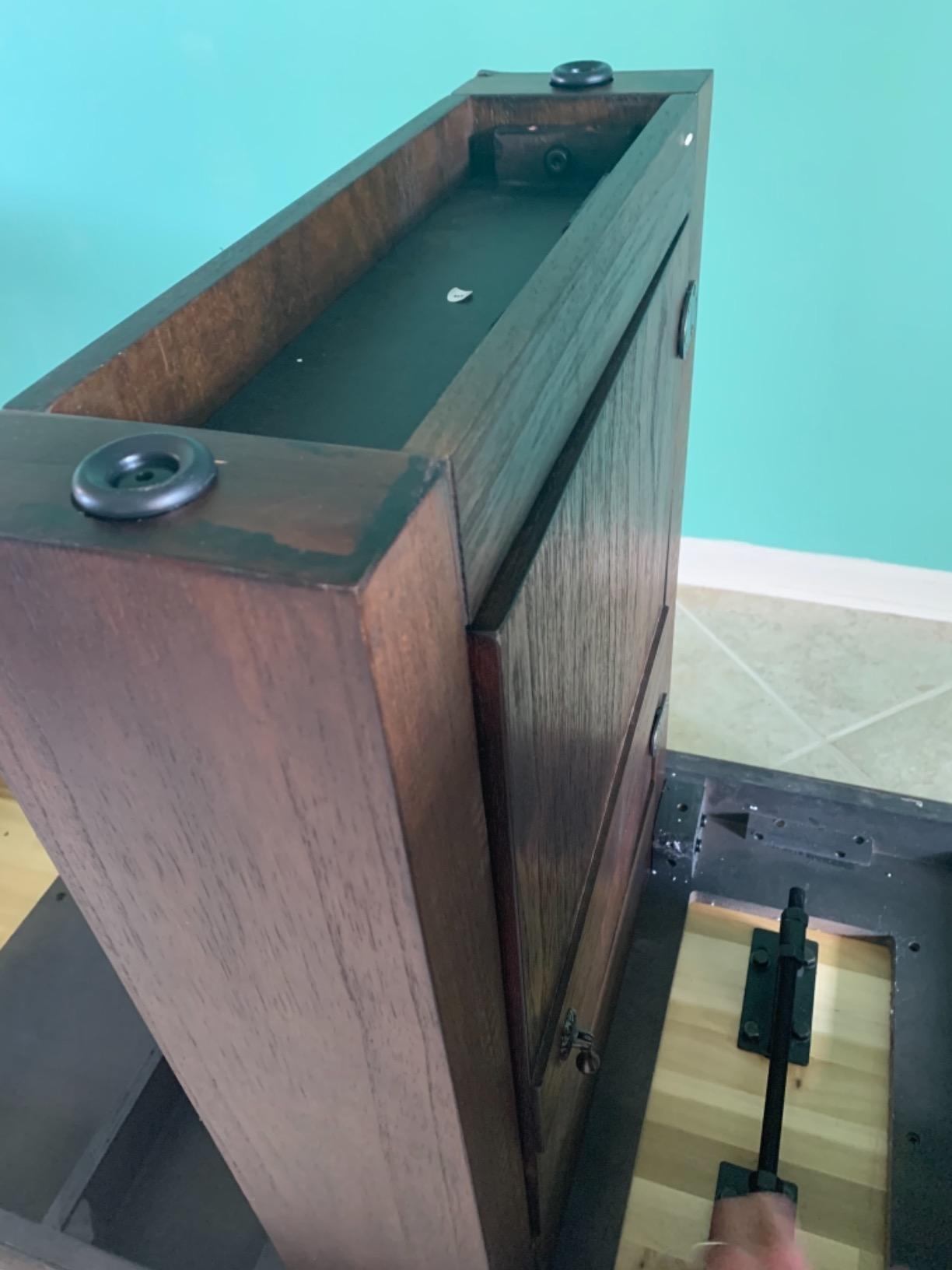
The playfield mainframe arrives preassembled, so assembly is legs, apron and cabinetry rather than building a bed from parts. Two wood bead-style slide scorers mount at the ends, and carpet-lined gutters and side walls keep the noise down in an enclosed room.
Review sentiment here is the most divided of any table on the list: 66 percent five star against 25 percent one star. Owners who receive a level unit love the playfield and the storage. The one-star reviews describe cabinet hardware failures, a support block that detaches during assembly, and at least one unit whose playfield could not be levelled at all.
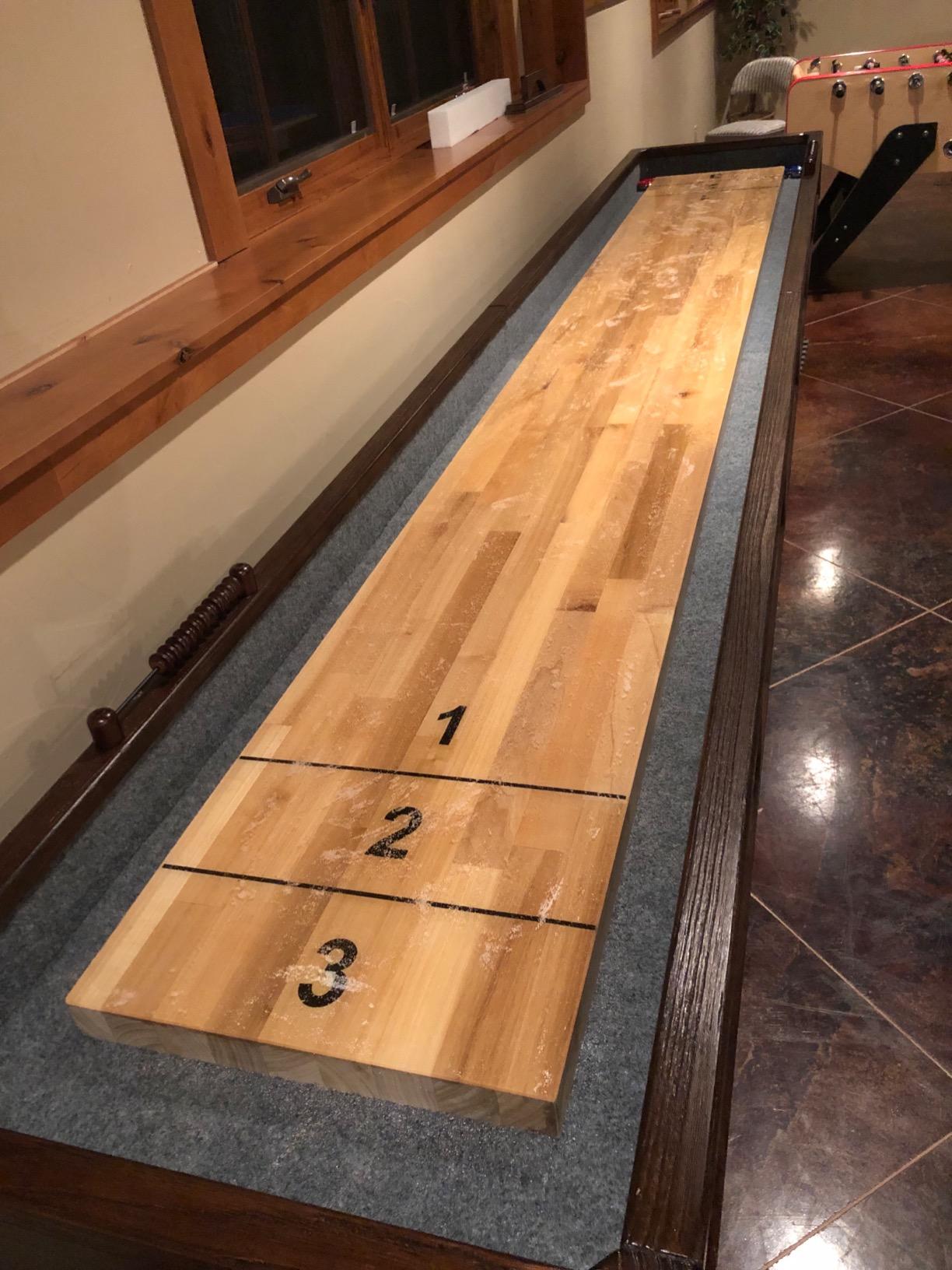
A 12 foot table with no storage pushes pucks, powder, silicone and brushes onto a floor that may be damp. Bracket-hinged pedestal cabinets with a shelf each solve that and keep the accessories off the concrete.
Hidden 1.5 inch leg levelers and under-table climate adjuster brackets are both fitted, so this table can be corrected on an uneven slab, the same advantage the 9 foot Urban offers at a smaller size.
Owners report 400 to 600 pounds including the pallet, and some spend more than four hours on assembly after over an hour of unpacking. Arrange in-home delivery with assembly, and confirm the crew will carry it to its final position rather than to the basement door.
The surface also runs very slippery until it is properly seasoned with silicone spray and slower powder, and the warranty is only 90 days.
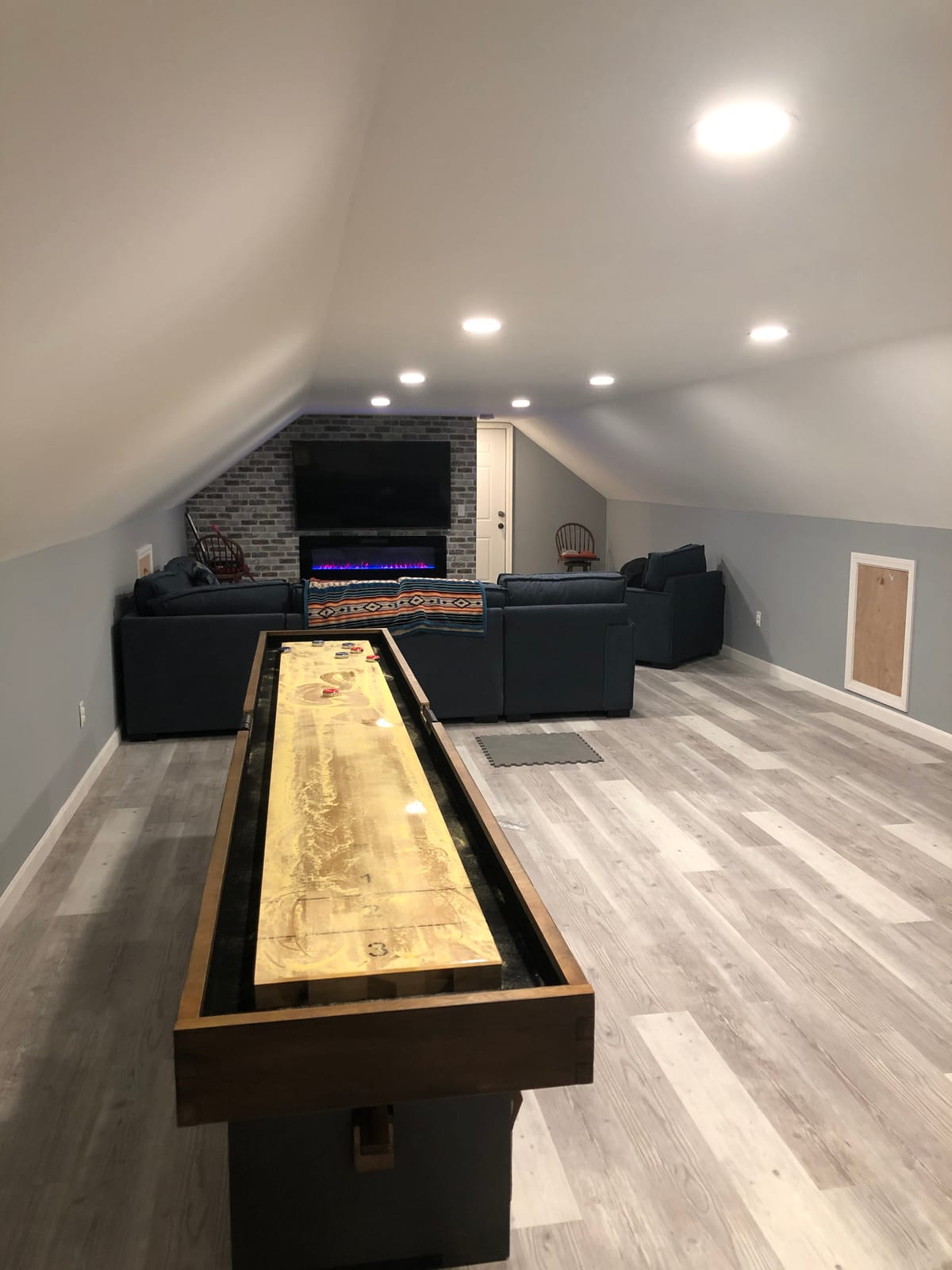
For most basements, 9 feet is the practical ceiling and 12 feet is the stretch goal. The industry rule is roughly 3 feet of clear floor at each end for players to stand and shoot, and about 30 inches of walking room along the sides. A 9 foot table therefore needs a room of roughly 13 by 6 feet; a 12 foot table needs closer to 16 by 6 feet.
The Hathaway Excalibur manufacturer recommends a 13 by 15 foot room, which is worth respecting if your basement also holds a sofa. Barrington gives 13 by 6 feet for the 9 foot Urban and 16 by 6 feet for the 12 foot model, which lines up with the clearance rule.
Vertical stave and solid butcher block sit at the top. The Playcraft Woodbridge and Georgetown use 1.75 inch true vertical stave boards, and the Hathaway Merlot uses 1.75 inch solid birch, all sealed with lacquer or multiple coats of polyurethane. These are the boards that keep a straight line through a humid winter.
Engineered and composite boards are the value tier. The Barrington Urban uses a 1.5 inch UV-coated engineered wood playfield, GoSports uses a composite butcher block surface, and the Hathaway Excalibur uses a poly-coated melamine top. All three play well, and all three show edge wear sooner in a humid room.
Finger-jointed hardwood, as on the Hathaway Challenger, sits between the two. The joints are glue lines, and glue lines are where seasonal moisture does its work.
Leg levelers correct the cabinet so it sits flat on an out-of-level slab. Climate adjusters correct the playfield itself, reshaping it as temperature and humidity change through the year. In a basement you want both, and the order matters: level the legs first, then shape the surface.
Every table on this list has some form of leg leveling, but only six ship with true climate adjusters: the Playcraft Woodbridge, the Barrington Urban, the Hathaway Merlot, the Playcraft Georgetown, the Hathaway Challenger and the Barrington 12 foot. Those six are the ones to shortlist if your basement is unconditioned or partly finished.
Lacquer and polyurethane seal a surface more completely than a thin poly coat, which is why the two Playcraft tables and the Merlot wear better. Scoring is either a bead-style slide or a dual abacus; the abacus is faster for family play because both sides can keep score at once.
Warranty length is a fair tiebreaker in a damp room. The list runs from 30 days on the American Legend Kirkwood to 180 days on the Hathaway models, and Playcraft lists one year on the Woodbridge. Longer coverage matters when a poly-coated top starts chipping and you want a replacement path.
Yes, shuffleboard can be played on concrete, and a poured basement floor is the normal surface for this kind of table. The concern is not the material but the levelness. A slab that slopes even slightly tilts the cabinet, and a tilted cabinet turns close games into arguments.
Run a 6 foot level along the length of the intended table position and across it, and note any deviation. Then check the basement is dry before the table arrives. If you have not sorted out drainage, our water leak detector picks and window well covers are worth fitting first, because a table stored over a damp patch is a warped table.
Put down a floor mat or rug under the table area. It protects the concrete from wax and silicone residue, gives the levellers something to bite into on a smooth slab, and stops accessories from rolling when a puck goes off the end.
This is the step that decides whether the purchase is pleasant or a weekend of regret, and it takes about ten minutes to measure. Do it before you order, not the morning the truck arrives.
1. Measure the basement door or bulkhead opening at the narrowest point, at both the top and the bottom of the frame. A closed door with hardware on the floor side can cost you an inch that matters.
2. Measure the stairwell width at the tightest point, and measure the turn at the bottom where the crew has to pivot from the stairs into the room. A straight run is easy; a 90 degree turn at the base is where tables get wedged.
3. Measure ceiling height at the bottom of the stairs and in the room itself. Anything over 36 inches of headroom on the diagonal lets a table stand up on end and turn, which is how most tight deliveries work.
4. Measure the longest continuous wall in the room, then add 6 feet for a 9 foot table or 9 feet for a 12 foot table. That total is your true requirement, not the table length.
5. Check the floor with a 6 foot level along and across the intended position. Note the high and low spots before the cabinet arrives, because that is when you set the leg levelers.
Weight is the other half of the equation. The Atomic table at 156 pounds is a two-person carry, the Hathaway Excalibur at 202 pounds and the Barrington Urban at 185 pounds are manageable with two or three people, and anything from the Hathaway Merlot at 268 pounds up to the Playcraft Georgetown at 345 pounds is a professional move.
Ask for in-home delivery with the move included, not curbside freight. Curbside means the table sits on your driveway until you arrange your own labour, and a 345 pound cabinet on a pallet is not a two-person job. Confirm in writing that the crew will place the table in its final position and that assembly is included.
If a tight route makes a single-piece table impossible, look for a 2-piece design. The Playcraft Georgetown and Woodbridge offer 2-piece options in 14 and 16 foot lengths, which is exactly the answer to a hard access space. Other manufacturers do not offer a split at all, so that narrows the field quickly.
The install stories on the web are worth reading with this in mind. Homeowners report getting tables into finished basements as a challenge but doable, and DIY builders on r/woodworking have built frames with 2×10 rails, 6×6 legs and a butcher block surface, which confirms the playfield width expectations we used above.
Humidity is the number one failure mode reported by table owners, and it is also the easiest to manage. A finished basement holds a narrower temperature and humidity range than a main floor, but an unconditioned one swings hard between a damp spring and a dry winter with a dehumidifier running.
Wood playfields move with that cycle. They gain moisture and swell in the humid months, then lose it and shrink in the dry ones, and a thin sealed board shows that movement as a crown or a bow. The symptom is pucks that drift off the scoring line, which players blame on the wax and not on the board.
Climate adjusters exist for exactly this. They let you raise or lower sections of the playfield under the cabinet, so you can re-flatten the surface as the season changes. Budget ten minutes with a screwdriver every few months, and do it before the surface is visibly off rather than after.
Practical steps that cost nothing: run a dehumidifier and keep it on the same circuit as the sump pump area so you are not chasing two failures at once, keep the table away from a concrete wall that holds damp, and leave airflow on all sides rather than pushing the cabinet tight against the foundation wall.
Finish is the other half of the equation. Ten layers of lacquer on the Hathaway Merlot and multiple coats of satin polyurethane on both Playcraft tables are the deepest seals here. A thin poly coat on a melamine or composite surface moves with the board underneath it, which is where edge chipping comes from.
Shuffleboard is a low-maintenance game, but the surface is the whole point and it is easy to damage. Keep the kit together: a cover, shuffleboard wax, a board brush, a surface cleaner and a silicone spray are the five items that cover it.
Brush the board before every game. Puck friction and fine grit are what dull a surface, and ten seconds of brushing keeps the glide consistent for years.
Wax is the surface control, not the protection. Every table in this group except the American Legend Kirkwood includes a canister of powder or sand, and most owners report the included speed is too fast for their basement, so plan to buy slower granules and tune from there.
On lacquer and sealed butcher block, a light silicone spray and a wipe with a soft cloth keeps the surface slick. On poly-coated and melamine tops, keep silicone off the surface and use it only on the metal legs and levellers, where it prevents corrosion on a damp floor.
Run the leg levelers and climate adjusters at the start and middle of each season, and again if you notice pucks tracking off line. If the basement takes on water at all, our sump pump guide is the place to start before you think about the table.
The Playcraft Woodbridge is our top pick for home basements: a 1.75 inch true vertical stave butcher block playfield, pro-style climate adjusters and 6 inch metal levellers, which is the combination that holds up on an uneven, humid concrete floor. For a smaller budget and a shorter wall, the Hathaway Excalibur at 9 feet ships with concealed leg levelers and dual abacus scorers.
Yes, and a poured basement floor is the normal surface for a shuffleboard table. The issue is levelness rather than material. Run a 6 foot level along and across the intended position, set the leg levelers to compensate for any slope, then use the climate adjusters to flatten the playfield itself. A mat under the table protects the slab from wax residue and gives the levellers something to grip.
For a basement, 9 feet is the practical maximum and 12 feet is the stretch goal. Allow roughly 3 feet of clear floor at each end for shooting and about 30 inches of walking room along the sides. That means a 13 by 6 foot room for a 9 foot table and a 16 by 6 foot room for a 12 foot table, plus the length of the stairwell route.
Yes, outdoor tables exist, and they are built differently from indoor cabinets. They use weather-resistant surfaces and frames intended to stand up to rain, temperature swings and UV exposure, and they typically sit on a covered patio or deck rather than in a basement. None of the ten tables reviewed here are outdoor-rated, so keep them indoors where the playfield stays stable.
For an unconditioned or partly finished basement, yes. Climate adjusters reshape the playfield as seasonal humidity changes, which is what keeps pucks tracking straight instead of drifting off the scoring line. They matter most on thin or engineered playfields, such as the 1.5 inch UV-coated surface on the Barrington Urban, and matter least on a sealed 1.75 inch vertical stave board.
Measure before you order. Check the narrowest point of the basement door and the stairwell, the turn at the bottom of the stairs, and the ceiling height on the diagonal. Then measure the longest wall and add 6 feet for a 9 foot table or 9 feet for a 12 foot table. Tables from 268 pounds upward need professional in-home delivery with the move and assembly included.
The Playcraft Woodbridge is the best shuffleboard table for basements overall, because a 1.75 inch vertical stave butcher block playfield with pro-style climate adjusters and 6 inch metal levellers is the only combination here that addresses all three basement problems: humidity, an out-of-level slab and a heavy cabinet on a narrow route.
If your wall is shorter than 12 feet or your budget is tighter, the Hathaway Excalibur and the Barrington Urban are the two to compare. Both have concealed leg levelers, both are around 24 inches wide, and both carry dual abacus scorers, so the deciding factors become warranty length and the Playcraft’s solid playfield.
Whatever you choose, measure the stairwell before you order and buy in-home delivery with the move included. That single step removes the failure mode that turns a good table into a garage sale. Use 2026 spec sheets when you compare, and re-check the warranty terms at the time of purchase.