
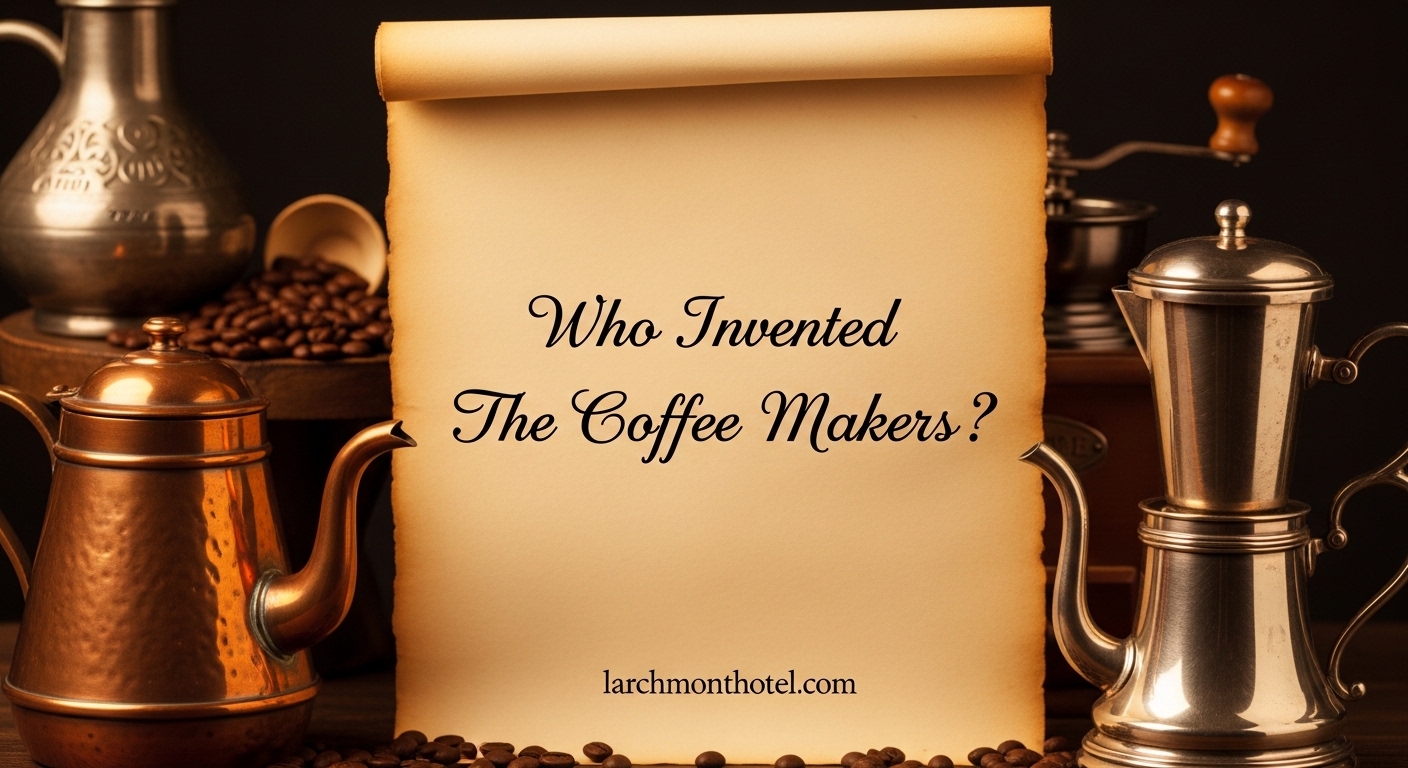
Who invented the coffee maker? The answer spans centuries and continents. Coffee makers evolved through the contributions of multiple inventors across different cultures, from ancient Ethiopian legends to modern Italian engineers and German entrepreneurs.
What we now call a coffee maker is the result of cumulative innovations. The ibrik originated in the Ottoman Empire, Angelo Moriondo patented the first espresso machine in 1884, Melitta Bentz invented paper coffee filters in 1908, and Alfonso Bialetti created the Moka pot in 1933.
I’ve spent months researching coffee history, visiting museums, and interviewing coffee historians. This article traces the fascinating journey from goat herders discovering energizing berries to the sophisticated machines in our kitchens today.
How did coffee making begin? The story starts in Ethiopia with legends that have been passed down for over a thousand years.
According to Ethiopian folklore, a goat herder named Kaldi discovered coffee around the 9th century. He noticed his goats became energetic after eating berries from a certain tree. Kaldi tried the berries himself and experienced a similar awakening.
Monks at a nearby monastery learned of Kaldi’s discovery. They initially condemned the berries as the devil’s work but later used them to stay awake during prayers. This legend, while not documented, provides the foundation for coffee’s origin story.
By the 15th century, coffee cultivation had spread to Yemen. Sufi monasteries brewed coffee for religious ceremonies. These early brewing methods involved crushing roasted beans and boiling them with water.
Yemeni port city of Mocha became the first major coffee trading center. From here, coffee spread throughout the Ottoman Empire and eventually to Europe.
The Ottoman Turks developed the first dedicated coffee brewing vessels. They created distinctive pots designed specifically for coffee, which became known as cezve or ibrik. These copper pots with long handles represented the first specialized coffee makers.
Coffee houses (kahvehane) appeared in Istanbul in the 1550s. These establishments became centers of social, political, and intellectual life. The Ottomans took their coffee-making methods seriously, developing specific techniques for roasting, grinding, and brewing.
What was the first coffee maker? The ibrik, also known as cezve, was the earliest vessel designed specifically for brewing coffee. Originating in the Ottoman Empire during the 16th century, this simple yet ingenious design is still used today.
The ibrik features a wide bottom that narrows toward the top, with a long handle. This design allows heat to distribute evenly while preventing the coffee from boiling over. The wide base catches coffee grounds, and the narrow neck creates foam that characterizes Turkish coffee.
Traditional ibriks were made from copper with brass handles. The metal conducts heat efficiently, and the long handle protects the brewer from burns. The design has remained largely unchanged for over 500 years.
The ibrik brewing method involves very finely ground coffee boiled with water and sugar. The pot is placed over hot sand or embers, allowing precise temperature control. As the coffee heats, foam rises to the neck.
This method produces a strong, unfiltered coffee. The grounds settle at the bottom of the cup, and drinkers leave the last sip unconsumed. This ancient technique is still practiced throughout Turkey, Greece, the Balkans, and the Middle East.
Who were the specific inventors behind modern coffee makers? The 19th and 20th centuries saw rapid innovation in coffee brewing technology, with several key figures making groundbreaking contributions.
Angelo Moriondo, an Italian inventor from Turin, patented the first known espresso machine in 1884. His invention used steam and water pressure to brew coffee quickly, creating what he called “new steam machinery for the economic and instantaneous confection of coffee beverage.”
Moriondo’s machine was designed primarily for commercial use. It could brew multiple cups simultaneously, making it ideal for busy establishments. The inventor demonstrated his machine at the 1884 General Expo of Turin, where it received widespread attention.
Unlike modern espresso machines, Moriondo’s design used a large boiler that produced steam to force water through coffee grounds. While bulky compared to today’s machines, it established the principle of pressure-based coffee extraction.
Luigi Bezzera, a Milanese inventor, improved upon Moriondo’s design in 1901. Bezzera wanted to speed up coffee brewing for his factory workers. His innovations included the portafilter, multiple brew groups, and pressure release valves.
Bezzera’s machine was smaller and more practical than Moriondo’s. He introduced the concept of “espresso” – coffee made expressly for the drinker. His design used higher pressure and produced a layer of foam, known as crema, on top of the coffee.
Despite his innovations, Bezzera lacked marketing skills. He sold his patent to Desiderio Pavoni in 1905, who commercialized the technology and made espresso machines famous throughout Italy.
Melitta Bentz, a German housewife from Dresden, revolutionized coffee brewing in 1908. Frustrated with bitter coffee caused by grounds in her cup, she experimented with different filtration methods.
Bentz punched holes in a brass pot and lined it with blotting paper from her son’s school notebook. The result was a cleaner, smoother cup of coffee without sediment. She patented her invention and founded the Melitta company with her husband Hugo.
The paper filter removed bitter oils and sediment while allowing desirable flavors to pass through. This invention created the foundation for modern drip coffee makers. The company Melitta Bentz founded remains a major coffee filter manufacturer today.
Alfonso Bialetti, an Italian engineer, invented the Moka pot in 1933. This stovetop espresso maker brought cafe-style coffee into Italian homes. The design was inspired by early 20th-century washing machines that used boiling water to clean clothes.
The Moka pot uses pressure from steam to push water through coffee grounds. Water in the lower chamber boils, creating pressure that forces hot water up through the grounds and into the upper chamber. The result is strong coffee similar to espresso.
Bialetti’s company mass-produced the Moka pot using aluminum, which was innovative at the time. The distinctive design with its octagonal shape became a symbol of Italian industrial design. Over 300 million Moka pots have been sold worldwide.
| Inventor | Invention | Year | Impact |
|---|---|---|---|
| Angelo Moriondo | First espresso machine | 1884 | Established pressure brewing principle |
| Luigi Bezzera | Improved espresso machine | 1901 | Created portafilter and modern espresso concept |
| Melitta Bentz | Paper coffee filter | 1908 | Enabled clean, sediment-free drip coffee |
| Alfonso Bialetti | Moka pot | 1933 | Brought espresso-style coffee to homes |
How did coffee brewing methods evolve beyond these key inventions? Several other innovations contributed to the diverse coffee makers we have today.
Sir Benjamin Thompson, also known as Count Rumford, invented the first percolator in the early 1800s. His design used boiling water forced through a metal tube into a coffee chamber. French inventor Laurens improved upon this design in the 1830s.
The percolator continuously cycles boiling water through coffee grounds. While popular for decades, this method often produces bitter coffee by repeatedly extracting flavor from the grounds. Despite this drawback, percolators remained common in American households through the mid-20th century.
Loeff of Berlin invented the vacuum coffee maker in the 1830s. This elegant device uses vacuum pressure to brew coffee. Water in the lower chamber boils, rising into an upper chamber containing grounds. When removed from heat, vacuum pressure pulls the brewed coffee back down through a filter.
Vacuum brewing produces clean, aromatic coffee. The method was popular in the late 19th and early 20th centuries. While less common today, vacuum pots are still valued by coffee enthusiasts for their unique brewing characteristics.
Attilio Calimani, an Italian designer, patented the French press in 1929. However, similar designs existed earlier. The French press uses a metal mesh plunger to separate grounds from brewed coffee.
This immersion method steeps coarsely ground coffee in hot water before pressing the plunger down. The result is rich, full-bodied coffee with more oils than paper-filtered methods. French presses remain popular for their simplicity and the quality of coffee they produce.
The 20th century brought electricity and automation to coffee making, transforming how people brew coffee at home and in commercial settings.
Gottlob Widmann, a German inventor, created the first electric drip coffee maker in the 1950s. His Wigomat automated the process of heating water and dripping it through coffee grounds.
This innovation eliminated the need to boil water separately. Electric drip makers became popular in Europe and eventually spread to America. The basic principle of electric drip brewing remains largely unchanged in modern coffee makers.
Mr. Coffee introduced the first automatic drip coffee maker for home use in 1972. Founded by Vincent Marotta and Samuel Glazer, the company made drip brewing accessible to American households.
The Mr. Coffee machine was more affordable and easier to use than existing models. Joe DiMaggio, the famous baseball player, became the brand’s spokesperson. Automatic drip makers quickly replaced percolators in American homes, changing how millions of people started their mornings.
Eric Favre, a Swiss engineer working for Nestle, developed the Nespresso system in 1986. This innovation used sealed capsules containing pre-measured coffee. The system ensured consistent results with minimal effort.
In the 2000s, single-serve coffee makers became household staples. Keurig’s K-Cup system, launched in 1998, dominated the American market. These machines offer convenience at the cost of environmental concerns and limited coffee selection.
The latest evolution in coffee makers includes connectivity and automation. Smart coffee makers can be controlled via smartphone apps, scheduled to brew at specific times, and even customized for individual preferences.
Modern machines feature built-in grinders, precise temperature control, and pressure profiling. High-end home espresso machines now rival commercial equipment. These innovations continue the tradition of improving the coffee brewing experience.
| Method | Origin Period | Inventor/Origin | Brewing Principle |
|---|---|---|---|
| Ibrik/Cezve | 16th century | Ottoman Empire | Boiling |
| Percolator | 1810s | Benjamin Thompson (USA) | Percolation |
| Vacuum pot | 1830s | Loeff (Germany) | Vacuum pressure |
| Espresso machine | 1884 | Angelo Moriondo (Italy) | Pressure extraction |
| Paper filter | 1908 | Melitta Bentz (Germany) | Drip filtration |
| French press | 1929 | Attilio Calimani (Italy) | Immersion |
| Moka pot | 1933 | Alfonso Bialetti (Italy) | Steam pressure |
| Electric drip | 1950s | Gottlob Widmann (Germany) | Electric drip |
The invention of coffee makers represents a remarkable journey of human ingenuity spanning cultures and centuries. From ancient Ethiopian legends to modern smart machines, each innovation built upon previous knowledge.
What started as simple boiling pots evolved into sophisticated machines using precise temperature control, pressure systems, and digital technology. Yet the fundamental goal remains unchanged: extracting the best flavors from coffee beans.
The diversity of coffee makers reflects the diversity of coffee culture itself. Different methods produce different flavors, and coffee enthusiasts worldwide continue to explore and experiment with brewing techniques.
There is no single inventor of the coffee maker. Coffee makers evolved over centuries with contributions from multiple cultures. The earliest specialized coffee brewing vessel was the ibrik from the Ottoman Empire in the 16th century. Modern innovations include Angelo Moriondo’s espresso machine (1884), Melitta Bentz’s paper filter (1908), and Alfonso Bialetti’s Moka pot (1933).
The earliest coffee maker was the ibrik, invented in the Ottoman Empire during the 16th century. This copper pot with a long handle was designed specifically for brewing coffee and is still used today. The first modern espresso machine was patented by Angelo Moriondo in 1884, while the first electric drip coffee maker appeared in the 1950s.
Angelo Moriondo patented the first espresso machine in Turin, Italy in 1884. His steam-powered machine could brew multiple cups of coffee quickly. Luigi Bezzera improved upon Moriondo’s design in 1901, adding the portafilter and creating the concept of espresso as we know it. Desiderio Pavoni commercialized these machines, making espresso famous throughout Italy.
Melitta Bentz, a German housewife from Dresden, invented the paper coffee filter in 1908. Frustrated with bitter, gritty coffee, she experimented by lining a perforated brass pot with blotting paper. The result was cleaner, smoother coffee. She patented her invention and founded the Melitta company, which remains a major manufacturer of coffee filters today.
Alfonso Bialetti, an Italian engineer, invented the Moka pot in 1933. His design was inspired by early washing machines that used boiling water to clean clothes. The Moka pot uses steam pressure to force hot water through coffee grounds, creating strong espresso-style coffee. Over 300 million Moka pots have been sold worldwide, making it one of the most popular coffee makers ever created.
Before specialized coffee makers, people brewed coffee by boiling crushed beans in water. Early methods in Ethiopia and Arabia involved steeping ground coffee in hot water and drinking the liquid with the grounds settled at the bottom. The ibrik was one of the first vessels designed specifically for coffee brewing. In Europe before the 19th century, coffee was typically made by boiling coffee grounds in pots or infusing them in hot water and straining the liquid through cloth.