

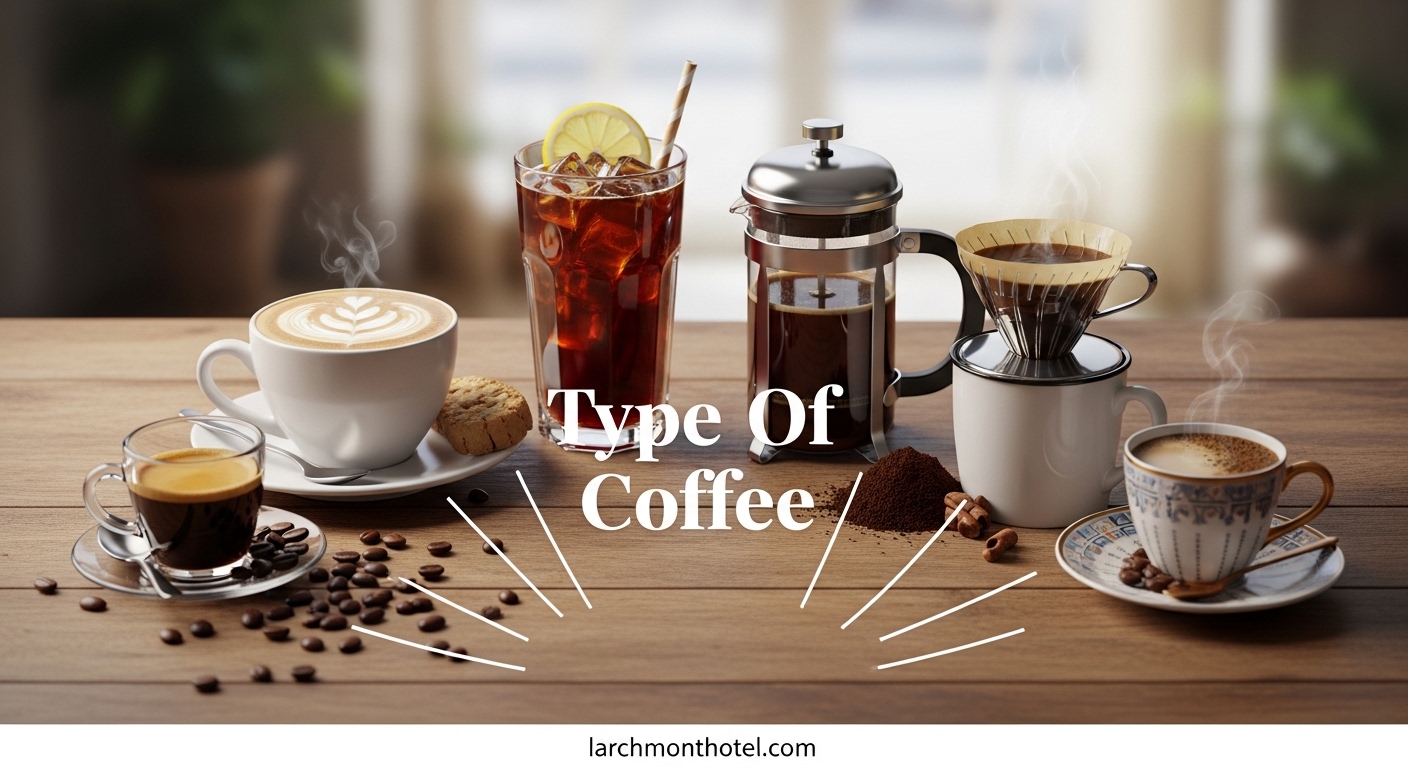
Standing in line at a coffee shop, staring at a menu filled with unfamiliar words, I’ve felt that same confusion many of you feel. Latte, cappuccino, macchiato, Americano what’s the actual difference?
Types of coffee can be categorized in four main ways: by coffee bean species (Arabica, Robusta, Liberica, Excelsa), by roast level (Light, Medium, Medium-Dark, Dark), by brewing method (Drip, Espresso, French Press, Cold Brew), and by the resulting drinks (Latte, Cappuccino, Americano, etc.).
Understanding these categories changes everything about how you order and enjoy coffee. After 15 years of drinking coffee and visiting cafes across 20 countries, I’ve learned that knowing the basics transforms that intimidating menu into a world of choices you can navigate with confidence.
This guide breaks down every type of coffee you’ll encounter, from the beans in your cup to the brewing methods that create them. By the end, you’ll know exactly what to order, how to brew at home, and why your favorite coffee tastes the way it does.
The four main types of coffee beans are Arabica (60% of production, sweet and complex), Robusta (40% of production, bold and bitter), Liberica (rare, fruity and floral), and Excelsa (a Liberica subtype with tart, fruity notes).
Not all coffee beans are created equal. The species of coffee plant dramatically affects flavor, caffeine content, and growing conditions. I’ve tasted hundreds of coffees, and the bean type is always the foundation of what ends up in your cup.
| Bean Type | Market Share | Flavor Profile | Caffeine Level | Growing Regions |
|---|---|---|---|---|
| Arabica | 60-70% | Sweet, fruity, floral, acidic | Lower (1.2-1.5%) | Latin America, East Africa |
| Robusta | 30-40% | Earthy, bitter, nutty | Higher (2.2-2.7%) | Africa, Vietnam, Indonesia |
| Liberica | <2% | Fruity, floral, smoky | Similar to Arabica | Malaysia, Philippines |
| Excelsa | <1% | Tart, fruity, aromatic | Similar to Arabica | Southeast Asia |
Arabica beans dominate the specialty coffee world for good reason. They offer complex flavors ranging from berries and citrus to chocolate and caramel, with bright acidity that makes each cup interesting.
These beans grow at higher altitudes (1,300-2,000 meters) and require careful cultivation. I’ve visited coffee farms in Colombia where Arabica plants grow on steep mountainsides, hand-picked at peak ripeness.
Most specialty coffee shops exclusively use Arabica beans. If you’re drinking coffee from a quality-focused cafe, you’re almost certainly tasting Arabica.
Robusta lives up to its name. These hardy plants resist pests and disease, grow at lower altitudes, and pack nearly twice the caffeine of Arabica beans.
The flavor profile divides people. Robusta tastes earthy, sometimes bitter, with rubbery or burnt notes that some find unpleasant. But in espresso blends, small amounts of Robusta add body and crema that pure Arabica can’t match.
Vietnam produces most of the world’s Robusta, and it’s essential in traditional Vietnamese coffee. I’ve tried 100% Robusta espresso in Rome, and while challenging to drink straight, it creates an incredible crema.
Liberica accounts for less than 2% of global coffee production. Native to West Africa, these beans now grow primarily in Malaysia and the Philippines.
The flavor is unlike any other coffee. Liberica combines floral and fruity notes with a smoky, almost woody body. My first taste of Liberica from the Philippines shocked me it smelled like jackfruit but tasted nothing like any coffee I’d experienced.
Excelsa was reclassified as a Liberica variety in 2006. These tart, aromatic beans add complexity to blends and are prized in Southeast Asian coffee traditions.
Coffee roast levels range from light (fruit and floral notes, high acidity) to medium (balanced sweetness and nuttiness) to dark (bitter, chocolatey, heavy body). The roasting process transforms the chemical makeup of green coffee beans, developing flavor, aroma, and color.
The same beans can taste dramatically different depending on roast level. I’ve cupped Ethiopian coffees roasted light, medium, and dark the light roast sang with blueberry notes, while the dark roast tasted like chocolate and charcoal.
| Roast Level | Appearance | Flavor Profile | Acidity | Best For |
|---|---|---|---|---|
| Light Roast | Light brown, dry surface | Fruity, floral, bright | High | Pour-over, manual brewing |
| Medium Roast | Medium brown, dry | Balanced, nutty, caramel | Medium | Drip coffee, all-purpose |
| Medium-Dark | Dark brown, slight oil | Rich, chocolate, spicy | Low-medium | Espresso, French press |
| Dark Roast | Black/brown, oily | Bitter, smoky, bold | Low | Espresso blends, milk drinks |
Light roast coffee retains most of the original bean’s character. Roasted just until first crack, these beans preserve delicate floral and fruit notes that darker roasts destroy.
I recommend light roasts for pour-over and drip brewing. The clarity of these methods lets those subtle flavors shine. When I brew a light Ethiopian Yirgacheffe, I taste jasmine, lemon, and berries characteristics that would vanish in a dark roast.
Medium roast hits the sweet spot for many coffee drinkers. Roasted between first and second crack, these beans balance origin characteristics with roast-developed flavors.
This is the most versatile roast level. Medium roasts work well in drip brewers, French press, and even espresso. They offer approachable flavors like caramel, nuts, and chocolate with pleasant acidity.
Most breakfast blends and house roasts fall into this category. It’s what I serve guests who want flavorful coffee without extreme brightness or bitterness.
Medium-dark roasts develop richer, heavier flavors with diminished acidity. Some oil appears on the bean surface as roasting pushes past second crack.
These coffees taste of chocolate, caramel, and spices with a fuller body. They’re excellent for espresso, cutting through milk in lattes and cappuccinos.
I prefer medium-dark roasts for my morning espresso. The balance between origin character and roast flavor creates a satisfying, comforting cup.
Dark roast coffee divides coffee drinkers. Roasted well into second crack, these beans become shiny with oil and taste primarily of roast, not origin.
Flavors include dark chocolate, smoke, and bitterness. The original bean characteristics mostly disappear, replaced by the taste of the roasting process itself.
Dark roasts work well in milk drinks and for people who prefer bold, bitter coffee. In Italy, dark roasts dominate, and many traditional espresso blends fall into this category.
Common coffee brewing methods include drip coffee (automatic machines), espresso (pressure extraction), French press (immersion), pour-over (manual drip), and cold brew (cold water steeping). Each method highlights different aspects of coffee flavor.
I’ve experimented with every brewing method imaginable, sometimes brewing the same coffee five different ways in one morning. The same beans can taste bright and clean through a pour-over, rich and heavy from a French press, or intense and concentrated as espresso.
| Method | Brewing Time | Flavor Profile | Difficulty | Equipment Cost |
|---|---|---|---|---|
| Drip Coffee | 4-6 minutes | Clean, balanced | Easy | $20-$200 |
| French Press | 4 minutes | Rich, full-bodied | Easy | $20-$50 |
| Pour-Over | 3-4 minutes | Clean, bright | Medium | $5-$60 |
| Espresso | 25-30 seconds | Intense, concentrated | Hard | $100-$2000 |
| Cold Brew | 12-24 hours | Smooth, sweet, low-acid | Easy | $15-$50 |
Drip coffee brewers heat water and spray it over ground coffee, extracting flavor as water passes through a filter and into a carafe. It’s the most common brewing method in American households.
Automatic drip brewers offer convenience and consistency. Good machines maintain proper water temperature (195-205degF) and even saturation. I recommend a quality drip brewer for most people they make excellent coffee with minimal effort.
The French press steeps coffee grounds in hot water for four minutes before a metal mesh plunger separates grounds from liquid. This immersion method creates rich, full-bodied coffee.
Because no paper filter absorbs oils, French press coffee retains all the coffee’s natural oils and fats. The result is a heavy, creamy mouthfeel with intense flavor.
My weekend morning ritual involves French press coffee. I use a coarse grind, four-minute steep, and slow plunge. It makes coffee that feels substantial and satisfying.
Pour-over brewing involves manually pouring hot water over coffee grounds in a filter cone. Popular devices include the Hario V60, Kalita Wave, and Chemex.
This method gives you precise control over every variable: water temperature, pour speed, agitation, and brew time. When done well, pour-over produces exceptionally clean, bright coffee that reveals delicate flavor notes.
After years of practice, I can pull nuanced flavors from a single-origin coffee using a pour-over. It requires attention and practice, but the results justify the effort.
Espresso forces hot water through finely-ground coffee at high pressure (9 bars). The result is a concentrated 1-2 ounce shot topped with golden foam called crema.
Espresso forms the base for most coffee shop drinks. Its intense flavor stands up to milk, creating lattes, cappuccinos, and macchiatos. Good espresso balances sweetness, bitterness, and acidity in harmony.
Learning to pull good espresso took me months of daily practice. Small changes in grind, dose, tamp, and temperature dramatically affect the shot. When everything clicks, there’s nothing like a perfect espresso.
Cold brew steeps coarse coffee grounds in cold or room temperature water for 12-24 hours. The slow extraction creates smooth, sweet coffee with lower acidity than hot-brewed coffee.
This isn’t just iced coffee it’s a completely different brewing method. Cold water extracts different compounds than hot water, emphasizing sweetness and minimizing bitterness.
I make cold concentrate every 2026 summer. Diluted with water or milk, it creates the most refreshing iced coffee I’ve ever tasted, with chocolate notes and virtually no acidity.
Espresso-based drinks are the most popular globally, with the latte being the top-ordered coffee drink in coffee shops. These drinks combine espresso with water, milk, or foam in specific ratios to create distinct beverages.
Understanding coffee shop menus starts with knowing these standard drinks. Once I memorized the basic formulas, ordering became second nature.
| Drink | Espresso | Steamed Milk | Foam | Flavor Profile |
|---|---|---|---|---|
| Espresso | 1 shot (1oz) | None | None | Intense, concentrated |
| Americano | 1-2 shots | None (hot water) | None | Similar to drip coffee |
| Macchiato | 1 shot | Dollop | Minimal | Strong espresso with slight milk |
| Cortado | 1 shot | Equal amount | Minimal | Balanced espresso-milk |
| Flat White | 2 shots (double) | 4oz velvety milk | Thin velvety layer | Strong but smooth |
| Cappuccino | 1-2 shots | Equal parts | Equal parts | Strong, foamy, balanced |
| Latte | 1-2 shots | 8-10oz | Thin layer (0.5cm) | Mild, creamy, milky |
| Mocha | 1-2 shots | With chocolate | Thin layer | Sweet, chocolate-coffee |
Espresso is pure coffee essence. A single shot contains about 64mg of caffeine, concentrated into 1 ounce of intense flavor topped with crema the golden foam that indicates proper extraction.
Drinking espresso is an experience. I take time to smell the aroma, observe the crema, and sip slowly to appreciate the complexity. Good espresso evolves in the cup fruit at the front, sweetness in the middle, chocolate in the finish.
An Americano adds hot water to espresso, creating a drink with drip coffee strength but espresso flavor. Legend says American soldiers in WWII diluted espresso to mimic the coffee they drank at home.
The ratio varies, but a typical Americano uses 1-2 shots of espresso with 6-8 ounces of hot water. I prefer this over drip coffee at shops the espresso base adds complexity that drip machines often miss.
The classic cappuccino combines equal parts espresso, steamed milk, and milk foam. In Italy, cappuccino is strictly a morning drink, never ordered after 11 AM.
A proper cappuccino has distinct layers: dark espresso at bottom, velvety steamed milk in middle, thick foam on top. When made correctly, the foam holds a spoon upright.
Cappuccino offers stronger coffee flavor than a latte because equal parts foam dilute the espresso less. It’s my go-to when I want espresso intensity softened by creamy milk.
A latte contains 1-2 shots of espresso with 8-10 ounces of steamed milk and a thin layer of foam. This popular drink emphasizes creamy milk over coffee flavor.
The milk in a latte should be micro-foamed tiny bubbles creating velvety texture. When poured well, latte art emerges hearts, rosettas, tulips floating on the surface.
Lattes appeal to people who find straight espresso too intense. The high milk ratio creates a mild, approachable drink perfect for flavoring with vanilla, caramel, or syrups.
A traditional macchiato stains a shot of espresso with just a dollop of foamed milk. The name means marked or stained in Italian.
This tiny drink (about 2 ounces) preserves espresso’s intensity while adding slight creaminess. It’s perfect for espresso purists who want just a touch of milk.
Be careful ordering in chain shops a caramel macchiato is something entirely different, essentially an upside-down latte with vanilla and caramel syrup.
The flat white originated in Australia and contains a double ristretto (restricted espresso) with 4 ounces of micro-foamed milk. Less milk than a latte, no foam layer like a cappuccino.
What makes a flat white special is the milk texture. It’s steamed to micro-foam consistency throughout, creating a velvety drink with no distinct foam layer.
After trying flat whites in Melbourne, I understood the hype. They deliver strong espresso flavor smoothed by perfectly textured milk, filling the gap between latte and cappuccino.
Cold coffee options have exploded in popularity. Beyond simple iced coffee, shops now offer cold brew, nitro cold brew, and iced espresso drinks.
Cold brew, steeped for hours in cold water, tastes smooth and sweet with low acidity. Nitro cold brew infuses nitrogen gas, creating a creamy texture similar to Guinness without any dairy.
Iced lattes and iced Americanos simply pour standard espresso drinks over ice. They’re quicker than cold brew but lack the smooth sweetness that cold extraction produces.
Coffee culture varies dramatically across countries and regions. Each tradition reflects local tastes, history, and ingredients that make coffee drinking a unique experience wherever you travel.
Seeking out these regional styles has been one of the joys of my coffee journey. From Turkish coffeehouses to Italian espresso bars, every culture has its own relationship with coffee.
Italy perfected espresso, and Italian coffee culture follows strict unwritten rules. Cappuccino only before 11 AM. Espresso consumed standing at the bar in one gulp. No milky drinks after meals.
In Rome, I watched locals order un caffe (espresso), drink it in two sips while chatting with the barista, then leave. The entire transaction lasted 45 seconds.
Vietnamese coffee typically combines strong Robusta with sweetened condensed milk. Served over ice (ca phe sua da), it’s an incredibly rich, sweet, strong drink.
The traditional phin filter drips slowly, taking 5-10 minutes to brew. Watching the dark drip into sweet milk is hypnotic. The result tastes like coffee chocolate milk but with a serious caffeine kick.
Turkish coffee boils extremely fine powder with water and sugar in a special pot called a cezve. The unfiltered coffee is served with grounds settled at the bottom.
Drinking Turkish coffee involves ritual. Sip slowly, stopping before you reach the sludge at the bottom. The remaining grounds can be used for fortune telling, a practice called tasseography.
Nordic countries consume more coffee per capita than anywhere else. Their light-roast, lightly roasted style emphasizes brightness and clarity over body and roast flavor.
Finnish coffee culture even includes a specific word for hanging out over coffee: kahvittaa. I’ve never felt more caffeinated than after a day in Oslo, where coffee flows constantly from morning until night.
Robusta beans have the most caffeine (about 2.2-2.7%), compared to Arabica (1.2-1.5%). For brewing methods, cold brew and espresso typically have the highest caffeine concentration per ounce, while a standard 8-ounce drip coffee has the most total caffeine per cup.
Caffeine content varies dramatically based on bean type, roast level, brewing method, and serving size. Understanding these variables helps you choose coffee that matches your caffeine tolerance.
| Coffee Type | Serving Size | Average Caffeine | Per Ounce |
|---|---|---|---|
| Espresso | 1 oz (single shot) | 64mg | 64mg/oz |
| Drip Coffee | 8 oz | 95mg | 12mg/oz |
| Cold Brew | 16 oz | 200mg | 12.5mg/oz |
| Americano | 12 oz | 77-128mg | 6-10mg/oz |
| Latte | 12 oz | 75mg | 6mg/oz |
| Instant Coffee | 8 oz | 30-90mg | 4-11mg/oz |
Caffeine Tip: If you’re sensitive to caffeine, choose Arabica beans roasted medium to dark. The longer roasting time slightly reduces caffeine content, and Arabica naturally contains less than Robusta.
The four main types of coffee beans are Arabica (60% of global production, known for sweet, complex flavors with bright acidity), Robusta (40% of production, bolder and more bitter with higher caffeine), Liberica (rare variety with fruity, floral notes and smoky body), and Excelsa (a Liberica subtype with tart, fruity flavors and unique aroma).
Espresso-based drinks are the most popular globally, with the latte being the top-ordered coffee drink in coffee shops. Arabica beans are the most consumed coffee variety, accounting for 60% of worldwide coffee production.
Coffee drinks fall into four main categories: espresso-based (espresso, Americano, macchiato), milk-based (latte, cappuccino, flat white, cortado), cold drinks (cold brew, iced coffee, nitro cold brew), and regional specialties (Turkish coffee, Vietnamese coffee, cafe au lait).
Light roast coffee is roasted for less time, preserving original bean flavors with fruity, floral notes and high acidity. Dark roast coffee is roasted longer, developing bold, bitter flavors with low acidity and an oily surface. Light roasts have more caffeine by volume, while dark roasts have slightly less due to longer roasting.
Robusta beans contain the most caffeine (2.2-2.7%) compared to Arabica (1.2-1.5%). For brewing methods, cold brew concentrate has the highest caffeine content per serving due to longer steeping time and higher coffee-to-water ratio. A typical 16oz cold brew contains 200mg caffeine.
The four main coffee roast levels are Light Roast (pale brown, fruity and floral notes with high acidity), Medium Roast (medium brown, balanced sweetness with nutty flavors), Medium-Dark Roast (dark brown with rich chocolate and nut flavors, lower acidity), and Dark Roast (black and oily, bitter and bold with no acidity).
The main difference is the milk ratio. A latte has 1 part espresso to 3-4 parts steamed milk with a thin layer of foam, making it creamier and milder. A cappuccino has equal parts espresso, steamed milk, and milk foam (1:1:1), creating a stronger coffee taste with lighter, foamier texture.
There are four main types of coffee beans (Arabica, Robusta, Liberica, Excelsa), four primary roast levels (Light, Medium, Medium-Dark, Dark), over a dozen brewing methods, and more than 30 recognized coffee drinks worldwide. When considering all variations, there are hundreds of coffee types.
After exploring all these types of coffee, where should you start? If you’re new to specialty coffee, I recommend beginning with a medium roast Arabica brewed as drip coffee. It’s accessible, flavorful, and widely available.
As you develop your palate, experiment with light roasts to discover fruit and floral notes, try different brewing methods to understand how extraction affects flavor, and visit local cafes to taste espresso-based drinks made by professionals.
Coffee offers endless variety. Understanding the types of beans, roasts, brewing methods, and drinks gives you the foundation to explore this world confidently. Start with what sounds appealing, trust your taste, and enjoy the journey.